Preface
Starting in the mid-1990s, presentations of women in Hollywood action films have caught many by surprise. By using aggressive and forceful means to defeat male opponents through physically challenging contests, bombshell womanhood began to face conflicts that so far had been reserved only for men and effectively gained triumph through what were considered masculine measures.
During my studies in the Faculty of the Arts at Tel Aviv University, I realized that the innovative displays of women protagonists in actionand-adventure manifestations might challenge major scholarly approaches that regard films as cultural reflections of gender roles in society. Being motivated by the acknowledgement that this disparity had not been thoroughly explored yet, I got excited to take on the mission to investigate the matter during my PhD research. The enthusiasm and interest of university students who took part in my academic course further pushed me to publish my current investigation into the dual puzzle: Is the action heroine representing a revolutionary cultural reflection, or is she merely a renewed representation of accepted notions?
Appreciating the new style of cinematic heroism as revolutionary, in this book, I offer explanatory foundations for its groundbreaking novelty. With the increasing integration of technological enhancements into our private and public lives, digital presentations of action women offer a new model of inspiration, both reflecting and determining our interpretations and understandings of the world we believe ourselves to inhabit.
To my mind, as artistic expressions that echo the spirit of our times, the new heroic presentations are cultural manifestations with virtual rather than actual foundations. While traditional cinema reproduces feminine images based on social and cultural practicalities that draw justification from natural boundaries, biology does not always function as the strongest barrier standing in the way of digitally enhanced bodies that transcend the physical.1 By avoiding material limitations, the digital woman embodies a postgender reflection and articulates a new potential for a cultural change in a cybersociety that embraces digital technologies as a central means of expression. By the inherent potential of being or becoming, the digital cinema expresses the possibility for multiple modes of existence and empowerment, and it offers digital spectators multiple prospective realizations of self-determination and self-construction.
Introduction
Cinematic representations of gender manifestation and its major ideological, cultural, and artistic implications have been discussed extensively since the 1970s. This book elaborates upon the revolutionary presentation of womanhood at the turn of the third millennium, one that did not exist in earlier days and that is presented and indeed enabled by a cinema that has assimilated computerized methods for expressive intentions.
The wide assimilation of digital technologies in films exhibits radical changes in cinematic expressions and displays. By transforming traditional narrative and visual conceptions, the flamboyant audiovisual escapades of digitally enhanced women who direct adventurous missions and accomplish challenging quests embody these changes.
By the 2000s, video game and cinematic presentations of female characters reflected practical and conceptual transformations in cinematic expressions of heroism. Endowed with unprecedented access to instruments of coercion and control, action-and-adventure female protagonists take part, more frequently than before, as main contributors in displays of physical endurance and fortitude.
Upstanding at the center of spectacular showcases of power and impact, the larger-than-life female lead initiates exceptional action performances with supreme merit, strength, and ingenuity traditionally ascribed to men. Halle Berry, Drew Barrymore, Emily Blunt, Emily Browning, Sandra Bullock, Jessica Chastain, Geena Davis, Cameron Diaz, Jennifer Garner, Daryl Hannah, Salma Hayek, Famke Janssen, Scarlett Johansson, Angelina Jolie, Milla Jovovich, Olga Kurylenko, Jennifer Lawrence, Lucy Liu, Zoe Saldana, Charlize Theron, Uma Thurman, and other key Hollywood figures portray overwhelming, vigorous, ruthless, stimulating, and resilient champions by participating in great battles and defeating competent masculine opponents.
By promoting an exhilarating impression of empowered human functioning at the extremes, the digitally enhanced performances of the new action heroines profile the digital woman as a gender class of its own. With her physical efficacy, domination, and supremacy, the digital woman undermines traditional conceptions and stereotypes of gender in films and challenges common considerations that regard cinematic representations as reflections of cultural conventions, which associate valor with virility, and humility with muliebrity.
As reality has steadily lost its status as a central source of reference for cinematic imagery, cinematic images abandon their traditional status as registration of the real and acquire a different source of influence. Rather than being faithful reflections of the actual, the idyllic image of the digital woman entails the new prospects of the virtual.
The steady replacement of analogical and photochemical procedures has afforded digital filmmakers a series of liberties, manifested in the farreaching potential of digital image creation and display. By becoming the playground upon which cinematic expressions are played out, digitally manipulated and virtually constructed action bodies exemplify the enhanced ability to control modular compositions of compound, reframe shots, and indicate on a transformation of digital filmmakers' expressive aspirations.
Apparently, the digital woman may embody an opposed categorization, which reflects a conflicted articulation. By narrative role and performance attributes, her ideal image of heroism embodies revolutionary ideas of femininity. At the same time, by a supreme physique and overstated sexuality, she reflects deep-rooted ideas about the female image as an instrument of male power.
However, rather than reflecting ambiguous expressions with a dubious nature, digital women's coherent and cohesive images that further advance the expressive force scenes, enhance the arousing effect of the action, and increase its exhilarating impact represent a revolution in films' constructions and displays by embodying simultaneous realizations, multiple incarnations, and contingent attributions.
A new understanding of the dynamic interrelation between cinematic presentations and their sources of inspiration is offered as an explanatory foundation for the radical change of female presentations in cinema, whereby the digital woman's fundamental nature and essential features reflect central changes in the way we experience films in contemporary cyberculture.
The main feature of the digital culture and digital cinematic manifestations has been identified as hybridity, a term originating in biology. It characterizes beings whose elements are drawn from compound foundations to create substantial new potentials. The hybrid nature of the digital film expresses a distancing from linear and dichotomous formations in favor of a nonhierarchical outlook and simultaneous realization of multiple-choice selections and combinations, embodying infinite multiple combinations of potentially unlimited origins and contingent constructing of almost boundless configurations.
In line with digital culture's fundamental characteristics, hybridity is understood as the cultural and mental expression of human existence in digital culture and the essential convention of digital manifestations as well. This affinity associates between contemporary spectators as subjects of digital culture and the fundamental nature of the digital cinema and is the key attribute to understand how digital women appeal to contemporary spectators.
A discussion of the position of the computer user and spectator in real and virtual life, the flow of perceptions and associations that construct comprehension, and the corollary cognitive mode that activates the appropriate emotions offers the ensuing model of the digital film experience that fits broadly within the paradigms that consider film spectatorship to be a conscious activity based on perceptual and conceptual systems.
While giving a more satisfactory answer to the question of the spectator's position in digital cinema as compared to previous notions of this subject, the idea of the feedback-loop mechanism is discussed here as the most appropriate description of the spectator's mental disposition toward digital presentations. The feedback-loop mechanism's immersive dynamics are very similar to those that shape our experience of other virtual worlds.
These dynamics represent a new approach for film spectatorship. Rather than presupposing the spectator's use of prior knowledge of the real world to reconstruct meaning and understanding, it assumes that digital image construction and comprehension shift from realistic contexts to virtual contexts.
The new model for the digital film experience provides the explanatory foundation for the type of dynamic interrelations between the adequate members of the cyberage and the new cinematic manifestations of female heroism. Changed perception and thinking patterns and a parallel shift in the aesthetic and thematic configurations of cinematic presentations have made the digital spectator—the subject of digital culture—the most suitable or compatible addressee of the digital woman image.
The digital woman is thus appreciated depending on its compatible relationship to its interpreters. Rather than reinforcing reality by being connected to actual objects of situations, the new relationship stipulates the spectator's perception and reactions and accounts for the digital woman as a distinct artistic expression of the cyberage.
Chapter 1The Emergence of the Digital Woman
Through the quest to stop a malicious army of machines from conquering the galaxy, Lieutenant Commander Shepard, the most serene leader in the galaxy, is seeking out future companions for the armed struggle against evil. Shepard launches recruitment and loyalty missions, gathers potential participants, and convinces them to join the cause. Throughout, Shepard learns about the combatants' past and motivations, gains their trust, and secures their good fortune and stability. Shepard guides the battle against the malevolent and leads the Great War victory.
Commander Shepard is the central character of the Mass Effect video game, a science fiction action role-playing third-person-shooter trilogy developed by BioWare and first released in 2007. The player is put into the role of Commander Shepard, whose looks and voice acting suggest a captivating, active, and bold commander.
The player follows the story, starting with reconstructing the protagonist's characteristics, choosing a preservice history as a spacer, earthborn, or colonist; a psychological profile as a sole survivor, war hero, or ruthless individual; and a class affiliation as a soldier, engineer, adept, infiltrator, sentinel, or vanguard.
The selected profile affects the conduct of the game and determines, for example, the references of others to the main character, how many bonus points one starts with, and the available assignments the protagonist gets.
However, the gender attributes of Commander Shepard do not have any effect on the conduct of the game. The protagonist's gender is customizable only by the character's name and appearance, as the video-game player may alter the male Commander John Shepard or the female Commander Jane Shepard's facial structure, head, eyes, jaw, mouth, nose, hair, scarring, makeup (Jane only), and beard (John only).
Apart from voice qualities and visual stereotypes that portray supreme figures underneath the same clothing, gender has no impact on the story line, as both characters perform comparable roles. Whether female or male, Commander Shepard's gender stands out only by external features of a character with the perfect body proportions of a shapely, well-built physique, while by narrative progression, both characters implement equivalent success potential at every stage of the game.
By signifying Shepard as the leading character most closely followed by the video-game player, whose conflicts with the antagonist are at the center of the story, usually pushing it forward by making the key choices that affect the game circumstances and the penalties, Mass Effect's narrative follows the aesthetics of the cinematic medium. Popular cinematic conventions also shape the game in terms of visual style, as for example by using cut-scenes to illustrate dialogues and facial expressions, shown via the shot-reverse-shot technique. At the same time, the narrative construction of the female protagonist Commander Shepard is incompatible with traditionally accepted realizations of gender roles in Hollywood films. In contrast to what is expected of gender power in Hollywood stories, Commander John Shepard and Commander Jane Shepard have equivalent heroic potency to advance the story line to the conclusion in prospect.
The two characters equally perform self-sacrificing actions, drive the majority of the action, and engage in most of the combat and exploration. Both dominate the game completely, using their special knowledge, superior abilities, and strength, and it concludes with their fortitude. Their corresponding characterization is illustrated by their aptitudes as well as by their appearance, as their identical guise emphasizes their body structure molded in accordance with generally accepted criteria of impeccable male and female figures.
By narrative construction and action performances, Mass Effect also breaks accepted cinematic conventions that traditionally determine that the leading action male protagonist dominates the action and the story line in terms of physical power and assertion, while the female figure is mainly related to emotional expressions and physical perfection.
The ascribing of a new action role to action female protagonists has become more common at the turn of the millennium, as computer technology is increasingly identified with action-and-adventure presentations that often display a dominant feminine character who successfully meets physically demanding challenges and mentally absorbing tasks with determination and competence traditionally considered the exclusive domain of male heroes.

Alternative Avatar-Inspired Simulations
Action female protagonists in digital films and their related video games undermine traditionally accepted gender depictions of womanhood in cinema. Through an astonishing path to triumph, leading heroines beat equal men who turn out to be inferior in regard to power, knowledge, technology, intellect, and morality. By offering unconventional resolutions of heroism by narrative roles, this characterization breaks the familiar cinematic pattern by disregarding the traditional female role as the passive, submissive, and exploited character and by declining deeply rooted cultural ideas of subjugation to patriarchal dominance.

One of the first examples that support this observation is the British explorer Lara Croft, who leads the interactive action-and-adventure video game series Tomb Raider, initially developed by Core Design and released by Eidos Interactive in 1996.2 The cinematic adaptations of the leading protagonist Lara Croft, as portrayed by Angelina Jolie in Simon West's film Lara Croft: Tomb Raider of 2001 and in Jan de Bont's film Lara Croft Tomb Raider: The Cradle of Life of 2003, are faithful to the video games' productions.
The video game provides Croft with personal background information: date of birth (February 14, 1968), aristocratic parents, British nationality, a rare blood type (AB negative), athletic hobbies, expertise (shooting, climbing, diving), a private-school education in England and Switzerland, and a protected childhood. A sudden tragedy changed her life, when she was the only survivor of a plane crash. The harsh experience transformed her into an independent, self-assured, adventurous tomb raider, who is capable of coping with danger and adversity, using highly professional skills to defeat tough male antagonists during physically challenging quests.
As an individualistic, omnipotent superhero, setting out on impossible missions to save the human race while standing at the focus of the action with meticulous movements and velocity, Lara Croft is making her way through to defeat secret organizations that hold the ultimate depraved goals of world domination and immortality.
In the sixth video game of the series, for example, Lara Croft Tomb Raider: The Angel of Darkness (2003), Croft fights her way to track medieval icons known as the Obscura paintings and to clear her name of the murder of her former mentor, Werner Von Croy. Through a quest across Europe, Croft dominates the game, revealing physical advantages and moral superiority. Using an arsenal of weapons, she confronts Pieter Van Eckhardt; his secret organization, the Cabal; and the underworld figure Louis Bouchard. She also fights a society of monks called the Lux Veritatis and destroys all her worst enemies, including the serial killer Monstrum and the Nephilim, an ancient biblical race whose ultimate goals are world domination. She refuses their offer of immortality.
In cinema, the secrets of Lara Croft's late father, Lord Richard Croft, as portrayed by Jon Voight, lead Croft in Lara Croft: Tomb Raider to search for a mythical cosmic element that has the power to bend time and space. She must locate the triangle before it falls into the hands of a secret cult that desires to control the world. To stop the cult, she endures and survives a dangerous pursuit, after which she reveals the secret of her father's death and defeats her opponents. Meanwhile, she maneuvers her allies and operates her supporters, Hillary and Bryce, as portrayed by Chris Barrie and Noah Taylor.
Croft's superior status as a charismatic character and a leading combatant with superior fighting skills and physical abilities, extensive knowledge and orientation, outstanding intellectual aptitude, and exceptional tactical and strategic creativity and resourcefulness is established in Lara Croft: Tomb Raider during the opening training robot sequence, when she secretly makes her way toward a diamond hidden in an Egyptian tomb.
The sequence begins with a close-up on Croft's eye as she observes a diamond inside the crypt and gradually expands to reveal her body hanging upside down on a rope. Targeting the diamond, she makes a triple turn, lands, and runs off, armed with two guns. As she stops to examine the crypt thoroughly, she catches a faint sound and, in a split second, is attacked by the giant robot SIMON, an enormous mechanical device armed with six limbs. The lower pair functions as legs, the central activates its weapons, and the higher are used to expand motion and to strike.
The robot catches Croft and throws her hard, trying to hit her limbs mercilessly. Vigorously, she is slipping away, making a square somersault back while pulling out her guns. While causing great destruction to her surroundings, Croft resourcefully uses a climbing rope and occasional trappings to dodge the robot by skipping over ruins and between them.
Finally, not before she empties and refills cartridges to shower the robot with fire repeatedly, she attacks it harshly using her gun and bare hands to furiously dismantle its armor and neutralize it.
As the defeated robot collapses beneath her, Croft smiles, leaps over its body, and approaches the targeted diamond. The robot surprises her again; however, it responds to her "stop" command. The diamond turns out to be a memory card. Once it's inserted into the robot's drive, the machine is programmed to play "Lara's Party Mix" instead of "Kill Lara Croft."
Now it appears that the incident took place in a practice arena in Croft's home. SIMON was created and programmed by her assistant Bryce as a super fighting machine and serves as her sparring companion in drills to challenge her skills. The robot being no match for Croft's exceptional competencies, she takes it down.
In a final act of victory, Croft drags the beaten machine into Bryce's office and throws it in front of his overwhelmed face. Initially, Bryce assigned it to assassinate Croft, as it is not "programmed to stop before it takes her head off," as stated. Ultimately, it reveals her priority as a fighter in every aspect.
In the following Lara Croft Tomb Raider: The Cradle of Life, Lara Croft discovers an orb that leads to the mythical Pandora's box. She strives to regain the orb from Jonathan Reiss, as portrayed by Ciarán Hinds, an evil scientist who will use it as the ultimate weapon for world destruction. Croft recruits a mercenary and former lover, Terry Sheridan, as portrayed by Gerard Butler, to help her find Pandora's box and does not spare his life when he stands in her way.
Here again, the impression of Croft's dominance is amplified during scenes of action that display her feats of potency in the ocean depths, upon a shark's back, and above the external hull of a submarine, as well as in face-to-face battles, an aerial fight, a race on the Great Wall of China, and daring sky-diving—action performances that reinforce her superiority in the power play between herself, her colleagues, and her rivals, further establishing her heroic fortitude.
Among all, Croft's resourcefulness is illustrated by the sudden abandonment of a plane set on a crash course and by the dangerous terrain motorcycle riding, while her vast knowledge of weapons and warfare devices as well as communications technology advance her mission step by step. As a physically powerful and great tactician, she defeats an opponent in a physical battle with her hands tied while Sheridan, humiliated, is beaten in the other room.
In the balance of power and relationships with her male counterparts, Croft's heroic supremacy is highlighted by displays of her relative courage and boldness. Her dominance is also established by her fetishistic attitude toward Sheridan, who expresses his discomfort by asking Lara not to look at his buttocks. Sheridan is the one who displays sensitivity and sentimentality, feels exploited and humiliated, and is bound in the nostalgic chains of their intimate relationship: "When you look back," he says to Croft, "was I the love of your life or just a punk you salvaged from the street and used for four months?" Croft discloses her uncompromised moral ideals and ethical standards as in a final deadly act she chooses to eliminate Sheridan as a traitor.
In addition, a fusion of diverse stylistic and generic elements promotes Lara Croft's superior position by endowing her with the greater attributes, which were previously associated with canonical images of male characters. Numerous references to Hollywood Westerns and action-and-adventure and martial-arts films challenge previous manifestations of heroism as determinants of male power.
Many associations can be found between the Lara Croft films and the Indiana Jones films.3 Not only does the title of Jan de Bont's film Lara Croft Tomb Raider: The Cradle of Life (2003) refer to the title of Steven Spielberg's film Indiana Jones and the Raiders of the Lost Ark (1981), but the two films are connected by their narrative construction as well.
The archaeologist and adventurer Lara Croft, recruited by British intelligence to find the mythical Pandora's box while fighting against evil capitalists, is reminiscent of the archeologist and adventurer Indiana Jones, as portrayed by Harrison Ford, who is hired by the US government to find the Ark of the Covenant before the evil Nazis do. Both characters are driven to save the world from total destruction through their resourcefulness and courage, using sophisticated knowledge and weapons and with the assistance of their loyal sidekicks.
Many motifs in the Indiana Jones film series are taken from the Arthurian romance genre and the well-established masculine tradition of chivalry.4 The legendary tales of the medieval knights are evoked by Jones's adventures, as his heroic quests for rescuing mythical artifacts possessing supernatural powers and bearing significance in Western culture impose gallant values of chivalry by following the code of knighthood as "truth, honor, freedom and courtesy—brave, but wise, meek and gentle."5
Similar to Indiana Jones, Lara Croft is endowed with the code of knighthood and functions as an authoritative, noninstitutional power, according to moral virtues and an aspiration for world peace and universal justice. She, too, is bound to the dynasties of the medieval knights. However, her femininity confronts rather than confirms the mainstream consensus regarding the ideal masculine knight.
Rather than operating in order to settle the conventional consent apropos the ultimate masculine cavalier, Lara Croft undermines this consensus as her performance shifts from the patriarchal tradition of heroism toward a new conception of female heroism. While Indiana Jones's obligation to the masculine tradition leads him in Steven Spielberg's film Indiana Jones and the Final Crusade (1989) to the Holy Grail, an object whose origin lies in the myths of chivalry and knighthood, The Cradle of Life focuses, among other things, on the feminine myth of Pandora's box, whose origin lies in the mythological tales describing the creation of the first woman.
Additional allusions to iconic male heroes are, for example, between Croft and James Bond films, as Croft's "license to kill," granted by the British intelligence in The Cradle of Life, evokes the "license to kill" that was given to James Bond, the ultimate hero of the genre, by the British queen in John Kavanagh's film 007: License to Kill (1989). Croft also adopts Bond's attitude by the sexual objectification of her associate Terry Sheridan.
Furthermore, Croft's riding on the back of a shark in the ocean's depths evokes the deep-rooted image of heroic masculinity embodied by Tarzan, the Lord of the Jungle, as portrayed by Johnny Weissmuller in a scene from Richard Thorpe's film Tarzan Finds a Son! (1939), where Tarzan is speeding as he clings to a shark's fin.
The links between Lara Croft and canonical images of male characters endow her with further heroic qualities traditionally related with male protagonists. With an emphasis on her physical strength and self-power, the video games as well as the cinematic adaptations grant Croft the role of an active and dominant protagonist who contradicts the pleasant, fragile, passive, and dependent reflections of the submissive, deprived, or enslaved female image whose roles are repeatedly supportive and romantic. Being ready for every act of expected retaliation, Croft, in her heroism, undermines traditionally perceived male patrimony.
Traditionally, Hollywood cinema portrays the tough, independent, aggressive, authoritative, and forceful male protagonist, emphasizing his strength and courage and privileging him as an active, dominant, and strong character.
At the same time, films tend to reflect a passive and dependent female protagonist, who is usually typified as a pretty, pleasant, and fragile character and placed in a position of relative weakness and thus subordination to the male protagonists.6
Popular films' presentations of gender relationships thus manifest embodied stereotypes of contradictory gender roles: a protective, domineering, or oppressive male protagonist against a submissive, deprived, or subjugated female protagonist.7 Often, her salvation may arrive by her marriage.8
In an example of such binary stereotypes, in Taylor Hackford's film An Officer and a Gentleman (1982), Hollywood star Richard Gere portrays the courageous soldier and revered aviator Zack Mayo, who redeems the factory girl Paula Pokrifki, as portrayed by Debra Winger, by marrying her, and in Garry Marshall's film Pretty Woman (1990), Gere portrays the successful businessman Edward Lewis, who functions as the Prince Charming of the prostitute Vivian Ward, as portrayed by Julia Roberts.

In this regard, films that depict an active, strong, and confident woman protagonist frequently end with her punishment, which can include self-sacrifice, sickness, or death. As frequently displayed in horror and science-fiction films, dominant female protagonists may represent cultural stereotypes of a monstrous femininity, exhibiting seductive and destructive behavior that constitutes a threat for the male hero. It is suggested that the use of sadistic force vis-à-vis a dominant female character is recurrent, as she is mortally threatened or held captive while her atrocious nature enables her to survive.9 Hence, in Ridley Scott's film Thelma and Louise (1991), the liberated femininity of Thelma and Louise, as portrayed by Geena Davis and Susan Sarandon, concludes with their death by a final act of self-punishment.
Meanwhile, investigations of gender differences in video-game characters show no significant gender differences between male and female performances in narrative roles, the types or amounts of weapons they use, or in their abilities.10 The more advantageously positioned female protagonists may illustrate a reversed depiction in relation to traditional incarnations of their gender role.

Æon Flux, the leading character, as portrayed by Charlize Theron, in Karyn Kusama's Æon Flux film (2005) and Majesco Entertainment's video game Æon Flux, released in 2005, is another example of a video-game and avatar-inspired female protagonist who exhibits nontraditional female characteristics in cinema by assuming unaccepted gender roles, featuring what is traditionally considered as masculine heroism through fighting abilities, physical power, high values, free will, and leadership. Æon Flux is exposed as the most daring, accomplished, and worthy champion, who undermines traditional power sources and fights them with atypical determination.11
Set in a dystopian future world in which a virus has wiped out the majority of the Earth's population and left a wasteland, both film and game introduce us to the secret agent and assassin Æon Flux, a member of the anarchist underground rebel organization known as Monica. The Monican warriors, who are skilled in assassination and acrobatics, and communicate through telepathy-enabling technology, are led by the Handler, as portrayed by Frances McDormand.
Sent on a mission to free the world from the tyranny of the current technocratic and repressive regime of the city-state Bregna, Æon Flux is determined to kill the state leader's brother, Oren Goodchild, as portrayed by Jonny Lee Miller, and his allies, who do everything to maintain the Goodchild reign and stay in power.
As a result of her actions, the city wall collapses, revealing the surroundings to be lush and fertile rather than the desert everyone believed them to be for ages. Her moral superiority is apparent as she spares the life of Trevor Goodchild, the leader, as portrayed by Marton Csokas, saving him according to her own judgment from a deadly fate. Among all, her acts prove her control over her own destiny and the lives of her male counterparts and foes.
Thus, rather than expressing a male-controlled submission to authority, Flux exhibits a strong urge to destroy the patriarchal hegemony through her moral choices and physical actions.12 After awakening in bed next to Goodchild, for example, she violently attacks him and causes him to faint, and their erotic kisses are reminiscent of their past affair rather than a sentimental expression. Her even more sensual kiss with a colleague, which was actually meant to pass her a telepathic pill, may demonstrate her true pragmatic nature. According to producer Gale Anne Hurd, in an interview for the Æon Flux Special Features DVD release, during Flux's quest, she exposes the patriarchal system as a "perfect lie."13
By narrative and performance attributes, video-game and avatarinspired female characters, who lead active, strong, tough, independent, aggressive, authoritative, and forceful determinations, personify an omnipotent heroism that denies the traditionally accepted action role characterization. During moments of struggle, which require physical exertions and omnipotent capabilities, these women engage in nontraditional performativity at the center of the action by illustrating improved intensity of movements with greater speed and rhythm and produce exhilarating theatrical and dramatic force that further grants them the spectators' appreciation and admiration and promotes their heroic supremacy.
Another example of action protagonist incarnation in video games and films is Alice, a foremost zombie hunter who undermines the traditional conceptions of gender roles in cinema by assuming a supreme heroic position of the leading protagonist, first introduced by the Resident Evil video games of 1996 and 2002, originally developed and published by Capcom for the PlayStation platform. In cinema, Milla Jovovich stars as Alice in the film franchise, Paul W. S. Anderson's film Resident Evil (2002), Alexander Witt's film Resident Evil: Apocalypse (2004), Russell Mulcahy's film Resident Evil: Extinction (2007), and Paul W. S. Anderson's Resident Evil: Afterlife (2010), Resident Evil: Retribution (2012), and Resident Evil: The Final Chapter (2016). Placed in a relatively heroic position of superiority in terms of fighting skills, resourcefulness, courage, and emotional adeptness vis-à-vis her male counterparts, Alice is the toughest and most daring overriding character, devoting herself to demanding missions as a sovereign, ingenious, and adept idol. By striving for domination and adopting the traditional masculine role of the savior, Alice personifies a masculine position and abandons the stereotypical subjugated and weak position of womanhood.
Resident Evil introduces Alice to the cinema as a deep-cover operative who investigated the Umbrella Corporation, one of the world's leading pharmaceutical companies. When she was infected by a T-virus contamination and gained superpowers, she became a test subject, well hidden in Umbrella's labs, where scientists were engaged in illegal viral research.
In the second film of the series, Resident Evil: Apocalypse, T-Virus infected people who turned into zombies reach Raccoon City, an industrialized town located in the midwestern United States, spreading the infection among the general population.
Worried about a possible worldwide contamination, the Umbrella Corporation evacuates all important personnel, seals off the city's main exit, commands their troops to fire in order to force the refugees back into the quarantine security zone, and dispatches the Nemesis Program, a genetically modified super soldier in the form of a giant man, designed to fight the zombies and protect the existing regime.
Dr. Charles Ashford, the T-virus creator, as portrayed by Jared Harris, refuses extraction while making efforts to locate his missing daughter, Angela, as portrayed by Sophie Vavasseur. Soon, Ashford discovers her hiding place in a school building and seeks help.
Meanwhile, Alice awakens in the deserted Umbrella lab. She manages to unstrap herself, exits imprisonment, and arms herself. Ashford contacts her and offers to arrange their evacuation from the contaminated Raccoon City in exchange for his daughter's extraction.
Through several deadly encounters with the super soldier Nemesis, Umbrella's militaries, zombie dogs, and infected children, Alice and her small force of survivors find Angela. On their way to the extraction point at City Hall, they face more bloody combat but manage to escape the latest encounters thanks to the sacrifices made by Alice when a nuclear missile crashes her helicopter. Three weeks later, the burned Alice awakens in Umbrella's research facility in Detroit, yet again on a mission to fight her way out.
The Ravens Gate Church fight scene announces Alice as a leading protagonist with a most impressive proficiency with weaponry and martial arts, when she comes to the aid of a group of civilians and armed forces who got trapped in the zombie-infested Raccoon City. The panicked office worker Mackenzie, as portrayed by Geoffrey Pounsett; the journalist Terri Morales, as portrayed by Sandrine Holt; and a member of Raccoon City's Special Tactics and Rescue Squad unit have found a haven in the church.
Soon, the heavily armed Alice rides a motorcycle straight through the church window, smashing the stained glass to pieces, with a mission to rescue the hiding survivors from the attack of vicious Lickers, eager to shed blood. While making her way into the center of the Licker-infected hall, Alice points her roaring vehicle in the direction of a bloodthirsty Licker. Then, releasing herself from the seat by performing an astounding somersault, she dispatches the vehicle as an improvised explosive device and destroys the monster in flames. Calmly, Alice directs her might to purify the cathedral. She fires two revolvers and a shotgun, blows more Lickers' heads off, and accomplishes a self-initiated mission to eliminate a threat nobody else is able to.
Rather than offering features that may be compatible with her traditional gender role as a victimized character, looking for male compassion and protection to be rescued, Alice's most exhilarating action performance establishes her heroic superiority as an essential nature, traditionally kept only for male heroes.

The motorcycle action scene as a spectacle of heroism alludes to established icons of superhuman male characters, such as the Terminator cyborg, as portrayed by Arnold Schwarzenegger, in James Cameron's film Terminator 2: Judgment Day (1991), Batman, as portrayed by Val Kilmer, and Robin, as portrayed by Chris O'Donnell, in Joel Schumacher's film Batman Forever (1995), or Wolverine, as portrayed by Hugh Jackman, in Bryan Singer's film X-Men (2000)—all enact daring performances using their preferred vehicle.
Trailed by a character of the same name in the Terminator 3: Redemption video game released by Atari in 2004 for PlayStation 2, Xbox, and Nintendo Gamecube, Jonathan Mostow's Terminator 3: Rise of the Machines (2003) is another example of a female character who takes the traditional place of the super-heroic male protagonist by corresponding with equally capable masculine icons.
The third instalment of the Terminator film series introduces us to the female Terminatrix cyborg T-X, as portrayed by Kristanna Loken, whose assignment is generally similar to the mission of the masculine terminators in the previous films of the franchise, James Cameron's films The Terminator (1984) and Terminator 2: Judgment Day (1991). The Terminator series presents the struggle of the resistance movement against the synthetic intelligent machine network Skynet, which identifies the human race as a security threat. Planning to wipe out humanity by the technology of time travel, Skynet sends Terminators—humanoid assassins—to prevent the underground organization, the Resistance, from being founded and defeating the machines.
Foretelling that the resistance would pursue professional assistance in ending its operation, in the third film, Terminator 3: Rise of the Machines, Skynet sends the T-X on a mission to assassinate the underground organization's members, particularly its future leader, John Connor, as portrayed by Nick Stahl; his future wife, Kate Brewster, as portrayed by Claire Danes; and her father, Skynet's originator, General Robert Brewster, as portrayed by David Andrews.
This assignment of the T-X equates to the original 1984 film The Terminator, when the iconic male cyborg T-800, as portrayed by Arnold Schwarzenegger, was assigned to kill Sarah Connor, as portrayed by Linda Hamilton, the mother of John, in order to prevent his birth and future work as the savior of humanity. Similarly, in the 1991 sequel Terminator 2: Judgment Day, the more advanced Terminator T-1000 male cyborg, as portrayed by Robert Patrick, attempts to terminate John as a teenager, as portrayed by Edward Furlong.
Thus, by narrative, the T-X functions equally to the preceding antagonists of the series and fully enters the adversary role previously embodied by male characters.
The opening scene of Terminator 3: Rise of the Machines introduces the T-X as she appears stark naked in a clothing store's showcase while its glass and mannequins are flashily melting. She approaches a woman sitting in a car and kills her while mimicking her clothes and takes her car.
Symbolically, the opening scene of Terminator 3: Rise of the Machines is reminiscent of the T-800 entrance in all Terminator films, as the T-X is put in an analogous position to her predecessors'.
In the first film of the franchise, The Terminator, the T-800's appearance, as portrayed by the stark-naked Schwarzenegger, during a flashy storm is followed by a fight against a group of punks. He ends up wearing their clothes. In Terminator 2: Judgment Day, a lightning storm precedes the appearance of the naked Schwarzenegger, who later leaves the Corral bar after fighting to get clothes and a motorcycle.
By characterization, all terminators, male and female alike, are cybernetic organisms having an appearance and personality resembling that of a human, though they all perform a restricted variety of sentiments. Physically, their living tissue covers an alloy skeleton, and unlimited access to vast internal databases allows them in-field improvisation and self-repair by adjustment of physical structure. Various modifications, such as armor plating, additional multiple limbs, and serrated talons, function so as to make their combat ability more efficient.
For example, the male terminator T-800 is able to mimic an object's voice and is almost impossible to damage, and the T-1000's liquid-metal construction allows it endless transformations without suffering any serious damage until after it is subjected to extreme temperatures.
The T-X, for her part, has mimetic abilities that enable her to impersonate by manipulating human forms. She is also temperature resistant and able to fight against other machines with extreme brute force exhibited during overwhelming and uninhibited shows of power. Often, as her body is badly hurt and her endoskeleton is revealed underneath, she is capable of swift self-recovery and returns to the battle with extra determination. Being well-equipped to deal with other terminator units, the T-X engages in the final hand-to-hand combat against John's protector, the reprogrammed Terminator T-800, as portrayed by Schwarzenegger. She is gaining an advantage through a combination attack, utilizing her mimetic polyglot feature to develop stabbing weapons and a buzz saw, severely hindering the T-800's abilities by dismembering him, however immobilizing him only temporarily.
Ostensible "Progression"
The portrayals of a strong and liberated womanhood may be interpreted as contravening the patriarchal oppression and contradicting accepted representations of the cinematic apparatus.
However, the prevailing attitude favors the empowered femininity as reflection of actual circumstances and true indications of cultural reality when higher social mobility advances women's access to control and power centers.
According to this approach, strong female characters reinforce rather than violate the restrictions of male-controlled society by reducing the female images to stereotypical reproductions of patriarchal ideas in ways that encourage, radicalize, and preserve the traditional cultural framework, guaranteeing and perpetuating male political supremacy.
Traditionally, female presentations in cinema are considered to be manifestations of established perceptions of gender relations in Western society, wherein women's subjectivity is constructed in order to serve the male interest of establishing the supremacy of the male ego.14
Feminist criticism usually considers women's images as the products of male fantasy, subconscious, and ideology, which tend to serve male pleasures and delights, reinforce the male sense of identity, and relieve male castration anxiety, regenerating prevailing structures when male shared aims are of direct class benefits.15
As cultural reflections of the patriarchal structure, which consider males as dominant and females as subordinate, it is thus indicated how films often replicate a stereotypical masculine perspective that strives for domination and a stereotypical feminine perspective that focuses on feelings, bonding, and romance. While masculinity is expected to demonstrate physical power and mental supremacy and is ascribed with strength, control, and assertion, femininity is associated with the concepts of emotional connection, solidarity, and inclusion.16
Customarily, the action-and-adventure genre, which requires presentations of body images of action and strength, agency and aggression, power and physical achievements, has traditionally emphasized masculine heroism by attending male interests while women have played mainly supporting roles in the genre. By ignoring the feminine point of view and by fetishizing women, films strip female protagonists of their personality and annul female subjectivity as they become distant objects. Thus, by performance attributes, action female protagonists are usually considered to perpetuate the binary presentations of gender relations by operating within the framework of patriarchal dominance17 or by presenting "erotic super bitches" who combine misogyny and exploitation.18
Action male protagonists, in contrast, are considered to be responses to broad-spectrum social and cultural conditions. A suggested association is between the white male "hard body" and the state of the American nation during the conservative revolution led by President Ronald Reagan in domestic and foreign policy.19 Other critiques emphasize class and racial dimensions20 or foreground the latent homoeroticism in "buddy films," such as Christopher Crowe's film Off Limits (1988). However, when it came to the interpretation of female action figures, Sarah Connor was devaluated as "Dirty Harriet"22 and Ellen Ripley as assuming a "figuratively male" performance.23
Thus, female characters that were introduced into the genre in the mid-1970s, such as Angie Dickinson as Sgt. Suzanne "Pepper" Anderson in the Policewoman television series (1974–1978), Pam Crier as Foxy Brown in Jack Hill's Foxy Brown (1974), and Jaclyn Smith as Kelly Garrett, Kate Jackson as Sabrina Duncan, and Farrah Fawcett as Jill Munroe in the Charlie's Angels television series (1976–1981), are frequently being measured as reasserting male control rather than representing true change in gender characterization. By the same attitude, action female characters who took a more central role in the genre from the 1980s to the mid-1990s are devaluated as tending to personify male heroic qualities by adopting traditional gendered characteristics and presenting female heroism as a function and privilege of white male power, thus highlighting white male iconicity.24
While action films primarily linger upon male heroes and place women in supporting roles, sometimes romantic, action presentations of female characters is thus associated with masculinization by her lack of maternal guidance and overidentification with a father figure, which makes her incapable of performing her socially prescribed feminine role; her "maternal masculinity" performances that employ physical force assigned exclusively for defensive heroic action; or her assignment to the sexual position of the traditional male hero through homosexual connotations.25
Accordingly, by portraying visual masculinization through bodybuilding and costuming, Ellen Ripley, as portrayed by Sigourney Weaver, in James Cameron's film Aliens (1986); Nikita, as portrayed by Anne Parillaud, in Luc Besson's film Nikita (1990); Clarice Starling, as portrayed by Jodie Foster, in Jonathan Demme's film The Silence of the Lambs (1991); Sarah Connor, as portrayed by Linda Hamilton, in Terminator 2: Judgment Day (1991); Morgan, as portrayed by Geena Davis, in Renny Harlin's film Cutthroat Island (1995); and Jordan O'Neill, as portrayed by Demi Moore, in Ridley Scott's film G.I. Jane (1997) are to be regarded as exhibiting embodied masculinity and thus as reflections of social acceptance of masculine heroism rather than feminine valor.
Among all, action females demonstrating strength, agency, aggression, endurance, and physical achievements are criticized as following "hard body" action heroes,26 such as Sylvester Stallone in the Rambo films, Arnold Schwarzenegger in the Conan series, and Bruce Willis in the Die Hard films. Scholars, who may remark upon the positive change in the presentation of action female protagonists, also appreciate them as reflections of social codes of behavior that echo the growing prominence and progressive mobility of women in Western culture. Social changes are suggested as a source of inspiration for the shift in female performances in the action film genre, along with the shift in heroic male performances.
In this regard, Leonardo DiCaprio in James Cameron's film Titanic (1997), Keanu Reeves in Lana Wachowski and Lilly Wachowski's (as the Wachowski Brothers) in the Matrix film trilogy (1999, 2003, 2003), and Ben Affleck in Michael Bay's film Pearl Harbor (2001), which feature a youthful, slim, and erotic look, are considered as more passive, boyish, intelligent, and to-be-gazed-at in a way that is traditionally associated with the female presentation.28
Thus, films that replicate the traditional male code of brotherhood by featuring female associations, such as the alliances between Xena and Gabrielle, as portrayed by Lucy Lawless and Renée O'Connor, in the Xena: Warrior Princess television series of 1995–2001, or Sarah Michelle Gellar and Alyson Hannigan as Buffy Summers and Willow Rosenberg in the Buffy the Vampire Slayer television series (1997–2003) are also observed as representations of gender mobility and social change, favoring the bonds of interdependency and mutual reliance, dialogues, and shared understanding among women.29
From another point of view, the reflections of female heroism may also be considered as unpretentious camouflage, a feminine masquerade that endows women with a protective shield that supplies an advantage against predominantly male adversaries who underestimate their abilities, a necessary measure to gain access to privileged information and spaces possessed or guarded predominantly by patriarchal boundaries. According to this approach, femininity is dressed as a disguise, to conceal the masculine attributes and to prevent the predictable retaliations if it is found that she has them.30
Thus, it is suggested that in action-and-adventure films, the feminine appearance functions as a mask—a superficial form that disguises her dynamic and vigorous characteristics, a pleasurable and harmless object for the male gaze, which conceals the female character's curious nature, compulsive desire, and an inner motivation to know and explore forbidden spaces. This masquerade protects her true identity by covering her true identity as an agent, keen on completing her adventurous mission and overcoming dangerous obstacles by active means.31

In this regard, the performances of Charlie's Angels—Cameron Diaz as Natalie Cook, Drew Barrymore as Dylan Sanders, and Lucy Liu as Alex Munday—in McG's films Charlie's Angels (2000) and s Charlie's Angels: Full Throttle (2003) are approached as engagement in feminine masquerades that concurrently produce positive/empowering and negative/ regressive impersonations. The idea of parodic mascara is also applied to Quentin Tarantino's films Kill Bill: Volume 1 (2003) and Kill Bill: Volume 2 (2004), which depict the proficient elite organization, the Deadly Viper Assassination Squad, with its female members—Uma Thurman as the pregnant Bride, Lucy Liu as O-Ren Ishii, Vivica A. Fox as Vernita Green, and Daryl Hannah as Elle Driver. The dissolution of the powerful sisterhood as a result of the harsh dispute within works to masquerade the heroic femininity by expanding its parodic connotation.32
Therefore, while the heroic profile of the female action protagonist is constructed through empowered traits, such as intelligence, aggressiveness, and physical strength, regressive devaluations may also position her as a travesty of heroism. By working under male domination and overstating male bonds of dependency by powerful sisterhoods that condition their heroic efficiency as a collective unit, they may reproduce absurd and parodic connotations that introduce nonthreatening efficiency. Thus, female heroic depictions yield distorted feminine valor rather than asserting real prowess.
The James Bond film series provides scholars with the opportunity to establish the common observation that the empowered female protagonist and the change in her relative position by narrative role since the mid- 1990s is a customary reproduction of the gradual change in Western culture's gender roles.
While undermining traditional gender relations without significantly shifting the balance of power vis-à-vis the Bond character, as the series progresses into the 2000s, the existing research with regard to the Bond Girls' "progression" is considered as actually corresponding with the patriarchal norms that reinforce social beliefs and values wherein female valor is limited or absent.33
Accordingly, in terms of film narrative, all Bond Girls are connected by their similar traits, and their roles link sex, violence, and violation; they are all courageous, resilient, strong, intelligent, and undeniably feminine characters, generally positioned to anchor Bond's hyperheterosexuality, fortitude, and dominance. The coercive power that Bond inflicts on a number of Bond Girls up until 1989, which links sex, violence, and violation, reinforces the traditional myth of the "just" male warrior in the action-adventure genre, wherein female characters are expected to be victimized, and the legitimate space for female heroism is limited if not nonexistent.34
A careful inspection of the Bond Girl villain indicates how the female antagonist who challenges Bond is recruited to heighten Bond's precarious position to intimidate him at first but finally strengthen his virile icon— facilitate rather than disrupt Bond's mission as her actions reassure his dominance.35
As exemplified, during the 1960s, the seductive sexual interest of the Bond Girl villain was usually recruited to heighten Bond's emotional vulnerability and precarious position. Formed with reference to film-noir stereotypes, the femme fatale Miss Taro, as portrayed by Zena Marshall, in Terence Young's film Dr. No (1962); the tempting dancer Bonita, as portrayed by Nadja Reginin, in Guy Hamilton's film Goldfinger (1964); and Fiona Volpe, as portrayed by Luciana Paluzzi, in Terence Young's film Thunderball (1965) are all alluring women whose sexual interest is formed as a hazardous menace, an attempt to distract Bond, as portrayed by Sean Connery, who resists their dangerousness. The Bond Girl menace culminates in the death of Tracy di Vicenzo, as portrayed by Diana Rigg, in Peter R. Hunt's On Her Majesty's Secret Service (1969), whereas Bond, as portrayed by George Lazenby, survives the assassination attempt immediately after their marriage.
During the 1970s, Bond's extreme vulnerability is articulated by his inability to perceive the duplicitous intentions of the Bond Girl villains unless he is warned, as by a tarot card in Guy Hamilton's film Live and Let Die (1973) or only once the villainous flight attendant pulls a gun at him in Lewis Gilbert's film The Spy Who Loved Me (1977).
During the 1980s, a focus on Bond's monogamous relationships relegates the perilous Bond Girl villain to a minor or absent position, further diminishing the tension between Bond and the Bond Girl and strengthening Bond's superior position. As Bond resists the Bond Girl's dangerousness, her actions reassure his dominance, corresponding with the cultural propensity to defend and protect the masculine phallic vulnerability. Accordingly, the sexual interaction between Bond and the Bond Girl at the film's climax is a grand reassertion of traditional gender roles.36
However, there are indications that a shift highlights the relative change of the female and male protagonists' positions in the Bond series. Among all, this assertion is attested by a change of the sexual tension that constructed Bond's hyperheterosexuality and reinforced his masculine dominance, usually reaching a predictable consummation with the female protagonist. Since 1995, the Bond films do not necessarily always end up with the expected traditional sexual culmination, and the Bond Girls are prominently depicted as vigorous and equivalent sexual partners, compared to their former counterparts.37
As exemplified by Martin Campbell's film Goldeneye (1995), the failed courtship of Bond after Xenia Onatopp, as portrayed by Famke Janssen, in a casino and her attempt to squeeze him to death with her thighs during their further encounter embody an ambiguity of sexual attraction and violent objection, a different culmination than evocative meetings in earlier films. In Michael Apted's film The World Is Not Enough (1999), Elektra King, as portrayed by Sophie Marceau, attempts to kill Bond, as portrayed by Pierce Brosnan, in a mechanical strangulation chair while sexually abusing him. In Lee Tamahori's film Die Another Day (2002), the double agent Miranda Frost, as portrayed by Rosamund Pike, maneuvers Bond, as portrayed by Pierce Brosnan, into bed to literally disarm him and render him vulnerable.
The changes that occurred in the Bond Girls' presentations of the mid- 1990s and 2000s are also indicated by the categorization of Bond Girls throughout the series as inferior, equal, or superior to Bond—in physical, emotional, intellectual, and sexual aspects, as well as in terms of courage. This indication points toward the blurring of the binary characterization of the traditional gender roles in the Bond films.38
Accordingly, since the 1990s, the Bond Girls can be considered as more competent than their previous equivalents39 and as superior to Bond more frequently than before. Natalya Simonova, as portrayed by Izabella Scorupco, in GoldenEye appears to be intellectually superior to Bond, as portrayed by Pierce Brosnan; Paris Carver, as portrayed by Teri Hatcher, in Roger Spottiswoode's film Tomorrow Never Dies (1997) appears to be emotionally superior to Bond, as portrayed by Pierce Brosnan, along with her superiority in terms of courage, helping Bond, and knowingly sacrificing herself while Bond remains uncertain and anxious about their reunification; Wai Lin, as portrayed by Michelle Yeoh, in Tomorrow Never Dies is far superior in her physical abilities, constantly outfighting and outshining Bond; and Jinx, as portrayed by Halle Berry, in Die Another Day appears to be sexually superior to Bond, as in an initial sexual encounter between them, Bond is thunderstruck.40
Furthermore, the various stunts performed in action scenes by the Bond Girls over a forty-year period indicates that in earlier depictions the Bond Girls appear powerless, contributing in a very limited way to action sequences and relying on Bond to save them. By contrast, since Tomorrow Never Dies, a certain equilibrium of actions and intents is appraised, reflecting a strong partnership between Bond and the Bond Girl during physically demanding scenes; rather than the women relying on Bond to save them, a distinct element of teamwork is attested, reflecting a strong partnership between Bond and the Bond Girl. The involvement of Wai Lin in the factory fight scene in Tomorrow Never Dies or Jinx's participation in the dual fight between her and Miranda Frost in Die Another Day while Bond fights Gustav Graves indicate that Bond Girls not only fight beside Bond as equals but also perform the greatest variety of stunts with competence and independence in coordination with him as a team or in solo sequences. These Bond Girls also employ a larger range of weapon types, from knives, swords, and pistols to machine guns, grenades, lasers, ninja weapons, and other objects, effectively and appropriately using them in ways that reflect skill, capacity, and a high level of training, and they kill more people than before.41
Tomorrow Never Dies may announce another change in the power relations between male and female protagonists in the James Bond films, as the film endows femininity with access to instruments of coercion in the political space42—a role that is embodied in the portrayal of the authoritative figure Barbara Mawdsley, M, as portrayed by Judi Dench, as a female protagonist and not as the traditionally male character.
M, who has assumed an authoritative position over Bond since Goldeneye, is the first woman ever to head the foreign intelligence wing of Her Majesty's Secret Service. This position, which is a rotating duty that has been undertaken by male characters—by Bernard Lee in the 1960s and 1970s and Robert Brown throughout most of the 1980s—is regarded by some as an overturning of Fleming's sexism.43
In Tomorrow Never Dies, the conversation between Admiral Roebuck, as portrayed by Geoffrey Palmer, and his commanding figure M, as portrayed by Judi Dench, illustrates the reversal in the prejudiced attitude of the series. He says, "With all due respect, M, sometimes I don't think you have the balls for this job."
M answers, "Perhaps…but the advantage is I don't have to think with them all the time" (quote from the film).
It is suggested that Martin Campbell's film Casino Royale may diminish Bond's misogyny, as the switching of Bond's hate from female to male, from Vesper Lynd, as portrayed by Eva Green, to Mathis, as portrayed by Giancarlo Giannini, may posit women as figures of authority and provide them with additional power, as exemplified when M corrects the emotionally involved and thus uncomprehending Bond and reveals the courageous and self-sacrificial deed of Vesper Lynd, thus placing Bond in a vulnerable position.44
By objectifying Bond's body in ways that the previous films objectified women, the film also works to place Bond in an offended position traditionally ascribed mainly to female characters, as demonstrated when Bond emerges from the sea waves in skimpy swimwear or when Vesper gazes at his "perfectly formed arse" (quote from the film). Vesper's successful rescue of Bond on two different occasions, and Bond's failure to rescue her, is offered as signaling the failure of his desire and of his mission and establishes Vesper's morally superior status.45
Thus, the associated privileges ascribed to the female protagonist within the Bond films since the end of the 1990s, of physical strength and fighting prowess, more balanced interpersonal relationships, and administrative and political positions of control and influence, work to legitimate authority not as exclusively masculine but also as feminine.
Being endowed with emotional control, the ability to adjust and adapt to varying situations, and emotional fulfillment and satisfaction—traits that are less frequently found in previous depictions—the later presentations may pledge to alternative ideals of strong femininity and reveal different perspectives of female heroism that link dominance, assertion, and control with both masculine and feminine qualities.
Regardless of the altered presentation of gender role models that link dominance, assertion, and control predominantly with the masculine as well as with the feminine, the Bond film series keeps on preserving the masculine domination as constituted by Bond. This perception may be supported by the fact that in Marc Forster's film Quantum of Solace (2008) and Sam Mendes's films Skyfall (2012) and Spectre (2015), the heroic performances of the female protagonists are marginal or absent altogether.
The established approaches understand the conventional presentations of gender roles, reflected among all by the alleged Bond Girls' "progression," as a reproduction of the dominant social context and political notions pertaining to the value of women in society. Apparently, the female protagonist's advancement from a subordinate position to a colleague or even a complete heroic equivalent reflects revisions in Western culture's gender roles, when social awareness modifies women's opportunities. Gradually, female protagonists are integrated into the genre and are valued as heroes in their own right, however, within the male-oriented tradition.
In accordance with this approach, action female characters are interpreted as coping with existing patriarchal norms by replicating gender relations in culture. Although repositioned to the focus of the story line, rather than being true promoters of a major breakthrough in cinema, these characters are commonly regarded as accepting and invigorating male dominance.
However, the portrayal of a strong and liberated womanhood in video games and avatar-inspired films may reflect another inclination that can be understood as a sharp deviation from the accepted representation of patriarchal conventions, an anomalous negation of the patriarchal oppression.
Rather than supporting the traditional conceptions of gender roles, characters such as Lara Croft, Æon Flux, Alice, and the T-X are reinforcing woman's power typically by focusing on a controlled execution of their physical performances in the center of action scenes. Compound illustrations of strength and courage operate to intensify their skill and agility, magnify their impact and contribution, and ensure their superior position throughout the story line progression. By occupying the nontraditional position of a feminine hegemony, these characters counterbalance the traditional image of the heroic body.
This impact of action females' enhanced presentations is produced by wide implementations of digital practices that support, strengthen, and indeed allow the heightened exhibitions of bodies in action during moments of great struggle and severe exertion.
For example, in an interview with CGNetworks magazine, the visual effects supervisor on The Cradle of Life, Ben Shepherd, describes the digital construction of Lara Croft riding a dirt bike on the Great Wall of China sequences,46 which enabled the presentation of her empowered image of heroic fortitude.
The setting was digitally manipulated to resemble China and had to be modified to suit the footage of Angelina Jolie performing against green screen, taken mostly in Wales and at Pinewood Studios. Various background shots consisted of matte paintings and 2-D images that were rendered in 3-D, the wall and its tower were computer generated, a 3-D track was built and shot on the green-screen footage, and a virtual camera followed its path with needed corrections and perspective synchronizations.
By technical and procedural measures, Alain Bielik's report for the AWN magazine indicates how the visual effects artists behind Æon Flux "handled turning the superhuman animated adventures of the title character into a live-action feature."47
Real locations, such as an animal shelter in Berlin, were extended with matte paintings and incorporated into 3-D environments with a giant complex in the background and many structures in the foreground while implementing the director's approach that the setting had to be based on organic designs throughout the movie.
Throughout the film, Flux's computer-generated head was composited over a stuntwoman's head, creating the desired visual preparation that reflects the ambition to create a most exhilarating action manifestation of the character's performance. A digital version of the actress was employed for stunt work that was not feasibly performed live. Charlize Theron was digitized and photographed in high resolution, and her face was scanned to capture a maximum of information and to enable artists to form a highly detailed replica of Flux.
By performance attributes in action scenes of Æon Flux, the protagonist's portrayal illustrates her as superior and competent standing at the focus of action scenes and demonstrates swifter movements with extra ferocity and agility with advanced performance during extreme moments of physically demanding struggles. As a victorious leader and righteous crusader who rises above all others, her achievements originate, among all, from her extraordinary ability to control her body and mind.48
The digitally enhanced action scene that illustrates Flux's mission to destroy Goodchild's surveillance center exemplifies Flux's physical and moral superiority over both allies and enemies, when she is subduing a group of armed guards using her bare hands. Her forceful and potent physicality are revealed by long shots of slow-motion flips and acrobatic jumps, which along with continuity editing style and camerawork, transmit the vividness and clarity of her movements, and the energy of her actionbody's gestures expose her aggression and endurance.
An example of the compound construction of visual compositions where Flux's image is put at the center of the action and leads it is the scene when Flux and her assistant, Sithandra, a medically enhanced girl, as portrayed by Sophie Okonedo, break into a government complex surrounded by unique security systems, which include grass that, upon contact, becomes as sharp as a razor blade.
The actresses were filmed on a green-screen stage, and the sharp grass effect was created by animating computer-generated grass, composited into photographic elements of the real stone garden location and then combined with CG extensions and matte paintings. Using photographic materials that were shot elsewhere, the building was reconstructed and extended with computer-generated additions and additional graphic elements assembled from scratch.
By standing in the center of and leading the action, Flux's digitally enhanced image dismisses and abandons the traditional gendered characteristics that present female heroism as a function and privilege of white male power. Her domineering strength, agency, aggression, endurance, and physical achievements reflect legitimate feminine valor that denies the broad-spectrum social and cultural conditions by subverting traditional constructions.
Another report by Alain Bielik for the AWN magazine indicates how the "vfx wizards behind the apocalyptic work done for the Resident Evil sequel" implemented a large-scale project, involving creature animation, computer-generated imagery, crowd duplication, and multifaceted miniature structures in order to enhance Alice's performance in action scenes and increase its believability.49
In a spectacular and very complex sequence that takes place at the city hall of Raccoon City that required face replacement in addition to costume and cable replacement, Alice is seen running down one of the tall facades with the help of a cable rig. When Alice hits the ground, the action keeps going as she is assaulted by two combat helicopters and Nemesis. The initial part of the shot was framed as if she were running along a horizontal surface. Then, the camera turns 90 degrees and reveals that Alice is actually running straight down the edge of the building. The live-action plates, which were shot at the Toronto City Hall with its unique twin cove-shaped towers mirroring each other, were captured via a special camera rig that was able to track along the fearless stunt double Joanne Leach attached to a safety cable.
Among all, a digital scan of actress Jovovich's head was attached onto the stunt double's body, and digital enhancements were used to feature a dramatic perspective and lighting change on the character, reconstruct the background, paint the character's clothes back to their customary form, and remove cable and safety harnesses. Nemesis was digitally enhanced for facial expressions, with special concern for the eye area to help disguise the prosthetics that cover the performer's face.
In order to enhance the performance impact of the female protagonist T-X in Terminator 3: Rise of the Machines, the digital effects supervisor Stan Winston says in an interview with Ron Magid for the American Cinematographer magazine that by blending various techniques, such as makeup, green-screen shooting, animatronics, and computer-generated imagery of makeup accents, he could effectively achieve visuals better than before, such as the visual exposure of the metal skeleton under the humanoid body of the T-X image. Winston says, "On T3, we can do for real what we just pretended to do in the first Terminator [using makeup effects], and what we made advances with in T2 [live-action puppetry and animatronics, and digital technology]."
The film's cinematographer, Don Burgess, testifies to a strong aspiration to ensure the expressive force of the sophisticated digital-effects-based scenes while eliminating undesirable impressions of a computer game. According to Burgess, their unique challenges was "to keep audiences 'in' the film and believing that it's reality-based, and it's tough because audiences have seen everything…When you work on an effects-heavy picture, you're always deciding how to make it believable and keep it interesting in order to keep the audience connected to the principal characters."50
The final brutal fight between the T-800 and the T-X illustrates the confrontation as a clash between two equal forces by placing the female terminator in an equal role of a most dominant, active, strong, tough, independent, aggressive, authoritative, and forceful action character.
Though an extreme sadistic force is used vis-à-vis the mortally threatened female character T-X, it is also used by her against her masculine counterparts. Indeed, the battle ends with the T-X's defeat, as the T-800 beats her mercilessly, physically damaging her endoskeleton by breaking and twisting it. Still, while confronting an established icon of male heroism, the T-X presents equivalent atrocious domination. Her competence and adeptness are assigned mainly for aggressive rather than protective actions, applying a destructive force that constitutes a comparable threat for her male adversary.
Therefore, enhanced presentations of the action female protagonist are enabled by the vast employment of computer-generated procedures that allow the construction of highly complex visual expressions.
The adoption of digital cinema technology is to be measured as an explanatory factor for the dramatic change in women's images in films. The vivid and swift transformation of female protagonists by narrative role and performance attributes, articulated by their digital representations of advanced bodies in action, does not reflect the gradual modification of women's cultural position in Western society but relies on different motivations and sources of inspiration that move away from customary foundations.
Ambiguous Designations
Prominently, critical devaluations of female heroism in cinema rest upon the shift of the action female body figure toward a constructive employment of excessive sexualized appearance.
With an ultimate appearance of the ideal body image, digital women may convey, more significantly than before, extreme beauty standards presented with exaggerated sexual signals. As overly attractive models of excessively sexualized figures, the spectacular exhibitions are likely to be understood as validating the conventional masculine perspective.51
The visual expression of this objectification includes oriented cinematography that presents fragments of the female form by focusing on partial shots of the female body, using designated shooting angles, lighting, and editing tactics, while the male body is shown in its entirety.52
Therefore, although leading the action with empowered strength and agility, critically humorous and cynical observations subvert the legitimacy of the new "girl power" as "today's collective dreams…a savvy supermodel, a combative action chick, a media goddess, a pop star who wants to rule the world."53
Typically by fetishizing her body image as a dangerous sex object and her performance as "freed masculine behavior"54 or as "action babe" cinema,55 hypersexual action female presentations are commonly criticized as acting out femininity in order to inflict erotic admiration and to "wow men with a body that is the epitome at once of sexiness and superheroic strength."56
Therefore, leading female protagonist and visually striking figures, such as Barb Wire, as portrayed by Pamela Anderson, in David Hogan's film Barb Wire (1996) or Sil, as portrayed by Natasha Henstridge, in Roger Donaldson's film Species (1995) and Peter Medal's film Species 2 (1998) inflict negative, regressive, and impaired connotations. In the same way, television characters, such as Xena and Gabrielle in the Xena: Warrior Princess television series; Vallery Irons, as portrayed by Pamela Anderson, in the VIP television series (1998–2002); Max Guevera, as portrayed by Jessica Alba in the Dark Angel television series (2000–2002); and Sydney Bristow, as portrayed by Jennifer Garner in the Alias television series (2001–2006) are likely to be considered by their overstated sexuality rather than as true reflections of heroism.57
Video games radicalize female images in visual conventions by further advancing the leading practice of presenting females as stimulating displays of the "ideal" woman, conspicuously associating computer graphics with eroticism.
Given examples in action-and-adventure video games are Funcom's Anarchy Online video games (released 2001–2009),58 Microsoft's Asheron's Call video games (released in 1999 and 2002),59 Sony Online Entertainment's EverQuest video game (released in 1999),60 Tecmo's Dead or Alive video game (released in 1996),61 and Rare's Perfect Dark video game (released in 2000)—all reflect an excessively sexualized appearance of the leading and overachieving woman protagonist.62
This appearance is branded as a young maiden with "bedroom" eyes, who usually wears skintight outfits or scanty clothing, which underlines unnaturally large breasts, visible nipples, a shapely behind, a narrow waist, a blushing face, big red pouting lips, disproportionately long legs locked in boots, and cleavage between breasts and buttocks.
In Perfect Dark, a first-person-shooter video game, the player takes on the role of the super-agent Joanna Dark, whose nickname "Perfect Dark" credits her impeccable performance in training. She is described on the IGN website as having "red shoulder-length hair with distinctive blond streak, blue eyes, pale complexion, and a slender, athletic build."63
Perfect Dark is hired by the Carrington Institute, a research-anddevelopment center that secretly operates in association with the gray aliens, the Maians. Her mission is to stop the conspiracy of the Skedar, reptile-like extraterrestrials that conspire with dataDyne, a military service provider that betrays ethical and moral standards while aiming for world domination.
Through a series of quests, Dark rescues the captured scientist Dr. Caroll; the Carrington Institute's founder, Daniel Carrington; and a Maian guard named Elvis, who is the key to stopping the plot. Dark also foils an attack against the president of the United States and a scheme to hijack an ancient spacecraft that contains a powerful weapon capable of destroying a planet. She manages to get free from the Skedar prison and defeats the Skedar high priest.
During her quests, Dark carries and uses an unlimited number and a wide range of weapons, such as different explosives, revolvers, rifles, tommy guns, a shotgun, rocket and grenade launchers, combat knives, and outer-space armaments. She uses numerous high-tech gadgets, disarms her enemies at close range, causes them serious damage, steals their weapons, or knocks them unconscious.
As a superhuman overachiever with an overtly sexualized body figure, Dark is more reflective of the typical female action image, who exhibits unmatched competencies and accomplishments, illustrated by epic displays of her action-body manifestations, whereas her abnormal body proportions with exaggerated sexual signals of exceptional height, huge bust, outstanding narrow waist, enormous eyes, tiny nose, rosy cheeks, and high accuracy of shapes and colors produce an impression simulation that is less reflective of a factual body.64
The figurative conventions of the computer-generated video game protagonists are to be found upon the big screen as well. In cinema, the implementation of computer practices for the idealization of the hypersexual female image is considered as radicalizing the prospects of applying male fantasies into the form of a female character by searching for the visual perfection of the feminine form.65
With sparse, tight clothing, Lara Croft's sexually appealing cinematic image exhibits figurative conventions of the ideal femininity, producing a spectacle of a fantasy figure, considered as combining distinct sexist clichés to address visual enjoyment and pleasure.66
During the training robot opening sequence, for example, designated cinematography exposes Lara Croft's ideally formed body, as camerawork and manipulative, fetishizing editing highlights meticulously shaped and overperfected fragments with large, rigid, and upright breasts; a slim waist; and curved thighs and buttocks from various angles, placing the emphasis on her lips, bust, and pelvis in a repetitious manner in order to convey a hypersexual image.
The enhanced action image of Æon Flux depicts a sex object as well. Her figure is emphasized by tight and skimpy attire, and her black leather outfit, or a black skirt with a side slit, reveals her bare thigh and black garters. In a few scenes, she appears almost naked, as her sparse clothing barely covers her body.
In Resident Evil: Apocalypse, the policewoman Jill Valentine, who is first introduced in Capcom's Resident Evil video game (1996) and portrayed in cinema following the Resident Evil 3: Nemesis video game (released in 1999), is frequently presented as equal or superior to her male counterpart. Her resourcefulness, boldness, toughness, and proficiency with weaponry and martial arts embody untraditional gender attributes, while her visual depiction reflects sexual excessiveness that enhances and radicalize traditional visual stereotypes.
In the police station shootout scene, for example, Jill Valentine is presented as a most resourceful and efficient shooter. She enters firmly into the building, skillfully aims at hostile zombies that invaded the police station, and rapidly terminates targets with the greatest skill and precision while protecting the lives of the good guys and securing them.
In the Ravens Gate Church scene, Valentine is presented as the toughest and most courageous among her police squad members in a way that contradicts the traditional damsel-in-distress stereotype—which Terri Morales, the victimized journalist, indeed presents by showing fear and loss of control.
At the same time, evocative and suggestive costuming of a tight shirt and miniskirt, with two guns belted on bared hips, disclose Jill Valentine's thin and agile figure and emphasize her slenderness. Camerawork exposes her figure from various angles through manipulative and fetishizing editing, closing in on her bare shoulders, narrow waist, and hips, impressing us with a perfect body, using a long shot from a low angle.
A scene that introduces Valentine as both an action lead and a sex icon is opened up as the camera follows her preparations for duty in the police force, right before she was called for the mission to cleanse Raccoon City of zombies, while she puts on high heels; a revealing miniskirt; a tight, strapless shirt; and a gun belt.
Camera close-ups emphasize her body fragments: feet, calves, thighs, hips, and torso. This visual body fragmentation works to convey an excessively sexual and fetishized image. Following this presentation, Valentine enters the police station and rescues the police force from the attack of zombies.
Evidently, in terms of visual appearance, the digitally enhanced and striking figures with impeccable physical standards of ideally formed bodies reconstruct the usual clichés of women's images as visual stimulations aimed to please audiences. However, their extreme sexuality does not compromise their heroic aptitudes.
While digital women exhibit excessive visual features, rather than enacting the traditional femininity by narrative and action performances, they adopt masculine performativity and thus may reflect allegedly contradicted foundations: objectified feminine figures ascribed with masculine attributes.
As superior protagonists who are most effective for offensive actions and presented as autonomous subjects, active and self-reliant, digital women occupy the traditional role of the male protagonist and challenge common notions of gender, which associate heroism with masculinity.
While leading the story line progression and standing in the center of action scenes, digital women inhabit the nontraditional narrative position of feminine supremacy. Simultaneously, digital women's hypersexualized appearance reproduces figurative conventions of the objectified womanhood form that meets stereotypical visual fantasies.
By apparently embodying contrasting features and stereotypes of visual and narrative conventions that synthesize innovative and traditional attributes, a combination of gendered sexuality and a heroic, threatening power, digital women may be understood as conflicted articulations that manifest untrustworthy heroism by embodying oppositions of disparate traits in a single image.
The ambiguity of the digital woman may be reconciled by different approaches. For instance, it may be reasoned by the designation of her image as a cultural icon that meets the taste of wide audiences. Her resulting objectification, as a spectacular object of sexual desire, has a marketing goal in mind, as both female and male players tend to prefer overtly emphasized sexual signs of female avatars.67
Consequently, by combining an erotic body and an exceptional personality, the digital woman is formed as an imaginary ideal rather than a representation of factual human beings to increase her marketing appeal.
Thus, in the video-game franchise, Lara Croft's extremely feminine image also reflects a multitalented, accomplished, and successful persona that corresponds with the preferences of both males and females.68
Indeed, since its early days, Tomb Raider sales are among the highest in the game market, as Lara Croft achieved worldwide multimedia recognition as the first virtual character who overlapped the virtual game world with the universal media reality. Croft's image starred in rock concerts, served as a model for fashion designers, and promoted merchandise sales, from watches and cars to soft drinks and print media. It has gone on to appear on the covers of newspapers and magazines and starred in dozens of comic books and video-game-based books. Thousands of fan sites and online magazines were set up, and her fans do not run out.69
For that matter, promotional accessories and merchandise depict different versions of the oversexualized character Joanna Dark of the Perfect Dark video game for commercial reasons. In 2001, the BBI manufacturer, for example, produced a twelve-inch collectible figure inspired by the video-game character, based on Joanna Dark's hypersexualized appearance dressed in a body armor suit or clad in a black leather jumpsuit. The ideal, shapely, curvaceous, and virtually imagined body of an iconic action figure is considered as producing genuine experience. The embodiment of Joanna Dark's figure through a doll, according to RTM magazine, "introduces a sexy and beautiful action figure" and "is a faithful reproduction of Joanna who comes complete with the weapons she 'packs' in the game… either way, this babe is ready for action!"70
Other explanations of the digital woman's dualistic nature may follow common evaluations that indicate that the presentation of a dual nature is consistent with the superhero narrative conventions.71
As superheroes' urges are sublimated into crime fighting, leaving no room for deep emotional activity, they are not vulnerable to sexual seduction and do not indulge in any short-term sexual relationships. Their perfect reflections as erotic superbodies, which exaggerate their exhibition as sites of spectacle, constitute a polymorphous sexuality, displaying androgyny that points to potential bisexual reader subjectivity, and thus again, apply to both male and female audiences.
Others may assume that the hypersexual female icon should reflect the balance of gender power in society. The right combination between visual and narrative conventions determines the success and failure of certain superheroic presentations of women in the box offices.72
Giving in to this claim, the successful commercial achievement of a video game or a film is the result of a proper equilibrium between a female character's appearance and the role she is playing. Her image should epitomize a harmony of contrasting qualities by a careful balance between sexual allure and physical authority.
However, whatever the case may be, by embodied combinations of overstated gendered sexuality and excessive nontraditional heroic performativity, which exaggerates stereotypical gender roles, hypersexualized female images usually draw power from their sexuality rather than from the denial or dismissal of it.
Thus, rather than an inherent contradiction that draws ambivalence and distrust, the apparently ambiguous reflection and opposing properties of the digital woman are regarded and further discussed as embodying intelligibility that promotes her as a legitimate image of heroism.

Multiple Visual/Heroic Conventions
By the 2000s, female performers frequently portray major characters that lead action-and-adventure story lines, participate as main contributors in enhanced struggles, and defeat competent males during flashy displays of durability and resilience. The prominent female leaders follow heroic conventions by narrative role and performance attributes.
While hypersexual and objectified presentation characterizes many of the digitally enhanced action female protagonists, prominent protagonists, who lead the action by narrative role and performance attributes, exhibit alternative heroic conventions by appearance.
Commonly, rather than overperfected shapely curves that convey a hypersexual image, more introverted exhibitions of external features may inhibit excessive depiction of female sexuality.
Rarely revealing any kind of salient physical attribute, video-game characters, for example, may defuse gender significances by both body form and attire, suggesting a slim, fit, and slightly muscular physicality, or even a more standard and ordinary appearance.
For example, the armored leader Samus Aran in Nintendo's Metroid Prime, a first-person-shooter video game released in 2002, reflects an indefinite impression of the gender of the androgynous character.
Samus Aran leads the battles against the Space Pirates and their biological experiments on the unexplored planet Tallon IV, while standing at the focus of the action by exhibiting special knowledge, superior abilities, and strength. Her mission to defend the galaxy from destruction concludes her heroic fortitude.
By appearance, Samus Aran's form-fitting shield of armor conceals her body attributes. Rarely revealed, her face contour, hairstyle, and vocal signals occasionally expose her hidden femininity beneath that shield. Her protective guise functions as a gender neutralizer that renders sexual interest as ineffective.73
A suggested explanation for the neutralized gender reflection of Samus Aran's image, which inhibits any excess depiction of physical attributes, assumes that the externalization of female sexuality is not a crucial narrative instrument to the game.74 Samus Aran's performativity is constrained to the more practical avatar role, a bare container suitable for playing, a stand-in as a graphic illustration of the player's movements. Her femininity may be a marginal point of interest and a negligible incentive for the gaming experience.
In between the broad range of hypersexualized and neutralized gender performativity, different models of digital women's images may embody diverse feminine ideals by appearance.75
Possible archetypes of a more counterbalanced sexuality, which present restrained gender visualizations of femininity with reserved and moderated appearance based on standard figure measurements, are exemplified by the multitalented Gwenno in Electronic Arts' Ultima IX video game (1999) and by Jodie Holmes, a young woman with supernatural powers, as portrayed by Ellen Page, in Sony Computer Entertainment's Beyond: Two Souls video game (2013).76 Presenting fully dressed figures in everyday outfits, which are more practical and decent, these and similar figures exhibit more ordinary appearances without being sexual objects.
Alternatively, without being oversexualized by appearance, athletic, strong, and lean heroines take on the untraditional feminine role of leading combatants and produce the impression of more physically fit characters.
Presenting thin body structure with slightly toned muscles and a less revealing outfit that features a more restrained than sexually extroverted look, Alexandra Roivas in Nintendo's Eternal Darkness: Sanity's Requiem video game (2002) performs self-sacrificing actions while engaging in combat and exploration through her combat with Pious Augustus, a Roman centurion in 26 BC who has transformed into an undead warlock and attempts to cast the universe into the horror of eternal darkness.77
As the leading figure in Crystal Dynamics' Tomb Raider (2013), the tenth title of the video game franchise, Lara Croft sets off on the ship Endurance for a mission of discovery. She manages to escape captivity, encounters and eliminates attackers, rescues her associates, and saves lives. By appearance, Lara Croft presents a more introverted look than her previous incarnations, as skintight outfits feature her athletic, strong physicality with a lean figure rather than oversexualized curves.78
By visual depictions, various forms of action images suggest multiple incarnations of female heroism in cinema as well. A common sight is the model of a leading protagonist with a shapely, durable, and fit figure, often revealed through tiny, tight-fitting attire. Examples are in Kurt Wimmer's film Ultraviolet (2006), where Milla Jovovich portrays Violet, a leading action protagonist with superhuman powers who protects a child for the sake of humanity.
In Mark Steven Johnson's film Daredevil (2003) and Rob Bowman's film Elektra (2005), Jennifer Garner portrays Elektra Natchios, a warrior, assassin-for-hire, and master of all martial arts with telepathy and telekinetic abilities.
Rhona Mitra portrays Sonja, an exceptional warrior pursuing deadly nemeses in Patrick Tatopoulos's film Underworld: Rise of the Lycans (2009). In Matthew Vaughn's film X-Men: First Class (2011) and Bryan Singer's films X-Men: Days of Future Past (2014) and X-Men: Apocalypse (2016), Jennifer Lawrence portrays Raven/Mystique, a supervillain mutant with the ability to shapeshift.
In Jon Favreau's film Iron Man 2 (2012), Anthony Russo and Joe Russo's films Captain America: The Winter Soldier (2014) and Captain America: Civil War (2016), Joss Whedon's films The Avengers (2012) and Avengers: Age of Ultron (2015), Scarlett Johansson portrays Natalie Rushman / Natasha Romanoff / Black Widow, an agent of a spy organization and a member of a superhero squad.
In George Miller's film Mad Max: Fury Road (2015), Charlize Theron portrays Imperator Furiosa, a war leader and commander.
In Bryan Singer's films X-Men 2 (2003) and X-Men: Days of Future Past (2014) and Brett Ratner's film X-Men: The Last Stand (2006), Halle Berry portrays the mutant Ororo Munroe / Storm, who can govern the weather and is the coleader of the X-Men.
In Neil Marshall's film Centurion (2010), Olga Kurylenko portrays the ferocious warrior Etain, the leader of the Picts, who fights the Romans.

In Luc Besson's film Lucy (2014), Scarlett Johansson portrays Lucy, the title character with physical and mental superabilities who fights the mafia and challenges the police forces.
At the same time, other common depictions of action protagonists may exhibit standard body measurements of a fit character and less revealing clothing, illustrating feminine attributes without overstating them. Frequently, they are presented with what can be considered as "normal" or "ordinary" appearance.
Examples are Clark Johnson's action crime thriller film S.W.A.T. (2003), where Michelle Rodriguez portrays the sturdy and agile character Christina Sánchez, a member of the Los Angeles Police Department SWAT team.
In Neil Marshall's film Doomsday (2008), Rhona Mitra portrays the lead role of Major Eden Sinclair, who exhibits tough and active physicality.
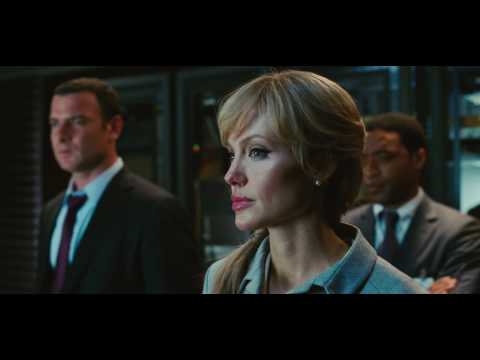
In Phillip Noyce's film Salt (2010), Angelina Jolie portrays the title character Evelyn Salt, a leading super spy who is chasing after a Russian defector and a domestic traitor without vibrant provocation of sexual connotations.

In Joe Wright's film Hanna (2011), Saoirse Ronan portrays the title character Hanna, a perfect killer who presents a moderate, conservative, and normal appearance of a sixteen-year-old girl.
In Olivier Megaton's film Colombiana (2011), Zoe Saldana portrays the title character Cataleya, an accomplished assassin in a vendetta against her parents' killer.
In Steven Soderbergh's Haywire (2011), Gina Carano portrays Mallory Kane, an undercover agent who works for an agency that handles unofficial operations for the government while being targeted for elimination.
In Joe Lynch's film Everly (2014), Salma Hayek portrays the title character Everly, a kidnapped woman who protects her family by fighting off numerous attacks of hitmen and torturers.
In Joseph Kosinski's film Oblivion (2013), Olga Kurylenko portrays Julia Rusakova, a betrayed astronaut who fights a vicious conspiracy, and in Stephen S. Campanelli's film Momentum (2015), Olga Kurylenko portrays Alexis Farraday, an infiltration expert and burglar with lethal skills looking to exact revenge from a master assassin and his team of killers.
In Alfonso Cuarón's film Gravity (2013), Sandra Bullock portrays Ryan Stone, a medical engineer and inventor involved in a space mission that goes awry, and in Paul Feig's film The Heat (2013), Sandra Bullock portrays FBI Special Agent Sarah Ashburn.
In RZA's film The Man with the Iron Fists (2012), Lucy Liu portrays Madam Blossom, a martial arts warrior and assassin.
In Gary Ross's film The Hunger Games (2011) and Francis Lawrence's films The Hunger Games: Catching Fire (2013), The Hunger Games: Mockingjay—Part 1 (2015), and The Hunger Games: Mockingjay—Part 2 (2016), Jennifer Lawrence portrays Katniss Everdeen, the leading protagonist and the chief of a team of braves.
Rarely exhibiting deliberately exaggerated sexual signals, these examples prove that digital women may present a more sexually moderate appearance, indicating that no attempt is made to overtly sexualize their image while their heroic capacities are not being compromised.
Chapter 2The Age of Transformation
Samantha Caine is a suburban schoolteacher and a housewife, endlessly devoted to her eight-year-old daughter, Caitlin, and to her enthusiastic partner, Hal. She is fully content with her motherhood and marital life, though she suffers from amnesia.
The unfortunate loss of memory occurred during Samantha's past life, as a traumatic incident has caused her sudden inability to retrieve any information about the past.
However, when Samantha's memory is restored, she renounces her lifestyle and recommits herself to her previous identity as the top-secret American agent and ruthless assassin Charlie Baltimore.
By both content and form, Renny Harlin's film The Long Kiss Goodnight (1996) and its leading character Samantha Caine / Charlie Baltimore, as portrayed by Geena Davis, signify an aesthetic and conceptual turning point in Hollywood action-and-adventure films.
By narrative, Samantha undergoes a makeover from the idyllic role of loving teacher, dedicated mother, and enthusiastic spouse to the lethal and dangerous Charlie character, who is involved in daring and bold physical conflicts that establish her role as a supreme action protagonist who beats male opponents using forceful measures.
By performance attributes, the placing of Samantha/Charlie's image at the center of heightened action spectacles actualizes graphically her outstanding capabilities, which are used to heighten the emotional effect of her daring achievements.
Further intensifying the protagonist's stimulating engagements and reinforcing her identity as a well-trained cutthroat emissary committed to overthrowing enemies with equal and even superior capacity, a myriad of techniques compose fantastic action shots using digital removals, adjustments, and augmentations, such as digital face replacement and digital image transformation, implementing models, miniatures, and computer-generated images.79
In the window jump scene, for example, after Charlie teams up with her partner, Mitch Henessey, the low-budget detective, as portrayed by Samuel L. Jackson, they are being attacked at the meeting point at the hotel bar by Timothy, the villain, as portrayed by Craig Bierko, who was supposed to kill Charlie eight years ago and now plans to complete the task.
As soon as Charlie realizes the threat, she grabs the gun in Mitch's right pocket and shoots right through Mitch's coat. Eventually, as the partners climb up the stairs, get trapped on the third floor, and run for their lives, Charlie blows a window with bullets and jumps with Mitch as the grenade explodes, allowing them to escape the blast path.
A scale-miniature of the hallway painted black was combined digitally into each shot of the fire flash resulting from a huge explosion that accrued as the characters seem to jump out of the fire into the snow below through the shattered window, illustrating the grave and seemingly hopeless circumstances, when Charlie resourcefully sprays bullets into the frozen ice below, breaking the ice enough so they can fall safely into the water.80
As evocative of Hollywood action-and-adventure cinema of the mid-1990s, The Long Kiss Goodnight is reminiscent of other films of that period, such as Brian De Palma's film Mission: Impossible of the same year, 1996, where Tom Cruise presents us with Ethan Hunt, another American agent who struggles to uncover an infiltrator within his secret organization. Through effects-intensive digital spectacles, Agent Hunt manages to defeat rivals in visually striking displays of courageous exertion.
A fifteen-minute climactic finale features a chase sequence under impossible circumstances, when Hunt is pursuing the renounced agent Jim Phelps, as portrayed by Jon Voight, who attempts to escape via a speeding train with the help of the helicopter pilot Franz Krieger, as portrayed by Jean Reno. The scene entails green-screen shootings; a computer-generated train; traditional analog enhancements, such as a model of a miniature tunnel; and numerous miniature helicopters imposed onto a digitally shaped setting.81
Significantly, one film brings to mind the other. By narrative structure, action performance attributes, and technical procedures, their similarities highlight them as reflections of a substantial turning point of their period.
Marked by the wide adaptation of the new digital technology in Hollywood action cinema, both films illustrate a strenuous effort to attain the desired arousing impact of greater heroic accomplishments by visual means.
At the same time, these films' disparity underlines the technological overturn as a watershed for the renovating image of action characters, most notably through altering the gender identity of the leading protagonist.
New Means and Regulations
As compared to traditional means, digital technology provides the filmmaker with better control over cinematic implementations and its expressive manifestations. This greater controllability may indeed be the distinguishing quality of digital filmmaking.
Due to the improved availability of digital media and communication channels and the growing demand for video and television presentations on digital screens, substantial upgrading in data compression techniques and computer storage space, and the expansion of software that mimics the twenty-four-frame rate, filmmakers have progressively embraced digital processes and increasingly implemented them in Hollywood productions since the mid-1990s.82
Statistical indicators of the film and video production and postproduction services industry show that the use of digital procedures in cinema has considerably accelerated as analog measures have been abandoned gradually in favor of the digital at the level of the entire film industry.83
As software and hardware are readily available and convenient to operate and the simplicity of digital data storage, retrieval, and sharing is improved and as a result the quality and efficiency of digital projection technology, the tremendous growth of the number of small businesses is attested as minor teams of fewer employees are able to finance and handle the production of a digital feature.
Sectoral indices also designate a steady decline of 35-millimeter film projectors, which are expected to disappear altogether; a significant growth rate of digital screens in theaters; and greater use of digital systems of data storage, cataloging, and retrieval at the expense of traditional systems for management and preservation of tapes and the celluloid film inventory.84
In cinematography, the transformation from physical procedures that require mechanical adjustments to digital recording allows filmmakers to capture, correct, and adjust footage instantly in real time and as well as during postproduction.
By editing, as filmmakers gradually embraced the more pliable, supple, and accessible digital methods as legitimate practices, the traditional analog and linear methods were pushed aside as relatively expensive, time consuming, inflexible, and cumbersome.
Ron Senkowski's film Let's Kill All the Lawyers (1992) is the first digitally edited film using AVID digital nonlinear editing system technology, allowing editors to manage their work with greater simplicity. Anthony Minghella's film The English Patient (1996) is the first digitally edited film to win the Academy Award for Best Editing, and Roland Emmerich's film Independence Day (1996) is the first digitally enhanced film to win the Academy Award for Best Visual Effects. The digital revolution became evident in 1996, as about 80 percent of Hollywood films were edited digitally.85
During the following decade, Pitof's film Vidocq (2001), George Lucas's film Star Wars: Episode II—Attack of the Clones (2002), Aleksandr Sokurov's film Russian Ark (2002), and Robert Rodriguez's film Once Upon a Time in Mexico (2003) are the first to be shot fully using digital cinematography. Roger Avary's film The Rules of Attraction (2002) is the first digitally edited film using Final Cut Pro technology, and Ethan Coen and Joel Coen's film No Country for Old Men (2007) is the first digitally edited film using Final Cut Pro technology to win the Academy Award for Best Editing. Danny Boyle's film Slumdog Millionaire (2008) is the first film shot digitally and received the 2009 Academy Award for Best Achievement in Cinematography.
The marketing success of Daniel Myrick and Eduardo Sánchez's film The Blair Witch Project (1999) illustrates digital productions' resourcefulness, availability, and convenience within the limits of a restricted budget compared to traditional productions. The film, which was written and directed by a small team of two film-school graduates, shot in eight days, and presented to a wide audience through the Internet, is considered one of the most profitable feature films of all time.86
Digital modifications more effectively facilitate certain aesthetic aspirations of filmmakers compared with methods that rather limit and restrict aesthetic options. Digital data's immediacy, simplicity, flexibility, and feasibility offer multiscale advantages that provide a virtuosic ability of almost unlimited control of the overall look of the film as well as greater control of the look of the distinct image. Designated graphics software enables the automatic adjustment of colors, grain, and sharpness, shifting effects and manipulating lighting in real time and during postproduction to accomplish the desired dramatic effect.
Traditional in-camera compositing, for example, which integrates physical objects, such as miniatures and models, and live-acting performances g upon a background setting using matte paintings and an optical printer, is regarded as a customary procedure that restricts the possibilities of cameramovement synchronization and the management of error correction and decreases a film's sharpness during a long and multistaged process.87
Digital compositing, in contrast, which can independently manipulate cinematic visuals, such as objects, backdrops, and even actors, and enhance them by combining and connecting them in a single image so as to create an illusion of unity, which is accompanied by virtually no generation loss, is considered far more effective for postproduction manipulations.
In addition, while the real-time analysis capabilities provided by digital systems allow the correction of problems in continuity or lighting during the shootings, digital postproduction facilitates the recreation of the desired atmosphere after the fact more effectively than before. By allowing random access with no need to rewind or fast-forward tapes to locate edit points, nonlinear digital-editing systems enable filmmakers to experiment with visuals in postproduction, easily altering them without the need to physically modify the existing cut.
Extra flexibility in visual adjustments may be required when it is necessary to coordinate visually between a figure and its background, simulating scenarios that are different from the setting during shooting; often, actors perform on a green-screen background, while the desired visuals, props, and special effects are composed to the scene during postproduction.
Martin Scorsese's film Cape Fear (1991) and James Cameron's Titanic (1997) illustrate the limitations of traditional, in-camera physical compositing and linear editing, compared to the digital procedures.
In Cape Fear n , to achieve the desired effect in the scene of the struggle between Robert De Niro as the criminal Max Cady and Nick Nolte as the lawyer Sam Bowden, the actors' range of motion is moderated in order to facilitate their close coordination with cameras, props, and background settings, while avoiding rapid camera movements, wide shooting angles, and extreme long shots. The visual alignment of the raging sea and the characters' fight was enabled by using background screening, rapid editing, and close-ups.
In Titanic, however, the use of computer graphics enables filmmakers to analyze and evaluate the free movement of dozens of extras and to combine them in the desired backgrounds. The effective organization of the numerous elements of the multilayered scene, such as the physical model of the sinking Titanic, the hull of the ship and its interior, computer-generated drowning people, and the digital ocean setting that illustrates compelling graphic images, such as seawater simulation, digitally adjusted colors, lighting, and camera movement, heightens the dramatic effect of the disaster.88
Janusz Kaminski, Steven Spielberg's cinematographer, appreciates the breadth of digital technology's capabilities and emphasizes the flexibility it has given him on the set in the 2008 interview with Todd Longwell for American Cinematographer magazine. Kaminski says, Sometimes I tell the visual-effects supervisor, "Look, this is a lousy image, but I know you can enhance it"…Sometimes it doesn't make any sense to spend an extra hour to improve it [on the set] because it's going to be so manipulated later. There's a sequence in [Steven Spielberg's] Indiana Jones and the Kingdom of the Crystal Skull [2008] where I knew that if I spent time getting the light right, we'd never finish the sequence. Because the sequence will be 95 percent computer-generated imagery, I knew I could control the canvas, control the color, later on, and that's what I would do.89
In an interview with Steven Kotler from Variety magazine, production designer Kevin Conran admits that in Kerry Conran's Sky Captain and the World of Tomorrow (2004), which combines footage of blue-screen performances with a mix of 3-D computer-generated imagery, 2-D photography, and a monochromatic or digitally colored virtual three-dimensional space, "On this project I've had total control. That's something that will be hard to give up."90 Set in 1939 New York City, the film situates the threat to humankind in forms that embody mixtures of robotic devices and genetic manipulations, integrating images of familiar sites and special places, robots, buildings, and flying machines with numerous interiors, facades, and live-action performances.91
The digital grading process exemplifies the ways in which digital nonlinear systems improve the creative flexibility in the postproduction phase, as it enables the alteration of colors, the addition of filtration effects, and the manipulation of delicate components of images and lighting.
Ever since Joel Coen and Ethan Coen digitally scanned and graded their entire pioneering feature film O Brother, Where Art Thou? (2000), the digital grading process has become common practice. Digital processes allowed easy and effective color modifications by reducing brightness and color saturation to perform the requested dark brown and faded yellowish dust color toning that achieve a desired atmosphere, which was totally different from the winter shooting of green and wet Mississippi. The converted color palette produces an impression of a nostalgic, magical, and surreal hallucinated environment of superstition and religious mysticism.
In Lee Tamahori's film Die Another Day (2002), the first in the James Bond series to widely embrace the technology, the multiscale usage of digital grading enabled filmmakers to match the color of various scenes that were shot in different sites and atmospheres, such as North Korea, Cuba, or Iceland, and overcome visual incompatibilities of different shooting hours throughout changing seasons.
In an interview for Die Another Day Special Features DVD release, the director, Tamahori, says, "The great thing is that before you could not see any kind of previsualization about what it was going to be like until you sent it to the lab. A week later maybe you got one dissolve back but here I could do nine layers of dissolves and cross and do all that stuff."92
Stephen Frears's film Chéri's cinematographer Darius Khondji refers to the sense of creativity entailed in the process in an interview with Benjamin Bergery to American Cinematographer magazine, marking it as an "artistic touch," one that facilitates his expressive intentions in ways that were less attainable by traditional means.
Khondji says, "I put a little bronze gold in the highlights and a bit of blue in the midtones and darks to create a more three-dimension effect with color…Adam [colorist Adam Inglis] had what I was looking for: the desire to make a work of cinema, not a pretty film with boosted contrast and video-like saturation."93
Another range of creative possibilities is produced by nonlinear digital practices that can be found in audio implementations. Nonlinear digital sound systems are endowed with a similar flexibility as their video counterparts, likewise liberating the filmmaker's expressive qualities by allowing him or her to guide the viewers to the center of the action and aurally immerse them in the filmic environment via broad expressive strategies that were much more difficult to attain in traditional linear systems.
In-depth discussion points out how digital sound systems allow the production of complex multichannel sound mixes and smoothly moves voices, sound effects, and music around the space of the theater.94
As exemplified in the opening sequence of Andrew Stanton's film Finding Nemo (2003), the director constructs dramatic sonic environments by relying on multichannel mixing of the soundtrack to convey information traditionally contained in the image, as the aural environment includes both specific effects suggested by the visual image and more general environmental sounds (swimming, bubbling). In Spike Jonze's film Being John Malkovich (1999), the director heavily employs point-of-view images and sounds to communicate complex perspectives. In Steven Spielberg's Saving Private Ryan (1998), the director aggressively moves sounds from one channel to another to help us keep track of which characters are shooting or being shot at (and from where). The complex interplay between sound and image affords a consistent frame of reference through a multichannel soundtrack that places audiences within the diegetic space of the film by helping orient them within the visually confusing quick-cutting and close-shot styles. Since digital data can be accessed, modified, or substituted without affecting the overall structure of an image, vast opportunities are opened to mold or shape this structure. Several key characteristics are discussed as differentiating digital media from their analog counterparts, such as numerical representation, modularity, automation, and variability.95
According to this discussion, the digital code that composes the computer-manipulated object and formally describes it through mathematical functions and algorithmic manipulations enables individual customization of its discrete and nonhierarchical structure, namely, a combination of its independent parts (such as pixels) into larger objects. This organization makes it very easy to access, delete, substitute, assemble, and store new objects automatically, using simple algorithms, templates, or digitized databases to efficiently manipulate, duplicate, modify, or generate different, potentially infinite, versions of the digital image.
The prospects of instant manipulation and customization of discrete, independent elements of the digital cinematic frame release the digital filmmakers' unlimited potential to control a film's aesthetics in order to reach the desired expression. By both content and form, Timur Bekmambetov's film Wanted (2008) illustrates this potential. In Wanted, account manager Wesley Gibson, as portrayed by James McAvoy, joins the Fraternity—an organization of assassins randomly designated to their missions by a waving machine, which provides them with targets through a concealed binary code. During his initiation, Wesley is trained to improve his unique ability to dominate body systems—such as his own heart function and metabolism. Wesley's abilities and performances are evolved to the point where his strength, speed, and reflexes prove to be superhuman while enabling his swift makeovers in healing baths of wax and rapid transferals of presence in shifting locations.
Thus, by narrative role, the former unsatisfied servant, deceived colleague, and betrayed lover Wesley, who used to take antianxiety medication for panic attacks, is renovated as a professional assassin with unique aptitudes and becomes a key man in a secret guild of murderers.
Visually, Wesley's revamped heroic position is articulated by his extraordinary control over the course of a single bullet, realized during hyperkinetic shooting scenes that center the "bullet time" effect. A meticulous delineation of a spatiotemporally differentiated computer-generated bullet is produced by digital procedures, utilizing numerous still cameras arrayed in a circle of varying height around the "flight path" of the finished shot and working to blend the many single shots into an apparently unbroken take.
Technically, to produce the "bullet time" effect, each camera is activated sequentially as action occurs, generating a set of frames that are digitally stitched together to make a 360-degree space, merging photographic and computer-generated elements by virtual camera movements. Finally, the resulting animation of a twisting, turning bullet is composited against a rotated background, corresponding to the path of what is essentially a virtual composite camera. Distinct from its background by its spatial trail and temporal pace, the discrete and rapid presentation of the image suspends the course of the events, as discussed in existing research, which serves the energetic influence of the action and enhances the emotional evocation of the accelerated sequence.96
In Wanted, the "bullet time" effect illustrates graphically Wesley's virtuosic control of his weapon when, for example, he calculatedly misses his colleague's head by a whisker or hits targeted destinations located in a distant crowd.
Thematically, Wanted raises various aspects relating to the ability d to control and wield influence under the conditions of randomness and uncertainty that characterize an unstable digital world, while provoking the seemingly enhanced aptitude to control and regulate this world as well as our own destiny or the fate of others. "For the first time in your life," the Fraternity's leader, Sloan, as portrayed by Morgan Freeman, says to Wesley, "you're in control."
Sloan's demand for total control, Wesley's ability to control and monitor natural phenomena, and the fatal choice made by Fox, Wesley's mentor, as portrayed by Angelina Jolie, who takes the lives of her associates as well as her own by firing a single bullet with a curving shot and killing the organization's members one after another, are all motifs that place human impulse, abilities, values, decisions, and actions against chance, luck, and major forces.
By violating traditional conceptions regarding accepted and secured evolutions, such as physical mechanisms and spatial and temporal transitions, the "bullet time" digital effect expresses visually the ways in which Wanted undermines traditional ideas of reality as a linear, coherent, and stable origin and suggests a contingent world based on variable realizations with multiple foundations.
Enabled exclusively by advanced means of visualization, the "bullet time" effect demonstrates the most prominent and significant potential of digital tools—to regulate the distinct image extensively and without restrictions to the level of the single pixel.
Virtuosic Manifestations
By performance attributes, characters' depictions manifest the practical and conceptual implications of digital data's potential manipulation. The power to influence and direct the appearance, facial expressions, gestures, and the very presence of a figure conveys the extensive ability of the digital filmmaker to control and deploy unlimited promises of cinematic presentation.
In terms of the possibility of controlling character attendance, digital replications and digital masking are used with great simplicity to replace the costly and operationally complicated physical presence of human extras, assert simultaneously the presence of outward identical figures, fabricate an entire performance of a deceased actor, or apply an actor's face over that of a stunt double who exhibits a preferred enactment—and thus successfully gain a desired expressive aspiration.
Multiplied groups of foot-soldier replications, for example, such as in Kenneth Branagh's film Hamlet (1996), Peter Jackson's film The Lord of the Rings: The Fellowship of the Ring (2001), Zack Snyder's film 300 (2006), and Mike Newell's film Prince of Persia: The Sands of Time (2010), effectively create enormous masses of armed forces that increase the impact of the fright and terror of their massive, glorious clashes.
In another technique, that of digital masking, digital face-replacement may be used to paste an actor's face on the body of a stunt double in order to produce the desired expression by increasing the impact of a character's performance.
In James Wong's film The One (2001), digital masking enables the simultaneous presence on screen of Gabe Law fighting his own evil image Lawless, both portrayed by Jet Li, while also conveying the existence of the two opposite forces coexisting in one body. As stated by the evil Lawless, "I just took those wasted energies and put them into one container—me. It made me faster, stronger, and smarter. It is our fate, to unite with our other selves, to be unified forever, to be one" (quote from the film).
In Darren Aronofsky's Black Swan (2010), digital masking enables Nina Sayers, the Swan Queen, as portrayed by Natalie Portman, to present an impressive dance, which was actually performed by a professional ballet dancer. Digital face replacement enables taking footage of Portman's face and convincingly applying it over the stunt double as a means to simulate an enriched presentation.
The masking technique proves effective and even indispensable when digital techniques enable the fabrication of the performance of the deceased actors.
Given examples are Brandon Lee's face replacement while portraying Eric Draven in Alex Proyas's film The Crow (1994) and Oliver Reed's face replacement while portraying Proximo, in Ridley Scott's Gladiator (2000). In contrast, films that had to employ traditional practices in cases of an actor's death during production by using doubles, outtakes, and other makeshift measures, such as Jack Conway's film Saratoga (1937), Lewis D. Collins and Ray Taylor's film Lost City of the Jungle (1946), Leo McCarey's film My Son John (1952), and Douglas Trumbull's film Brainstorm (1983), are much more costly and time consuming.97
Digital green-screen practice, yet another technique to control a character's attendance within a desired backdrop, enhances the performance impact and produces the desired expression while enabling an effective integration of images within highly composite environments.
In Guy Ritchie's film Sherlock Holmes (2009), green-screen performances and digital layering techniques enabled multiperspective controllability of the image of Holmes, as portrayed by Robert Downey Jr., and its integration into a slow-motion shot of an exploding and burning background. While creating a life-threatening effect, the actor has not faced a real risk. In Tim Burton's film Alice in Wonderland (2010) and James Bobin's film Alice through the Looking Glass (2016), digital layering techniques facilitated multiperspective controllability of the integration of Helena Bonham Carter's green-screen performances into desired backdrops, allowing the successful deployment and effective integration of the Red Queen / Iracebeth and Crims's image in compound settings.
The stolen tarts scene in Alice in Wonderland, for example, presents the Red Queen as she screams out in rage at her frog footmen and puts them to a cross-examination to find out who has stolen her tarts.
The Red Queen image was formed by capturing Bonham Carter's live acting on a series of green-screen stages and synthesizing it with a computer-generated image in such a way that enabled the distortion of the queen's head size while synchronizing it with the actress's performance. The flexibility in displaying and manipulating the captured data enabled the queen's image to suggest a modified version that accurately represents the geometry of Bonham Carter's puffed head. Digital color grading was used to establish her customized color scheme, and the entire composite image was seamlessly blended into a full computer-generated environment.98
The stolen tart scene, which successfully composes multiple elements into a group of shots to create the impressive effect of a character's charismatic performance, won the Outstanding Compositing in a Feature Motion Picture Award by the Ninth Annual Visual Effects Society Awards.99
The advanced "digital capture" technique, which involves motion-capture, performance-capture, or universal-capture practices, first used on a large scale in the Matrix film trilogy, extends filmmaker's controllability over a character's performance more than ever.
Respectively customizing a character's form, body movement, and behavior and automatically assembling the deployed image into varying contexts enables the virtual formation of a character with a bodily substance, as the looks, movement, facial expressions, and gestures of the final image reliably mimic the lines of nature.
In Peter Jackson's film The Lord of the Rings: The Return of the King (2003), the captured data of Andi Serkis's voice, movements, body language, and facial expressions were integrated into the sculpted 3-D image of the Gollum creature, a digitally manipulated virtual marionette portrayed by Serkis, providing filmmakers with extensive controllability over his performance. A computer-generated animation process enabled the translation of the combined data into a modular structure that gives expressive suppleness befitting Gollum's contradictory attributes, which alternate between the good personality of Sméagol and the violent and treacherous Gollum.
In making Robert Zemeckis's film The Polar Express (2004), a film shot entirely using performance-capture technique, visual-effects supervisors Ken Ralston and Jerome Chen admit in an interview with Katherine Feeny of the Digital Cinema journal that the main goal was to control and integrate the performance of Tom Hanks, who portrayed several distinct characters—the boy, the father, the conductor, Hobo, Scrooge, and Santa Claus.
A live-action cast, digital sets, and performance-capture system— entailing sixty-four digital cameras, infrared receivers, monitors, and computers designed to capture every nuance of a performance—were all directed to provide the attendance, appearance, behavior, and interactions of characters in such a way that gives power to their ensemble performance. According to Jerome Chen, "Capturing data from all possible angles gave the production team the flexibility to place the actors anywhere within the virtual sets we created. The coverage also gave us a better reconstruction so that later we could place our virtual camera anywhere within the scene to create any shot, from every possible depth and angle."100
In Jon Favreau's film Iron Man (2008), the image of Tony Stark was created by blending the human gestures of Robert Downey Jr., who plays the character with the digital image of Stark's metallic armor. According to animation supervisor Hal Hickelm, as cited by Zahed Ramin in Animation magazine, the key challenge for his team was the building of Iron Man's image by the convincing assimilation of the real actor with the virtual armor to guarantee plausibility.
Hickelm says, What I liked about the film was that we were creating something on the outside that was a hard robot on the surface, but we always had to be aware that underneath it all, it had to be a flesh-andblood human character—always a Tony Stark…It was a great partnership with Robert Downey—he would do everything from the inside and we'd work on the outside…From an animation standpoint, we had to make this suit of armor fit his body perfectly… The human body is so flexible—and the armor was only made of hard pieces, not from rubber, so we had to work hard to rig it in a way that all the pieces mesh together seamlessly.101
In David Fincher's film The Curious Case of Benjamin Button (2008), we witness the progressively younger versions of Brad Pitt's face, created to fit Benjamin Button's gradually younger body as he regresses from old age into youth and infancy.
By capturing digital-performance data based on an analysis of actual and digital footage, natural human behavior, body language, and facial expressions, the reversed aging images were successfully merged into compound scenes, assuring credibility and producing the desired impact of its instable, upturned shifting of the character.
In an interview with Ron Magid for Animation magazine, Character Supervisor Steve Preeg says, "We didn't want to project video of Brad onto digital geometry or composite him in wearing old-age makeup; in order to work, Button had to be completely digital. Essentially the goal was: It's not any kind of trick; it's completely computer-generated for 325 shots— including up-close dialogue and moments of quiet contemplation. It's not a performance we could hide between motion blur or rain or nighttime; it's Fincher with his 250-frame shots, so it was a scary thing to step into."102
In James Cameron's film Avatar (2009), most of the footage consists of performance capture, giving editors the ability to isolate and combine the best individual actor-performances from each take. The protagonists Neytiri and Jake Sully, as portrayed by Zoe Saldana and Sam Worthington, were placed onto many screens that enabled director Cameron to view scenes from different angles so that he could direct it in real time and composite it with computer-generated sets in postproduction as he saw fit.
In an interview with Peter Caranicas from Daily Variety magazine, Cameron says, "You might like Zoe from take four and Sam from take eight. Now you're doing a 'combo.' Or you like Zoe from take four until a certain line of dialogue, then from take seven. Then you're doing a stitch—stitching her motion together."103 Editor Stephen Rivkin clarifies the suppleness and agility inherent in those techniques, which leave every possibility obtainable.
Rivkin says, Normally, when you shoot a live-action film, and there's more than one actor in a shot, you're limited to the performances in that take. In Avatar, after the performances were captured, Jim often wanted to combine performances from different takes into a camera "load"—or section of a scene— r and build a composite from different performances. We were able to create a "master" that had the best performances from every actor—combining actors in the same g load and "stitching" them together if necessary. We could also use the performance capture from two different takes of the same actor, which could be made into a continuous take, so you aren't limited by one particular performance. The first line can be from one take, the next line from another. By combining different performances in the same load, you have the flexibility to create the best possible master…Jim was looking at a set on his viewfinder. Nothing was there on the stage, but in his camera there was a whole virtual world.104
In the Beyond: Two Souls video game, yet another example of performance capture practice, the character of Jodie Holmes is formed by capturing Page's live-acting on a series of greeng screen stages and synthesizing it with a computer-generated image in such a way that enables the synchronizing of the actress's facial expressions, body movements, and behavior, producing a humanlike performance.105
Further broadening the creative prospects of digital artists, the advanced flexibility in controlling the performance of actually based virtual figures proves that many more goals of cinematic presentations are attainable than before, as digital enhancements are increasingly acquired.
Experimental filmmaker Babette Mangolte explains that the filmmaker's position as absolute master is unique to digital cinema since it offers him or her control with no need for direct touch, as anything can be undone with the ease of a click, at a distance, against the mouse and keyboard, leaving a simple surface of effects.106
Michael Snow's experimentation with computer-generated imagery in his film *Corpus Callosum (2002) emphasizes the fundamental manipulability and controllability over the human body image by implementing the capabilities of computer-generated imagery to increase, diminish, rotate, crush, bend, overturn, alter, and inflict overall chaos on the physical body by handling the placement, size, shape, color, and identity of various people and objects that usually do not blend seamlessly.107
As a manifestation of the digital filmmaker's new power to control human images throughout cinematic space and time, Snow employs shapes and colors to confuse identities and forms, such as when a blond woman in a brown skirt, pink shirt, white tights, and brown shoes is played by different actresses at different times.
At a certain point in Snow's film, a woman appears naked and pregnant and later has a penis blended seamlessly with the rest of her body. A black figure turns white and a white figure turns black. An electric current electrifies a worker performing an electrified handstand. A man's penis expands to meet the exposed backside of a woman waiting on top of a desk and then suddenly contracts when a bell rings. A man twists the entire body of another man by just holding his arm and then whips him with a belt before they part, blowing kisses to each other. A plump woman's body is expanded like a balloon and bursts. A man and a woman enter a door and squeeze together to emerge in a rectangular shape.
The digital proficiency is regarded as a new freedom available to those who strive for the most effective cinematic composition. Its inventive prospects are recognized as a revolutionary change compared to the professional, practical, and schedule restrictions of the former procedures of cinematic presentations.
As a leading promoter of technological advancement in cinema, the American filmmaker and entrepreneur George Lucas considers digital technology as crucial for controlling both the technical aspects of the image and the expressive aspects of storytelling, allowing what he regards as the definitive emancipation of the imagination. Lucas argues, "I think cinematographers would love to have ultimate control over the lighting; they'd like to be able to say, 'OK, I want the sun to stop there on the horizon and stay there for about six hours, and I want all of those clouds to go away.' Everybody wants that kind of control over the image and the storytelling process. Digital technology is just the ultimate version of that."108
Filmmakers and scholars address the potential entailed in the digital medium as its essential quality, which advances desired manifestations and facilitates what Dante Spinotti, the cinematographer of Michael Mann's film Public Enemies(2009), describes in an interview with Jay Holben of the American Cinematographer magazine, as "a more dynamic use of film grammar."109
Enthusiastic about the fact that shooting digitally allows him to adjust settings in relation to the existing lighting and humidity conditions in a way that is very hard to achieve with traditional film lighting, Spinotti proclaims, "There's so much you can do in post!"110
The effects-designer Doug Trumbull is cited recalling the making of Stanley Kubrick's film 2001: A Space Odyssey (1968): "There were scenes in 2001 that were held in the freezer for over a year, waiting for the matte paintings to be filmed. Now you can do most of that in a computer with CGI and output to film."111
The cinematographer Kees Van Oostrum, known for Ron Maxwell's films Gettysburg (1993) and Gods and Generals (2003), Tom Holland's film Thinner (1996), John Schultz's film Drive Me Crazy (1999), and Robert Dornhelm's film Spartacus (2004), among others, indicates in an interview with Todd Longwell for Hollywood Reporter magazine on the new technology's intense power of expression.
Van Oostrum says, "Once you embrace that technology and educate yourself about it, it becomes a dramatic tool more than a technology… Some directors I've worked with have said, 'If I'd known about some of this stuff, I would've written the script differently.' That's probably the strongest comment you can make about visual effects. When you really understand what the technology can do, you work differently."112
According to Visual Effects Supervisor Alan Marques, known for his work on Martin Campbell's films GoldenEye (1995) and Vertical Limit (2000), Iain Softley's film Hackers (1995), and Stephen Hopkins's film Lost in Space (1998), among others, the colossal change in the way visual effects are executed provides directors with almost unlimited visual accomplishments.113
Film theorist Markos Hadjioannou argues that the skill and ability to maneuver the digital image provides the digital filmmaker with the benefit of virtuosity by granting him or her complete control over chance occurrences and allowing him or her to represent his or her own notion of the ideal image.114
The creative latitude of digital imaging may be regarded as a source of inspiration by the ways it embodies an infinite potential to reach endless possibilities, according to the most suitable means for attaining the digital filmmaker's expressive aspirations.
The possibilities of the advanced technologies inspire the digital filmmaker as a palette of colors and a collection of brushes may inspire the painter. The potentially infinite visuals operate as a source of inspiration as well—a stimulus that encourages filmmakers' creative decisions.
Novel Sources of Inspiration
The digital filmmaker's position of mastery, control, and transcendence over the digital compositions enables the attainment of the most affective composition for advancing exhilarated displays and heightening the sensory impact and the genuine emotional arousal of action scenes.
While ensuring the desired dramatic aspirations, playful displays of actionbody manifestations function on an expressive rather than a realist level, y exhibiting significant distancing from acceptable motivations and sources of inspiration, which are traditionally attributed to the cinematic image.
In 1973, one of the first digital images was introduced to the cinema. John Michael Crichton's film Westworld simulates a robot's point of view, d realizing an innovative practice of image production and display.
Starting in the sixties, the pioneering filmmaker Michael Crichton showed practical interest in advanced technologies. During the thirty years that followed, he made groundbreaking use of computer programs in cinematic productions, a work that earned him an Academy Award in 1995 for outstanding achievements.
Revolutionary for its time, Michael Crichton's first exercise with digital imagery in cinema can be appreciated as a preface, an introduction of a new means for artistic expressions that reflect their own time and place.
Westworld outlines the events in Delos, a theme park populated by d humanoid robots that endorse visitors' fantasies. By taking part in the Wild- West-world scenarios, such as bar fights, horseback chases, and shooting battles, the humanoid robot Gunslinger, as portrayed by Yul Brynner, promotes the adventures of John Blane and Peter Martin, a couple of friends hosted in the park, as portrayed by James Brolin and Richard Benjamin.
Yet, as a result of a malfunction in the command and control systems, the park becomes a death trap for its visitors, when the robots turn vengeful and violently attack the guests.
Conceptually, this chronicle underlines the conflicting encounter between incompatible contradictions. By assuming that their alignment breaks solid and secure boundaries between traditional dichotomies of binary oppositions—human beings and programmable machines—the film marks the synthesis between computers and humans as unnatural and thus inevitably disastrous.
Gunslinger, a character who has held a compelling human charisma associated with the iconic persona of Yul Brynner since John Sturges's film The Magnificent Seven (1960) and Richard Wilson's film Invitation to a Gunfighter (1964) personifies this idea. While embodying the semblance of a popular and recognized figure by appearance and the nature of a programmable instrument by narrative role, Gunslinger symbolizes the tragic effects of the conflict between inherent contradictions and the catastrophic implications of the breach of conventional law and general rules, as the humanoid robot's unrestrained doings yield harsh and dreadful consequences.
The digitally constructed shots that represent Gunslinger's eyesight visually illustrate these technophobic reservations. Shaped by digital scanner, pixelated and grainy frames represent the protagonist's visual perspective. Human perspectives, in contrast, are represented by conventional cinematographic images. While computer-generated images signify a robotic instrument—a conditional and programmed mechanical device— what is considered as a natural and rational standpoint is produced by the film camera in real, actual, and physical expressions.
Stylistically, the differences between the separated beings are clearly marked by a montage of visually distinct shots that bring together the robot's peculiar machine-driven outlook—distorted reflections shaped by artificial means, with the natural and true representations of "normal" reflections shaped by the camera eye.
The visual encounter between the two types of representation violates, both conceptually and stylistically, customary film practices. By disrupting continuity, the successive turnover between the distinct images expresses the instability and disorder of traditional imperatives as a result of computer technology innovations, envisaging the unstable nature of the false combination between humans and machines.
While introducing state-of-the-art image visualization by groundbreaking three-dimensional digital images, such as a human head and hand that appear on Delos Control Center's monitors,115 Richard T. Heffron's sequel Futureworld (1976) depicts the succeeding events in Delos Park d when the loss of control over the advanced androids yields disastrous consequences that cost human lives.
In a similar way, digital image breakthroughs during the following years serve cinematic expressions that embody the cultural anxiety of the perilous consequences of the blurring of boundaries between humans and machines.
George Lucas's film Star Wars (1977) exhibits digital images of aircraft s on the spaceship monitor of Luke Skywalker, as portrayed by Mark Hamill, visualizing the struggle of civilization for the Death Star—a destructive product created by technologically advanced societies that threaten to extinguish the human race.116
The set of Ridley Scott's film Alien (1979) is dominated by computer screens and monitor displays, as the film announces the existential threat to humankind following the takeover of an advanced, hi-tech-oriented foreign entity. The film introduces a breakthrough by a three-dimensional computer-generated model of the Nostromo starship's navigation map, simulating a slow-changing perspective of the terrain during a landing sequence. g Robert Wise's Star Trek: The Motion Picture of the same year deals with the extinction of humanity as a result of an abnormal connection with robots and computers. The computerized image of the wormhole effect, presented on the wide screens of the Enterprise spaceship's monitors, exhibits the spacecraft's journey through parallel space-time that causes the human body difficulty in adjusting.
The essential cultural fear of computer technology manipulated to the point of human annihilation is disclosed during the 1970s by other audiovisual media as well, using digital presentations to illustrate comparable technophobic ideas.
David Bowie's "Space Oddity" music video of 1972, for example, applies digital imagery to illustrate concerns regarding technology's takeover of society.
The song lyrics tell the story of Major Tom, an astronaut who has lost contact with the world and vanished during his excursion into space. The loss of control over the spacecraft is articulated by "ground control's" failure to communicate with Major Tom, who finds himself powerless, "floating in a most peculiar way…and there's nothing I can do…I think my spaceship knows which way to go."117
Aesthetically, electronic records of digital signs are implemented into the video clip, a remake of the original 1969's "Space Oddity" music video. The new version reflects visually the concerns regarding the precarious repercussions rooted when life and advanced technologies are crossed together.
The early implementations of computer-generated imagery signify and promote ideas regarding the fateful penalties concealed by technological progress that motivate precarious incidents for humanity. Digital technology serves narratives of worries, aversions, and evasions, presuming human annihilation following the integration of computer technology with human functions and reflecting inherent cultural concerns of the danger embedded in objects and situations that mix technological utilities with human capabilities.
During the 1980s, digital practices took a more positive role in cinematic expressions. Steven Weisberger's film Tron (1982) reflects the change by depicting the first computer-generated character, Bit, a polyhedral figure with a changeable shape that mirrors its emotional state. As an endearing reflection of human manners, the constructive role of the favorable Bit as the friendly and humorous companion of Clu, portrayed by Jeff Bridges, is established by its humanoid charm and appeal, evoking the spectator's sympathy and affection.
Nicholas Meyer's film Star Trek: The Wrath of Khan (1982) presents a positive viewpoint on the potential that lies in the technological capacity for humans as well, exhibiting the spectacular and groundbreaking computer-generated firestorm "the Genesis effect," a process that brings inanimate objects to life through a subatomic transformation, whereby worlds unsuitable for living in could be made appropriate for humans.
Nick Castle's film The Last Starfighter (1984) is considered a cinematic breakthrough because of the widespread use of computer graphics to display digital imagery of spacecraft in battle scenes, borrowing advanced video games' aesthetics at times when an emerging market of video games indicated a growing interest among target audiences.
And the visual effects of James Cameron's film The Abyss (1989) stunned s spectators, when an underwater creature appears in an unprecedented computer-generated cinematic scene. A digitally constructed amorphous aquatic pillar of seawater replicates human facial expressions, presenting an expressive and favorable nature that manages to evoke spectators' pleasure and sympathy, consistent with its role as a noble protector of many lives.
The Abyss won important awards, such as the Oscar for Best Visual Effects, the USA Award for Best Sound Editing—Sound Effects, and the 1991 Academy of Science Fiction, Fantasy & Horror Films Award for Best Director.118 The effective allure of digital presentations and their marketing potential has become evident.
The procedural, visual, and conceptual evolution in film aesthetics launched a considerable debate over the impact of digital technology on the art of cinema. Digital practices were considered by many as questioning the camera's role as a major expressive tool and undermining the traditionally established position of reality as the main source for cinematic imagery.
In the early days of cinema, filmmakers and scholars alike hailed the ability to perceive, expose, and intensify the qualities of reality, striving to reveal the true "nature" of things. The recognition of cinema as a unique and advantaged method of objective vision, a new tool of knowledge that allows systematic exploration with its power of inquiry and validation with extraordinary immediacy, was broadly articulated in both theory and practice.119 Concerned with the truth value of cinema, photography and cinema were considered to be expressing a tangible significance, since the recorded form is equivalent to its original model in the world.120
Realistic approaches favor the camera and the photographic process as supplements to the eye, mechanisms for approachability to life itself, unregulated by the associative arrangements enforced by the pictographic. These mechanisms defeat painting in its ability to represent objects from reality, since the filmed form is equivalent to the original model and has the capacity to deliver the spirit to the world and its physicality.121
According to this attitude, by registering the qualities of reality— multidimensionality, chiaroscuro, perspective, and time/space relations—traditional cinema enables us to present the essence of the filmed subject, an objective beyond the simple mechanical act. The persuasive powers of cinema are greater since filming is a mechanical process in which man takes no part. Trust is to be placed in the film's objective character, which cannot grant the subjective painting due to the involvement of the human hand. The automated camera is the single mediation between reality and its reproduction, a means for exposing that which the eye does not see, a process that may bring about the revelation of the truth and its presentation, creating a real-life imprint.
On the other hand, digital representation—the framing of a virtual image or an illusionary fictional world on screen—is an act of simulation. The computer functions as an instrument through which the digital filmmaker, intending to establish the desired effect, exhibits the ability to model both actual or absent elements with the visual resemblance of reality and to control them across space and time to form illusionist spaces and images that are true to another reality rather than the actual.122
Rather than affirming reality as a concrete origin and a central source of reference for cinematic images, the nature of the digital image is no longer representing a desired affinity with a real source. Its iconic, computer-based nature distances it from the traditional status of reality and the metaphorical and practical contexts entailed therein. Thus, the emergence of computerized processes and their implementation in films were considered by many as diminishing a unique value of the art of cinema—its ability to record true events in actual locations.
In this regard, digital manifestations were criticized as extravagant exhibitions at the expense of the story line, theatrical tricks that aim to stimulate admiration and amazement rather than inspiring the believability of the early days of cinema.
In view of that criticism, the visual breakthrough of Steven Spielberg's film Jurassic Park (1993), which plausibly incorporates computer-generated dinosaur figures with live actors, was condemned by those who regard the imagination and effort invested in Spielberg's dinosaurs as damaging the credibility of the story and detracting from the spectators' involvement in the film.
The critic Kenneth Turan, for example, argues in the Los Angeles Times that by stunning viewers, Spielberg's spectacular displays are overshadowing the plot in favor of pure visual pleasure that interrupts the course of the film and miscues its designation—to tell a meaningful story.123
Michael Jackson's skeleton dance scene in Stan Winston's film Ghosts (I) (1997) faces critics who consider it a digital stunt that lacks depth and significance, aiming to encourage appreciation rather than profound meaning.124
And in Entertainment Weekly magazine, the critic Owen Gleiberman disapproves of Robert Zemeckis's Forrest Gump (1994), arguing that the film subtracts the true value of reality as the digital integration of archival material, such as the allegedly documented encounters between Gump, the protagonist, as portrayed by Tom Hanks, with momentous figures, such as John Lennon, Presidents Lyndon Johnson and Robert Kennedy—and reduces historical events to amusing mock-ups.125
From a historical perspective, the observations that reject innovative technologies, doubt their artistic value, and signify them as a gimmick, an ephemeral flirt that lacks vital significance, are familiar annotations.
The dramatic effect of the transition from black-and-white to Technicolor, for example, was repeatedly criticized with cynicism and suspicion, and the sound revolution, heralded by Alan Crosland's film The Jazz Singer (1927), was disparaged by filmmakers and critics alike, questioning its aesthetic value.126
The critical standpoints reflect a determinism that regards technological advancement in cinema as a process that directs and dictates uncontrollable and unavoidable artistic choices.
Proponents of this approach consider the digital cinema as a fake revolution, not driven by artistic determinations but by utilitarianism, such as commercial benefits, to increase the profitability of target audiences127.
The contrasting indeterminism, the doctrine that rejects technological determinism, favors the technological innovation as a new means of expression, which provides a solution for the filmmaker's expressive aspiration rather than leaving it to be determined by antecedent technological grounds.
According to this approach, filmmakers adopt technology in accordance with their creative intentions, and the artistic value of their work must be examined in the context of the particular circumstances of their period.
Thus, redirections of filmmakers' expressive aspirations are accompanied by ongoing adaptations of advanced digital procedures that change image production and display, reflecting the renovation of cinema as artistic expression that echoes a changing cultural spirit.128
Social conditions, political sensitivities, cultural perceptions, and technological modifications are mutually connected in ways that change filmmakers' objectives and ideas and encourage the adoption of digital technology to ensure efficient expression and effective experiences for spectators.129
In an interview with Ron Magid for American Cinematographer magazine in 2002, George Lucas, an enthusiastic supporter of the latter approach, underlines his enduring determination to shape the future of cinema by advanced technologies. Lucas supports the view that digital technologies are essential for image construction and improvement through changing times and testifies that this realization drives him to foster the development of computerized methods to promote artistic ambitions.
Lucas says, All [digital technology] does is give you more to work with. It's a much more malleable medium than film, by far; you can make it do whatever you want it to do, and you can design the technology to do whatever you want to do. This whole field is really going to ramp up in the next ten or twenty years…It's very much like going from frescoes to oils—one is very rigid, very disciplined, very definite about the way it works, and the other is much more open, offers you more options and enables you to manipulate the pictures more, and I think that bothers people…There's a lot of freedom and malleability that didn't exist before. It's easy to move things around in the frame, to change various visual aspects of the film, which just wasn't possible before. It's the same kind of thing that you find in still photography if you use Photoshop.130
The latter attitude reflects the digital filmmaker's general aspiration to provide an impact by pursuing a sense of special quality because of the medium's unique forms of production and transmission.
According to this idea, the physical presence and uniqueness possessed by the work of art generates a sense of distance and reverence—a filmic aura. Scholars acknowledge that in digital cinema, a film's auratic power is called into question since the medium further highlights the mediated nature of the experience and contributes to the spectator's consciousness of the process of representation.131
A point made is that films do not inspire such feelings of reverence and remoteness because they are reproduced mechanically in an arbitrary number of nearly identical copies and because the artistic expression is centered in the film camera and editing techniques, which condition us to view the world through associations and mediate the experience by breaking the physical connection to an aura-endowed place or object.132
Then again, others indicate that cinema can evoke a legitimate aura. The Hollywood style affirms the auratic power of films by relieving the spectators of the awareness of the mechanics of representation (camera movements, editing), so as to enable them to experience an imaginary world as natural and to focus on the drama itself. In digital cinema, this ambition is articulated by the interplay of two opposing strategies of digital representation: the strategy of transparency and the strategy of hypermediacy.
To that end, Hollywood filmmakers aim to evoke aura by capturing the reality of the characters, places, and situations, seeking to emulate a supposed immediacy by obscuring the negotiation between the measures that mediate between the spectator and the presentation. The spectator is supposed to overlook the process of image construction and focus on the content through continuity editing as well as an engrossing narrative.133
The pursuit of aura or for the charismatic effect in digital cinema is reflected by the so-called "photorealistic ambition"—the aspiration to reproduce the realism of traditional cinema. This aspiration was initially confined to the look of special-effect images that might otherwise have been created by traditional methods through models, miniatures, costumes, masks, or makeup.134
Forrest Gump, for example, reflects the photorealistic ambition through digitally composed scenes, such as Gump's insertion into documentary footage among historical figures; the swirling feather that lands in Gump's lap at the opening sequence; the replication of the massive crowd at the march on Washington; the entire stadium for the table-tennis tournament in China and the ball hit at superhuman speed; and through the positioning of Lt. Dan Taylor, portrayed by Gary Sinise, on the hospital bed after having his legs blown off in battle.
The film may call to mind the special effects in Woody Allen's film Zelig (1983), wherein the main character is inserted into different settings g by traditional optical techniques. However, while the nondigital aesthetics express a different, postmodernist motivation as they aim to reinforce doubt and unbelievability,135 the digital aesthetics of Forrest Gump aim to reinforce the narrative conviction and believability by reaching the most natural, photorealistic appearance of both actual and digital images.
The ability to inforce believability by implementing "realistic" virtual images via digital intermediaries, aiming to mimic what scholars regard as camera-reality, reflects the intention of attaining the most convincing visual impact by seeming far more lifelike than the mechanical duplication of miniature models and stop-motion animation images.136
The ambition to grasp improved camera reality by digital means is articulated by the visual-effects supervisor Denis Muren, known for Steven Spielberg's War of the Worlds (2005), Artificial Intelligence: AI (2001), and Jurassic Park (1993); Ang Lee's Hulk (2003); George Lucas's Star Wars: Episode II—Attack of the Clones (2002) and Star Wars: Episode I—The Phantom Menace (1999); and James Cameron's Terminator 2: Judgment Day (1991) and The Abyss (1989), among others. Muren says, In the Star Wars films, you saw lots of X-wings fighters blow up, but these were always little models shot with high-speed cameras. You've never seen a real X-wing blow up, but by using computer-generated imagery, you might just suddenly see what looks like a full-sized X-wing explode. It would be all fake, of course, but you'd see the structure inside tearing apart, the physics of this piece blowing off that piece. Then you might look back at Star Wars and say: 'that looks terrible.' Therefore, the awe-inspiring, breathtaking effect of the opening parade of the Seventy-Fourth Hunger Games scene in Gary Ross's The Hunger Games (2012) is produced as a fire-ignited Katniss Everdeen and her male companion Peeta Mellark, as portrayed by Jennifer Lawrence and Josh Hutcherson, when they introduce themselves to the Capitol City audience of Panem.
Indeed, the extreme, digitally assembled manifestation of the large audience and arena; Capitol City's avenues, squares, and buildings; and the flamboyant appearance of the couple may underline the scene as a mediated construction.
At the same time, by disguising or erasing any signs of the production process, the cinematic composition also seems reliable, as if the shapes, color, texture, and motion are produced by concrete rather than computerized measures.
While producing the effect of camera reality, a convincing impression allows one to experience the spectacle as both natural and grand.
The overwhelming presentation of the two adolescents, marching in unharmed though surrounded with live flames, attains authenticity or visual fidelity as their flaming images enhance the impact of character performance.
This impact evokes the spectators' emotions, stimulating the desired sense of delight and excitement that arouse reverence—and eventually endow the leading protagonist, Katniss Everdeen, with special merits that, among all, crown her as the greatest triumphant.
Rather than reproducing a concrete and physical reality and emphasizing the similarities with an analogous actual model, the persuasive potential of the appealing nature of the digital image construction is determined by what is regarded as a hyperrealistic excess.
By focusing on elevating and exaggerating the effect of exclusiveness— a unique expression of its kind, digital filmmakers heighten the illusion of invented realism while emphasizing its identity as a copy without a source, a second-degree simulation and not a symbolic depiction of the real.138
At the same time, the digital expression maintains what scholars label "perceptual realism"—audiovisual features whose engagement with reality match spectators' knowledge and experience of daily life. The perceptual realistic image corresponds with spectators' perception of space and how light, color, texture, motion, and sound are incorporated within.139
Scholars associate the battle sequence in Roland Emmerich's Independence Day (1996), considered to be a landmark in digital film aesthetics modification, with the innovative determination of the digital filmmaker to shift the spectators' attention from the photorealistic image to the digitally integrated compound shot, which may be referentially illusory but perceptually truthful.140
The film that won the 1997 Oscar for Best Visual Effects tells the story of humanity's fight against a hostile air fleet of a mysterious and powerful alien species that attacks and destroys populations by massive numbers of spaceships that blast destructive beams of fire on cities all over the planet. With superior weapons, human ingenuity manages to rebuff the enemy by employing technological sophistication.
The spectacular final encounter with the army of aliens is illustrated by an air battle, which includes a large number of different types of peculiar aircraft. The scene combines numerous elements, such as large numbers of US F-18 fighters and alien attackers based on motion-control models, computer-generated imagery, and background photographic plates.
Here, the process of presentation does not frame the virtual image but demonstrates the filmmaker's control over the compound shot while maintaining its perceptually realistic composition. The scene also empowers the focused attention of the spectator to the cohesive on-screen world and evokes the desired emotional reaction.
By this definition, the digital filmmaker composites the set of modular and malleable elements in such a way that disguises or erases any sign of the production process. By reframing a compound configuration while assuring legibility, the filmmaker attains the effective expression and its emotional evocation.
According to Visual-Effects Supervisor John Nelson, the Coliseum arena in Ridley Scott's Gladiator (2000) reflects the latter objective through the smooth combination of live-action construction, computer-generated set extensions, and matte paintings. The flight shot over the top of the Coliseum seamlessly integrates numerous elements, such as live-action shooting, digital crowd replication, three-dimensional computer-generated buildings (including the top of the Coliseum), and flying birds. In an interview with Kathy DeSalvo for Shoot magazine, he says, "The greatest compliment, really, is to have people not notice your work and ask you what you did."141
In the Matrix trilogy, shooting factors were accomplished via various means, including green-screen techniques and motion-control systems. These were impeccably synchronized with other images, such as background photographic elements and three-dimensional images that composed a malleable digital environment, which was stylized using simulated phenomena, such as water and light.142
John Gaeta, the visual-effects supervisor of the trilogy, told Jennifer Champagne from Millimeter magazine that he became obsessed with the notion of seamlessly integrating digital and real-world images, as the procedure involved the incorporation of different postproduction artists and diverse facilities into an on-set compositing system. According to Gaeta, each stage added more detail to the scenes, often changing parameters and adding levels of complexity. Virtual cinematography embodies reality capture by trying to represent a three-dimensional visualization of virtual backgrounds by combining a dynamic, floating, virtual camera with fixed, still cameras. Photographs were used as real-world parameters for acquiring textures for the many three-dimensional elements in order to create a viable relationship between the digitally generated world and the physical world. These background plates were combined with computer-generated creatures, miniatures, and synthetic humans—virtual characters produced by performance and facial-capture systems applied to three-dimensional body versions of the characters. The sequential animation of independently triggered stills cameras in a circular setting took as many as 120 single-frame positions. The compression of these still frames into a complex composition produces virtual 360-degree camera movements within three-dimensional simulated spaces of virtual reality fused with world elements.
In Game of Thrones, the visual-effect-intensive television series initiated in 2011, the heroic characteristic of Princess Daenerys Targaryen, as portrayed by Emilia Clarke, is designed through compound scenes of spectacular performance that integrate various processes and images without leaving any visible trace of its inconsistent foundations and eventually shape Daenerys's image as a powerful warrior with higher moral values and strong leadership.
Here again, the careful and precise arrangement of multiple elements, their meticulous coordination, and attentive synchronization produce a consistent and coherent visual world, dismissing our consciousness of its complex setting and compound assembly and ensuring the desired impression of heroic mastery.
Believing she is the rightful heir of the Mad King Aerys II and Queen Rhaella, though living in exile, Princess Daenerys, the last of the Targaryen Dynasty to rule the Seven Kingdoms, is on a mission to reclaim the seat of the Iron Throne. Her heroic superiority is first proven in "Fire and Blood," the tenth and final episode of the first season, directed by Alan Taylor and first aired on June 19, 2011. Physically inured to heat, she is walking unharmed out of the fire where she laid the three eggs from which her baby dragons later emerged.
The dragons follow Daenerys to season two as she leads her Dothraki followers across the Red Waste, and in a spectacular finale scene in the tenth episode "House of the Undying," aired June 3, 2012, they burn to death the leading sorcerer, Pyat Pree, as portrayed by Ian Hanmore, while Daenerys survives the great fire again.
According to the VFX producer, Steve Kullback, in a video interview on the Game of Thrones Season 2 Featurette: Inside the Visual Effects, the compound structure of the latter scene is based on a "complicated setup because lots of different elements were put together" to create "almost a video game like" puzzle.144
The live-action location in Dubrovnik castle, combined with a computer-generated stone wall, produces the desired historical scenery; puppet models of dragons were set on a table to enable convincing eye contact with Emilia Clarke in her green screen performance; a stuntman was set on fire to simulate Pyat's burning; reactive lightning that throw flamecolored light along the walls and on Daenerys's body-image are combined with computer-generated fire to simulate flames; and computer-generated animation produces the dragon creatures.
Visual-Effects Supervisor Sven Martin says in an interview held in 2015 with Thomas Johnson from the Washington Post that the 3-D dragons' animations are based on the combination of chickens' actual bone and muscle structure to produce believable functionality of their bodies, concept paintings, and 2-D models based on a variety of clay modeling software.145
The final shot visually integrates Emilia Clarke's live performance in the physical setting with the graphical images of the dragon firing all over the place and seemingly burning everything besides Daenerys herself. Being formed into joint construction that enhances plausibility and not by a separate, dazzling, and outstanding element that is being transplanted into it, this setting provides the scene's magnificent impression that further establishes the character's formidable potency, prowess, and leadership.
In order to reach the most exhilarating action character, the digital filmmaker's organizational capabilities became a major task, as the plausible combination of images of different contexts and designs establishes the protagonist's heroism in ways that may be regarded as a conceptual attempt to "approach the sublime."146
Advanced Bodies in Action
A controlled execution of structural abilities in digital cinema works to amplify the impact of the action-body presentation and enhance its emotional evocation. Rather than realistic commitment, the digitally enhanced bodies reflect new determinations by performance attributes and editing strategies.
The integration of a character's heroic image in action scenes illustrates excessive complexity in organizing images and freely directing bodies in space and time and proves the realization of what is called an "organizational mode of creativity."147
A suggested example is the plethora of supportive digital editing strategies used by Ang Lee in Hulk (2003). As a story about mutating bodies operating in a deformed space and time, Hulk exhibits a nonlinear spatiotemporal distortion of images. Unstable background/foreground visual relations, image dissolves, and transitions within a shot were meant to melt together the details of the image by ungrouping its various elements, isolating them, and using them as expressive and emotionally effective indicatives within the narrative of the film to express the sense of rupture and break, ambivalence and uncertainty, that accompanies the transformation of Bruce Banner, the protagonist, as portrayed by Eric Bana.148
As discussed at length, digital effects in Hulk disrupt space continuity by adding moving inserts or unusual wipes and fades, and the digital nonlinear editing system enables deliberate play with the conventions of the traditional spatiotemporal organization, such as split-screen presentation, which shows the diverse reactions of different personnel in the military installation. Other practices, such as green-screen, motion-capture, and digital modeling were used to dramatize the deformation of Banner's body and its implications.
An example is the green plume in Bruce's eyes, which establishes a visual connection between his green body, the explosion at the military base, and the repressed memories of his father's past actions—all having great emotional resonance in his adult life.149
Among all, through the application of organizational abilities, a most exhilarating dramatic effect is achieved by reconstructing a character's desired point of view. The flashing alternations between hypothetical positions of a camera plausibly integrate images and enhance the impact of digitally action-constructed scenes.
Through rapid and discontinuous shots, fragmentation, and swift interchanges between many camera positions, the police station shootout scene in Alexander Witt's film Resident Evil: Apocalypse (2004), for example, illustrates the series of gunshots that Jill Valentine, the police officer, as portrayed by Sienna Guillory, fires at the zombies while progressing inside the police station to rescue the threatened officials. The disjointed, frantic sequence demonstrates Valentine's special abilities and extraordinary capacities by generating further tension and excitement that increase the impression of her achievements and promote the admiration of her success in abolishing the zombies while all her colleagues have failed and thus establishes her heroic superiority and authorizes her as a rightful and valued foil to the main protagonist, the superheroic Alice.
Quick alternation between fragmented shots is also used in Zack Snyder's film Sucker Punch (2011), promoting the exhilarating impact of the heroic character Babydoll, as portrayed by Emily Browning, who overcomes physically demanding challenges while fighting to escape a compulsory hospitalization in a mental facility.
Standing at the center of spectacular action scenes, Babydoll's flashy performance is underscored by rapid changes in camera standpoint, as enhanced rhythm and prompt exchanges of images endows an exhilarating effect for her striking movements and displays of speed and balance that elevate her as a fast and agile fighter. The sudden alternations of camera perspectives further magnify the expressive force of her enhanced image and establish her prominent position as a leading action protagonist.
Alternatively, the first-person-shooter point of view editing strategy, which guides spectators through what appears to be a free exploration of an overlying, continuous space, is constructed as a panoptic array stitched together by flexible spatiotemporal shifts of camera movement. The uninterrupted flow of the shot represents a fluid change of perspectives.
Infrequent use of fixed-camera positioning in contemporary video gaming often applies first-person-shooter point of view, starting with Atari's Battlezone video game (1980), Malcolm Evans's Monster Maze video game (1982), id Software's Wolfenstein 3-D video game (1992), the Doom video game (1993), and Quake (1996).150
Articulating a denial of human limitations through the context of a utopian discourse of possibilities, inspiring awe within a reassuring sense of free play and reciprocity through the narrative space, first-person point of view is considered to increase players' participation, involvement, and satisfaction from the game by reducing uncertainty about space, time, and cause-effect sequencing. The freedom of movement of the freeranging camera empowers the player's position, amplifies the impact of the action, and enhances its emotional evocation.151
Films that simulate these visual aesthetics by importing video-game conventions are regarded by scholars as "video-game-style films," identifying the playful flair of films, such as Tony Scott's film Déja Vu (2006), Alex Proyas's I, Robot (2004), the Matrix trilogy, Peter Jackson's King Kong (2005), and George Lucas's Star Wars film series (1999, 2002, and 2005) with the "PlayStation Generation" of twenty-first-century filmmakers. Along with playful visual constructions, the "video-game-style" playful aesthetics also incorporate video games' narrative conventions by story line progression and the cycles of video-game characters' progress through levels, death, and reset.
Through the playful style of the first-person-shooter point of view during the course of the entire Ilya Naishuller film Hardcore Henry (2015), for example, we follow the events through the eyes of the mute character Henry, a revived cyborg.
The nonstop camera flow produces a heightened impression of the protagonist's amplified movement and increased energy, amplifying the exhilaration of the action impact of his performances during his mission to save his wife/creator Estelle, as portrayed by Haley Bennett, from the mysterious villain Akan, a telekinetic warlord, as portrayed by Danila Kozlovsky, with a plan to bioengineer an army of mercenaries.153
While leading spectacular achievements as a legitimate frontrunner in action scenes, playful configurations of digital compositions reflect the determination to exploit the action, based on what others refer to, regarding computer games, as "gameplay-affecting features."154
Gameplay-affecting features of videog g game style films exhibit new possibilities for expressive manifestations through innovative, exhilarating presentations of the digitally enhanced body image, as this image is effectively managed and controlled to prove a character's narrative superiority.
Improbable visual adjustments, spatiotemporal transformations, and infinite reconfigurations execute the new power of the digital filmmaker to implement expressive aspirations by corresponding in new ways to known principles. Evidently, desired action-body presentations center on the epic performances of a superheroic protagonist, almost free from reality's constraints.
In order to reinforce the impact of Neo's action-body performances in y The Matrix Reloaded, for example, his fight scene against hundreds of Agent Smith clones—the secret proxies, as portrayed by Hugo Weaving—illustrates how digital filmmakers' excessive control over the characters' virtual body images inspires the drama and stimulates the desired emotional response. Agent Smith, who is programmed to monitor the world of the Matrix, appears in multiple dimensions during the roof fight scene with Neo by replicating himself into many identical characters occupying the same space and challenging Neo's superhuman abilities.
The awe-inspiring presentation of Violet Song Jat Shariff, as portrayed by Milla Jovovich, in the library combat scene in Kurt Wimmer's film Ultraviolet (2006) demonstrates the transformation of the digital filmmaker's ambition toward a creative goal guided by the desire to achieve the target action shot that is most stimulating and exciting. By carefully organizing the performance of the action-body image among many other visual elements into consistent and continuous spatiotemporal manifestations, the spectator's concentration is captured by a comprehensive hectic thrust.
Violet Song Jat Shariff, a woman infected with the contagious vampirelike disease hemoglophagia, and a member of an underground resistance movement who holds advanced martial arts and extraordinary fighting abilities, goes on a mission to protect the plague-infected population and to overthrow the Arch ministry, a malevolent government headed by the militant group of Vice Cardinal Ferdinand Daxus.
The library combat scene, which follows Violet's encounter with an enormous mass of armed assassins during her quest to obtain an antihemophage vaccine, introduces us to her overstated physical abilities with extreme accuracy of movement, rhythm, form, and sound, as she reacts with precise timing to outbreaks of violence and constantly avoids a barrage of bullets and machine-gun fire in a perfect and well-organized tempo.
Violet's theatrical performance exhibits overtly augmented but conceivable dynamism that displays a strenuous effort to heighten the sensory impact of her actions by creating an adrenaline-charged, excessive manifestation, as the amped-up digital scene centers on the heroine's supreme endeavors.
By endorsing dramatic, intensified action presentation, the digital action body functions at the expressive rather than realist level. Its duration on screen has a detrimental effect on the production of the chaotic atmosphere it centers.
The realistic ambition, in contrast, is indicated as compatible with actors' "loose style" performances, which employ realistic restraint. Actors' performances mimic normal behavior and convey merely an impression of action, not sharply delineated, exaggerated, or cleanly defined to articulate an impact; gestures remain tentative and incomplete, emphasizing the face rather than the whole body.155
Examples include action films, such as Renny Harlin's film Die Hard 2 (1990), Richard Donner's film Lethal Weapon 3 (1992), Michael Mann's film Heat (1995), and Michael Bay's film The Rock (1996). When actors make no effort to dramatize their movements, the sense of dynamic eventuation is given by the stylistic editing.156
Digital editing makes the most of jump-cut montage sequences, intercutting of color and black-and-white, replayed shots, alternating fast shots and reverse shots, insertion of more reaction shots, utilization of fewer and briefer establishing shots and long-held two-shots, and creation of an elliptical style, using a 180-degree staging system—and thus further increases the energetic impression of the characters' performance.157
What is labeled as the "discontinuity editing strategy" exhibits a balance between long pauses of poised stillness and outbursts of violence, such as in a swift attack or defense move in a battle, and achieves diagrammatic clarity—a clear realization of movements based on isolated, discrete gestures on a moment-by-moment basis—which exaggerates the motion-arousing features of the martial art. Camerawork that focuses on the energy of each gesture and a soundtrack that clarifies the action by underscoring pieces of action through layers of sound on various channels promotes the strategy of expressive performance amplification by further magnifying the action.158
It is suggested that as characters are presented on screen for limited periods, it prevents the spectator from perceiving the conjoined, digitally manipulated compound shot as a computer-generated product.159
Indeed, while cutting very brief shots on celluloid is labor-intensive and complicated, digital editing allows filmmakers to easily shave shots frame by frame.160 As specified, the number of shots and the average shot length (ASL) has grown immensely at the turn of the millennium—from between 300 and 700 shots in a film and ASL of around eight to eleven seconds between 1930 and 1960 to 1500 shots and fourand five-second ASL in the 1980s to an extreme rapid editing of 3000 to 4000 shots with threeto six-second ASL in 1999 and 2000.161
The digitally enhanced Trinity fight in The Matrix's (1999) opening chase scene illustrates practical and effective use of the aesthetic choices that combines the discontinuity editing strategy and performance tactic to achieve a graphic performance that underscores dynamism and magnifies the action energy, attaining an extra dramatic force.
The extreme aesthetics of Trinity's performances and her ability to move in open space, as well as her physical force and agility, reconceptualize physicality and power. Rather than reflecting actuality, her playful presentation proves the desire to further dramatize the action-body progress, y failure, and success toward mastery.
Trinity, as portrayed by Carrie-Anne Moss, in the Matrix franchise is a computer programmer and a famous hacker who escaped from the Matrix, a sophisticated computer program in which most people are trapped. She is the right hand of Morpheus and gradually develops a close relationship with Neo. She is proficient in martial arts, capable of using various types of weapons and vehicles, and able to defeat large numbers of well-armed opponents. Trinity is first introduced in The Matrix's opening scene, in which she overpowers a group of armed police officers who came "to deal with the little girl" (quote from the film), leaving them battered and defeated.
During the opening fight scene, disjointed performance tactic based on isolated discrete gestures on a moment-by-moment basis, camerawork that focuses on the energy of each gesture, and a soundtrack that clarifies the action by highlighting pieces of action through layers of sound on various channels reveal a dynamic set of forces, postures, and facial gymnastics in her digitally enhanced action body with its energetic, fast, explicit gestures and rapid movements, separated by noticeable points of stasis for fractions of a second that establish a balance between long pauses of poised stillness and outbursts of violence, such as in a swift attack or defense.
A discontinuity editing strategy advances the synchronization of the effectual composition, while a virtual camera trajectory, which freely revolves around Trinity's body image, exhibits her movements more clearly in a way that intensifies her action performances as the main focus of the scene as she jumps and rests momentarily, turns, halts, spins, and restarts the battle.
The frozen-time effect of a virtual camera that moves and stands still throughout the space exhibits her image from a series of viewpoints and clarifies her performance through long shots that can be broken into closer views, overemphasizing her superheroic performance by achieving a vibrant realization of her movements through spatiotemporal fragmentation— which exaggerates the motion-arousing features of her action-body image. Another prominent example for the controlled execution of Carrie-Anne Moss's digitally enhanced action-body performances as Trinity is the skyscraper jump scene in The Matrix Reloaded (2003), where Trinity's image creation and display are enabled by capturing the actress's performance through a number of positioned marks, allowing an intelligible outlook of her action-body image leaping through the glass walls of a high-rise building, tossed in the air while holding two automatic rifles, directing them at Agent Johnson, as portrayed by Daniel Bernhardt, and shooting upward while falling down.
Overstating Trinity's extraordinary skills and energetic force, this presentation operates to exaggerate her aptitudes and further establish her iconic image as a super-action heroine. Camera match-moving (camera tracking) g enabled a coherent perspective in the shot, separately captured different dimensions of the actress's performance and facial expressions, and then reassembled with Moss's image to create an animated three-dimensional virtual-human shape, which was assembled automatically into the shot.
As spectacles of fortitude and control, digital women images provide tangible illustrations through which to analyze the ways digital practices have shifted visual and narrative conceptions to create the desired expressive impact by implementing extreme shapes and patterns and new editing and performance strategies that articulate hyperrealist ambition, magnify the journey of the enhanced-body toward mastery, and grant the protagoy nist's achievements greater expressive force.
The flexibility in displaying and manipulating the actress's captured performance enables the final incredible composition, as the character's body image is respectively customized to the compound setting by multiperspective controllability in integrating green-screen shootings and maximum flexibility in maneuvering its size, position, and shape; extreme accuracy of forms and colors; and excessive complexity in deploying and preparation of backgrounds.
Placed at the focus of the scene, the digital action image interacts harmoniously with other elements and effectively is recast in the mise-enscène, as all the visuals are carefully located within a coherent composition, conclusively manipulated and organized to create an impact.
The organized display of the digital woman's heroic physicality and spectacular achievements and the spatiotemporal manipulation of her body image with disjointed and diagrammatic tactics construct her superability to maneuver in space with extreme agility and velocity.
Functioning as the magnifier of her powerful, agile, skillful, and superheroic accomplishments, the digital aesthetics promote the female protagonist's heroic position vis-à-vis her equivalents and adversaries.
Rather than realistic restrictions, the controlled execution of her image, as well as new performance and editing strategies, contributes to the intensification of her image as an action character and exposes the conceptual attempt to reach an awe-inspiring experience of such distinction, magnificence, and attractiveness as to stimulate great appreciation of her superhuman abilities.
Rather than representing the real nature of the world as a concrete origin and the physical body characteristics and limitations as placing boundaries and restricted presentations, the playful style proves the aspiration to heighten the sensory impact of bodies in action by creating spectacle performances that are much more exhilarating and genuinely experienced than factual.
Thus, digital woman manifestations may reveal gender attributes as contingent qualities in a given action context, as one of many different significations of the body image, practically selected out of a broad, general-purpose pool and combined with what is considered as the most effective attributes that support the digital filmmaker's aesthetic decisions and expressive aspirations, known as the filmmaker's "will to art."162
Since, in digital filmmaking, there is no longer necessarily a linear connection between the actual and the invented,163 the digital woman articulates the freedom from material and analog restrictions. The digital woman image highlights gender attributes as the product of a process in which the computer interface functions as a control panel that allows filmmakers productive actions that take advantage of the new capacities while negotiating with cinema conventions to produce novel expressions.164
In this regard, the excessive, hyperrealistic aesthetics of hypersexualized digital women further underline the absence of a real source and highlight them as envisioned models. Their extreme shapes and patterns of bodies articulate an ambition to heighten the illusion of invented realism in order to emphasize their alterity, which, following the filmmaker's designations, contributes to the intensified impression of their actions.
Rather than performing a process of referential denotation that makes a general statement about contemporary gender relations in culture, digital filmmakers choose to implement certain gender attributes as a conceivable application of the heroic body to promote, magnify, and intensify the cinematic experience, functioning as an affecting stimulus rather than as a faithful reflection of the actual.
Instead of expressing the actual state of affairs in the concrete reality and rather than performing a process of referential denotation that makes a general statement about contemporary gender relations in culture, the digital filmmakers choose to follow their ideal expressive application of expression that inspires spectators.
While heightening the sensory impact of the action, the digital woman's narrative role and action enactments may compete with those of the male hero and exceed them by employing digital procedures and aesthetics that abandon traditional perceptions regarding the heroic body. Simultaneously, the digital woman's figure exhibits multiple degrees of sexual extroversion that answer multiple expressive resolutions, which may overdo preconceptions concerning the visual pleasure of the female body.
A fusion between overstated, spectacular female sexuality and traditionally masculine outstanding endeavors, superiority, and dominance, for example, produces an excess of spectacles of power and impact. The resultant visual extroversion promotes the desired exhilarating effect of action.
Chapter 3The Loss of Traditional Foundations
Hanna Heller is a fifteen-year-old girl living in an isolated shelter in northern Finland. She has been trained by her father since the age of two to secure her life from those who seek her evil by applying extraordinary skills of physical and mental ascendancy with ingenuity and potency. As a synthesized human being genetically manipulated to generate a supersoldier, Hanna's nature embodies many inherent contradictions, being a good-natured young girl and at the same time an accomplished and ruthless murderer who kills proficient special forces agents and other assailants with ease and a self-educated knowledgeable who is unaccustomed to cultural and social aspects of contemporary life and has to find her way in interhuman relationships.
Director Joe Wright film's Hanna (2011) presents us with the initiation story of Hanna by combining diverse generic elements from action-andadventure stories, crime and mystery thrillers, and fantasy and dark fairytales with mystical and surreal qualities. The film's opening scene serves as an introduction for the protagonist's (portrayed by Saoirse Ronan) ambiguous appeal as we are presented with her juvenile figure and innocent look when she follows and stalks a reindeer, shooting and slaying the animal with tough determination.
Technically, a successful composition of images works to increase the desired impression of a dreamlike environment, which conveys Hanna's transformation to adolescence with enhanced human capacity. It cannot distinguish between the realistic, originally shot background of the snowy and wild location of the North Pole and virtually constructed images, such as the falling snow added in postproduction or the computer-generated arrow stuck in the dead body of the animal.
The process by which raw materials of diverse origin and media are modified and synthesized in a continuous and coherent space to create a convincing expression indicates the shift from linear organization, temporal relationships, and hierarchical order to new features that undermine established spatiotemporal and generic conceptions. Rather than reflecting the traditional process of filmic registration of realistic depictions, which rely on a tangible source of reference, the incorporation of a broad range of procedural, visual, narrative, and genre conventions produces nonlinear and spatially ordered constructions that embody a new affinity between film and culture.
The digital woman personifies this affinity by featuring an amalgamation of multiple elements from different sources. The simultaneous and contingent assimilation of these elements blur the boundaries between traditional and innovative conceptions of gender roles.
Fundamental Transgressions
By visual constructions, the compound structure of the digital film frames invented reality embedded with multiple oppositions and contrasts. Manifold elements and procedures incorporate virtual and real, ideal and actual, illusive and factual without leaving any visible trace of the contradictory foundations of the distinct visual elements.
Complex manufacturing processes with apparently contradictory origins and media (cinematography, typography, cell animation, 3-D computer animation, painting, photography, drawing, captions, graphics, image rendering, and compositing); different mechanisms, such as automatic and handmade crafts; dissimilar motion states, such as static and active; diverse material indications, both concrete and insubstantial; and varying references to the actual world, iconic and indexical, all fuse together through a modification process.
A new, firsthand context is established by the seamless assimilation of different media and previously distinct visual languages and design via procedural and stylistic resolutions. Elements based on ostensibly incoherent foundations are adapted to create a convincing pattern that enhances plausibility as it is being formed into what seems like a solitary, unbroken, and intelligible universe.
The distinct foundations of this universe are the loss of natural boundaries, the blurring of traditional dichotomies, and the simultaneous existence of contradictory elements.
The XF-11 crash scene in Martin Scorsese's film The Aviator (2004) required a seamless blending of different sources and material, illustrating comprehensible synthesized construction.
A composition of green-screen live-action footage of two extras with binoculars onto a background landscape plate, a radio-controlled model, a hanging miniature, and a computer-generated image of the H-1 plane were seamlessly synthesized into a logical and continuous spatial setting that launches Howard Hughes's record-breaking 1935 flight of the H-1 racer.165 The outcome effectively promotes the painful and horrific ordeal of Howard Hughes, as portrayed by Leonardo DiCaprio.
In the case of Michael Bay's film Transformers (2007), a lower part of a s model of Megatron's body was visually merged with computer-generated elements of the robot's upper body. By taking into consideration realworld physics, such as weight and speed, flares and shadows, and adding layers of dust, debris, fire, and smoke, along with bullets, missile trails, and brick, sand, and mortar chunks of buildings blowing off, it was possible to integrate live-action actors walking around his giant legs to create a believable setting, which typically brings out the manner and style in which a humanoid robot works, functions, and operates around humans and thus produces the desired effect of the scene.166
In Joe Johnston's film Jurassic Park III (2001), we cannot always deter- I mine whether a given element is a reality-based or a computer-simulated image. The handmade models, costumed actors, or animatronic dinosaurs walk between painted and computer-generated foregrounds and backgrounds in perspective matching the scene, interacting with animated light and fog, and reacting to landscape, lighting, and blue-screen shootings of live-acting actors167—bringing into being a striking atmosphere that pays homage to the Jurassic Period.
In Roland Emmerich's film The Day after Tomorrow (2004), a multilayered composition of computer-generated images combined with photographic images and simulated texture, radiosity and illumination effects, layers of cloud-movement, a painted matte background, and virtual-camera panning-down movement, all of which enabled the filmmakers to construct a conceivable impression of the frost rapidly consuming the Empire State Building. Several companies teamed up to create the big freeze—to produce the most photorealistic expression possible of the Manhattan cityscape, the animated texture of the frost covering the buildings, and the water, clouds, snow, and tornado effects, all of which were rendered digitally to illustrate the environmental disaster.168
In Sam Raimi's film Spider-Man 2 (2004), during the combat between Spider-Man, as portrayed by Tobey Maguire, where Spider-Man fights his nemesis, Doctor Octopus / Otto Octavius, as portrayed by Alfred Molina, along the exterior walls of a high-rise building, the faces and bodies of the actors were digitally rendered by combining footage of their faces with their computer-generated body performances, managing aspects of gravity, fighting acts, and facial expressions.169
In Alex Proyas's film I, Robot (2004), the human appearance of Sonny, as portrayed by Alan Tudyk, and other robots—for example, the skin tones of each individual robot—was manipulated in ways that produce conceivable presentation, according to Director of Photography Simon Duggan and the Colorist Skip Kimball in an interview with Michael Goldman for Millimeter magazine. Duggan says, "In the old optical world, would not have been easy to do…There are always imperfections that happen between shots on set, or between live-action shots and stuff composited…In fact, I don't believe we could have matched all the opticals to the original camera negative and achieve the same look or balance photochemically…without the digital intermediate."170
In Mike Newell's film Harry Potter and the Goblet of Fire (2006), a computer-generated image of Harry Potter, as portrayed by Daniel Radcliffe, heading toward Hogwarts on his broomstick during the Triwizard Tournament, with a fire-breathing dragon chasing him, was built by g match-move animation, blended into a live shooting of a stunt double and green-screen actor's performance, and assimilated into backgrounds composed from photographs and three-dimensional matte paintings.171
As sites of contradictory foundations, digital expressions frequently articulate ambiguous characteristics by reversible metamorphosis of characters who embody multiple incarnations.
Superheroic characters who impersonate various inherent powers and features exemplify more complex forward and reverse multidimensional and multidirectional transfigurations of human bodies, whose physical features come into play periodically depending on context.172
A prominent example of a character who personifies nonlinear and nonhierarchical order and embodies inherent transgressions that impersonate various inherent contradictions is the digital morph—a fluid transformation of an image occurring throughout a single shot.
During the digital morphing construction, the visual elements that assemble the morphing image are filmed, digitally captured, or drawn and then cross-dissolved and planted into the scene using compositing techniques.
By facilitating the clear, distinct boundaries and transition points between cuts, digital techniques coordinate the visual alteration of elements and synchronize them with background both spatiality and temporality, giving the image's transformation an alluring impression of an incessant and coherent makeover.
The morph's eternal reversibility and enduring changeability introduce the reversion and merging of times and spaces. Rather than relying on the clear and distinct boundaries between sequential shots, which have long been considered as the basic atomic units of linear editing and fragmented camerawork, the alternation and merging of diverse visual elements backward and forward suggest omnidirectional quality and reflect a nontemporal and nonlinear nature.
The idea is exemplified by James Cameron's film Terminator 2: Judgment Day (1991). There is no hierarchy between the various objects that compose the T-1000 character; the policemen, the warden, and the chromatic figure are all lineaments of the morph's temporal and spatial incoherence.
Michael Jackson's music video for "Black and White" (1991), in which human characters of differing ages, sexes, colors, and other physical traits sing harmoniously while continuously morphing into one another, expresses the same rift from a mechanical, serial, hierarchical, and linearly ordered presentation to a nonhierarchical organization.173
Overstating a boundless potential to reinvent oneself, the morph's embodiment of multiple expositions that entail contradictory and ambiguous revelations undermines accepted hierarchies and expresses the possibilities of inherent moral, ethical, and conceptual oppositions and transgressions embedded in digital manifestations.
The conflicted foundations are categorically declared in science-fiction films that feature a combination of human characteristics with artificial biogenetic, chemical, mechanical, and supernatural organisms.
For example, the unstable and malleable robotic morph T-1000 in Terminator 2: Judgment Day manifests multiple identities within the same character as its different embodiments collapse into a given image.
In Mark Steven Johnson's film Ghost Rider (2007), daredevil Johnny Blaze is transformed into a Ghost Rider, the devil's bounty hunter, as portrayed by Nicolas Cage, whenever he is in the presence of evil, embodying the pure flame hellfire that burned his soul as he sold it to the devil, giving him a solid physical substance and supernatural mind power to exact the devil's revenge on the wicked.
The first transformation of Blaze to Ghost Rider is a visual conversion through a morphing process, during which smoke comes out of Blaze's eyes, his body seems to burn from the inside, breaking into flame, and his head is shifting into a flaming skull. Conceptually, this transformation process visualizes the idea that Johnny Blaze and his morphing incarnation as Ghost Rider embody conflicting personalities—a ruthless agent of the devil who burns within by eternal flame, possessing heightened reflexes and superhuman strength with invulnerability to physical damage, as well as a compassionate and benevolent human personality who would help the underprivileged and abandoned.
In Brett Ratner's film X-Men: The Last Stand (2006), the antagonist Mystique, a shapeshifting mutant portrayed by Rebecca Romijn, personifies infinite entities, as she exhibits the ability to transform her appearance into anyone she desires—from Magneto (the infamous mutant) to the president of the United States and a crying little girl.
The smooth mutability and supple reversibility between visually dissimilar and substantially contrasting elements conceal the ambiguity inherent in the digital morph, which plausibly fuses its diverse and contradicted elements embedded within.
In contrast, rather than the automatic operation of a continuous process of visual makeover, the traditional analog morphing transformation is subject to the practical limitations that yield a fragmented nature, underscore the process as mechanical and serially ordered, and thus express traditional hierarchical and linear conceptions embedded in nondigital cinematic expressions.
This is evident in John Landis's film An American Werewolf in London (1981), which illustrates the complex and challenging makeover of David Kessler, as portrayed by David Newton. Visually, the process of transformation from human to wolf is realized by using makeup and lighting, masks and costumes, models and body limbs, and camerawork and editing. Visual gaps and inconsistencies that illustrate the affected body fragmentation overdramatize the process, contribute to the scene's theatricality, and harm its natural imprint.
In another case, Godley and Crème's music video for "Cry" (1985) illustrates a shapeshifting head by using an optical effect to overlap two shots so as to present gradual transitions between numerous weeping faces. The dissolve technique marks the visual morphing as a crafty stunt and produces an eccentric impact.
By producing multipotential structures that undermine established spatiotemporal and generic conceptions, digital strategies generate new aesthetic and practical gains. The rendering of complex images and dramatic narration expands the possibilities to manifest new expressions, which may exhibit new possibilities for expressive manifestations through visual articulations.
By stylistic decisions, combinations of images from different contexts in the history of cinema illustrate the mixture or crossbreeding of contradictory foundations, as both the content and design, articulating the loss of hierarchies and the destruction of old boundaries.
The compound nature of Sky Captain and the World of Tomorrow (2004), which is revealed not only by its visual assimilations but also by conceptual decisions to incorporate nostalgic images from American culture, is proved by the successful implementation of the visions of Shangri-La, Skull Island, and New York; massive dated aircraft; and flying robots, which recall Frank Capra's film Lost Horizons (1937), Victor Fleming's film The Wizard of Oz (1939), Merian C. Cooper and Ernest B. Schoedsack's film King Kong (1933), William Cameron Menzies's film Things to Come (1936), and Dave Fleischer's film Mechanical Monsters (1941). As suggested, the film is plausibly placing a futuristic narrative of science fiction in a setting that recalls 1930s American culture, situating the constant threat to humankind in contemporary forms that embody mixtures of robotic devices and genetic manipulations.
By editing strategy, while cuts and long shots represent a linear and hierarchical approach toward temporality and spatiality, the potentialities of the shift from linearity, hierarchical order, and temporal relationships as the basic concepts of traditional film aesthetics, which follow Eisenstein's practical and theoretical contributions to spatiality through noncut as a basic concept of digital aesthetics, are realized by novel interplays between linear and nonlinear space and time, uncommon in traditional, analog cinema.175
For example, what is termed the "cosmic zoom" practice, which simulates the free flow of a virtual camera in a cinematic space and exhibits drastic shifts in a shot's scale, is also identified as serving certain expressive strategies.176
As exemplified in Baz Luhrmann's film Moulin Rouge! (2001), the virtual camera races over the rooftops of old Paris toward the Moulin Rouge nightclub, occasionally resting on selected faces.
In Tim Burton's film Sweeney Todd (2007), the virtual camera speeds over old London, pausing briefly on different faces before returning to the face of Todd, as portrayed by Johnny Depp.
In Tom Tykwer's film Perfume (2007), the virtual camera tracks the countryside until it discovers the intended victim.
It is suggested that the combination of visual spectacle with an explicit narrative emphasis on the nonvisual senses in these films serves the aesthetic strategies of the synesthesia metaphor by transgressing the lines between visual and sensual impressions.177
Instead of the familiar continuity editing, characterized by distinct boundaries and uncertain transition points between shots, the so-called "array aesthetics," attained by the already discussed point of view editing strategy, as a virtual camera simulates an optical perspective of a character or an absent observer, seemingly eliminate the framing of the image in ways that are considered as reducing the spectator's uncertainty about space, time, and cause-effect sequencing. The new expressive potential embedded by the tracking shot, which produces an impression of velocity and physical, kinetic movement in a compound, unbroken space by creating the sensation of depth is unattainable by the conventional zoom.
Swiftly oscillating between satellite-range to a facial close-up without recourse to marked shot segmentations, an ongoing transformation of the camera perspective produces the sensation of uninterrupted motion in never-ending deep space. Examples are Robert Zemeckis's film Contact (1997), David Fincher's film Fight Club (1999), Mike Figgis's film Timecode (2000), David Fincher's film Panic Room (2002), Aleksander Sokurov's film Russian Ark (2002), Alfonso Cuarón's film Children of Men (2006), and Alejandro G. Iñárritu's film Birdman or (The Unexpected Virtue of Ignorance) (2014).
In Fight Club's opening shot, for example, the camera passes through walls and other solid obstructions that share a compound, unbroken physical space, demonstrating the way in which the continuity of camera perspective is seemingly eliminating the framing of images in the digitally synthesized space and producing the convincing impression of coherent and continuous spatiotemporal structure.
In Alfonso Cuarón's Gravity (2013), an effortless spatial flow of a virtual camera illustrates the unstable and insecure situation in which the astronauts Ryan Stone, as portrayed by Sandra Bullock, and Matt Kowalski, as portrayed by George Clooney, find themselves, hovering between hope and despair when their malfunctioning spacecraft has left them helpless and apparently hopeless.
An apparent impossible choreography of an inquisitive, omnipotent camera heightens the expression of uncertainty about space, time, and cause and effect by shifting speeds from close-up to long shot to point-of-view shot and so on, while also gliding all over the space, itself digitally manipulated by warping and morphing.
By coordinating computer-generated elements, such as the spacesuits, the space station, space debris, and Earth, to match the human bodies' performances, the compound presentation conveys a photorealistic impression of a continuous solid space while attaining the effect of floating in zero gravity.
In an interview with Benjamin Bergery of American Cinematographer magazine, the director, Alfonso Cuarón, and cinematographer, Emmanuel Lubezki, explain the significance of their impressive technical and aesthetic accomplishments that afforded an immense freedom of camera movements.
The filmmakers say, "We wanted to surrender to the environment of space, but we couldn't go there, so the only way of doing it was through all of these technologies…[enabled] to keep a lot of our shots elastic—for example, to have a shot start very wide, then become very close, and then go back to a very wide shot."179
By line of storytelling, Steven Spielberg's Minority Report (2002) expresses the spatiotemporal transgression embedded narrative construction. In this film, criminals are caught (in the present) before they commit crimes by watching them (i.e., their virtual images) through wired surrogates' consciousness, showing the crime (in the future) upon digital screens in police headquarters.
The new policing system of an immersive virtual space incorporates the virtual (the vision of the crime) and the practical (the crime itself) and thus enables the prevention of disastrous events, which will actually never be committed since the criminals have already been caught.
Stylistically, split-screen presentation is another visual illustration of a line of story that subverts traditional dichotomies of time and space. In Mike Figgis's Time Code (2000), the split-screen storytelling technique interfuses four different viewpoints of the same event in four frames that follow chorally, rather than linearly, a story of love, betrayal, and jealousy.
By genre, the plausible fusion of inherent oppositions and contrasting forces is also articulated by the synthesis of diverse conventions, as digital films illustrate the expressive potentials embedded in the consolidation of comics, science-fiction, fantasy, martial arts, action-adventure, and other generic practices in order to achieve both aesthetic gains and expressive aspirations.
Obviously, by importing the already discussed video-game "playful" style into films, the digital aesthetics manifest a transgression of the action cinema genre tradition toward the video-game genre. Besides video-game aesthetics, the digital film incorporates other genres in order to achieve both aesthetic gains and expressive aspirations.
An example is James McTeigue's film V for Vendetta (2005), which is regarded as combining mainstream film conventions with superhero comicbook aesthetic and narrative orientation in order to indicate the post-9/11 social and political atmosphere and the role of violent confrontations.
Shari Springer Berman and Robert Pulcini's film American Splendor (2003) mixes animation and documentary-style interviews in order to convey a self-reflective view of the devaluation of ordinary life in the era of corporate media.180
John Woo's film Face/Off (1997) is discussed as fusing varied generic elements of the martial-arts genre, Hong Kong's action-cinema aesthetics, and science fiction.
The film tells the story of Sean Archer and Castor Troy, an FBI agent and a powerful criminal, as portrayed by John Travolta and Nicolas Cage. Through his campaign of revenge for the killing of his son, Archer manages to pose as his enemy Troy by going through a surgery that cuts off their faces to exchange their looks. Consequently, Troy now seeks revenge on Archer for taking his face.
The mixture of diverse generic traditions, such us comics, sciencefiction, fantasy, and martial arts favors the epic since it assists the desire to further dramatize the protagonists' struggle through male-bonding themes of loyalty and honor, graphic violence, and futurism.181
In this regard, Zack Snyder's film 300 (2007), which synthesizes live action and computer-generated imagery, is considered as presenting body images that combine popular and historically authentic representations of the heroic past with modern conventions of ideal manhood and thus evokes a new idolatry that does not exist in previous representations of the heroic body.
The digital enhancement of the classical statuary musculature body form yields idealized physiques that might be considered an inhuman, deathlike, or schizophrenic representation that is both homoerotic and homophobic, thus charging the imagery with layers of new contexts.
In contrast, Fred Niblo's Ben-Hur: A Tale of the Christ (1925) demonstrates the ways analog filmmaking techniques may also produce a heroic body that is synthesized through inherent association and implied connections with iconic presentations from the art past but lacks the compound nature possessed by the digital fusion.182
Unstable Personifications
The elastic modifications and expansion of time, space, body forms, genres, and narratives into unlimited, omnidirectional, and multiple features bring a shift in the contexts of cinematic presentations, addressing the destabilization and destruction of the existing order and the breaking down of reference systems, such as spatiotemporal orientation, visual recognition, and cognitive knowledge.183
With computer technology functioning as a major factor in an individual's life, contemporary cinema illustrates the idea of hyperlinked, multiconnected, and multiple realizations of one's selves when life is manifested through cyberlinked bodies.
The expansion of human awareness and the regeneration of the human body in both tangible and virtual worlds, functioning under new laws of spatiotemporality in modular, infinite spaces, express uncertainty regarding the layers of reality that establish one's being.
For example, The Matrix (1999) introduces Thomas A. Anderson, an average computer programmer by day and a computer hacker known as Neo by night, as portrayed by Keanu Reeves. Anderson develops a friendship with Morpheus, portrayed by Laurence Fishburne, a legendary computer hacker branded a terrorist by the government. Morpheus presents Anderson to like-minded Trinity and awakens him to the real world, a ravaged wasteland where most of humanity has been captured by a race of machines that enslave the remainder of the humans and imprison their minds within an artificial reality known as the Matrix. Neo discovers that he can confront the agents who monitor this virtual world and save humanity.
In The Matrix Reloaded (2003), a lethal war evolves between the machines and the refugees of Zion, the last human zone. Neo, who is meant to be the savior, finds himself trapped between the two worlds, and Trinity and Morpheus struggle against Agent Smith, who has become an even more powerful enemy, to release Neo.
In the sequel The Matrix Revolutions (2003), the humans of Zion battle for the future of humankind and try to ward off the invasion of the machines.
In the Matrix trilogy, the possibility of the multilayered existence is based on its manifestation within Neo's mind. As Neo's physical body is passive and connected to a computer, his virtual body may be generated in endless and simultaneous variations via his cognition, which is able to exist in various media, to venture into the virtual and real worlds simultaneously in different contexts.
Neo introduces us to human existence through a cyberlink between the physical body and computer hardware, as human cognitions are connected and perception is a product of multilayered realities, embedded by and in each other and independent of actual and physical factors, such as the time-space element.
The complexity of visual effects in The Matrix materializes on the screen the collapse of traditional spatiotemporality and produces an impression of unaccountable reality.
As parts of images are manipulated separately in ways that imply the extension of the image's segments into an elastic dimension of spatial depth through rapid alternation between extreme slow motion and extreme high speed, time is an elastic dimension, suggesting that everything is conceivable. Instead of the totality of the traditional, definite, modern materiality, nonhierarchical and nonlinear order and reversibility typify the hyperlinked and multiconnected virtual reality.
This impression is realized through action-body performances that reflect the visual defiance of the laws of physics—characters floating in midair, climbing walls and ceilings, duplicating forms, and splitting into simultaneous existences in a given space.
By breaking down conventional referents to the physical environment, expanding spatiotemporal dimensions, and generating a modular, infinite, and supple space, Christopher Nolan's Inception (2010) is another narrative and visual expression of the unstable, pliable nature of human existence in a world that synthesizes the virtual and the real.
Leonardo DiCaprio as the mind-thief Dom Cobb uses technology f to extract subconscious secrets from vulnerable sleepers through dream invasion. In a chance for redemption, Cobb and his team of specialists are offered a corporate espionage mission by Saito, a Japanese tycoon, as portrayed by Ken Watanabe; they are to plant an idea in the mind of a competitor in order to break up his energy company. If Cobb succeeds, he will be cleared of accusations that he murdered his wife, allowing him a free return to his children in the United States.
On the narrative level, it appears that Inception undermines the traditional hierarchy of (1) the material world as the highest level; (2) the imitations of a reality intended to be planted in the dream as a second-degree level; and (3) the dream-state itself as a third level. Instead, the film interweaves layers of perceptions that produce a simultaneous existence in both the virtual (dream) and actual (physical) worlds.
While the allegedly objective reality produces simulations of dreams aimed "to build cities and cathedrals that never existed," it turns out that the mental world integrates both dreams and reality. "In a dream we create and perceive our world simultaneously" (quote from the film).
The manufacture, alteration, and invasion of dreams in order to manipulate the dreamer causes Cobb's own consciousness to fuse into his object's dreams. The distinction between their diverse minds as different sources of visions is blurred as they have dreams within dreams within dreams. The construction of dream worlds via the linking of multiple dreamers so that different people experience simultaneously the same dream world further blurs the lines between dreams and reality, objectivity and subjectivity, collectivity and individuality.
Though the characters all use a personal object as "an elegant solution for keeping track of reality," no orienting guide regarding the layers of reality is given as visions of different layers interfuse. One consequence is that the grasp of reality of Cobb's wife, Mal, portrayed by Marion Cottillard, is blurred, leading her to commit suicide.
Thus, the visual difference between reality and dreams had to be seamless so that, just as the characters do not know whether what they see is a dream, the spectators might not know the difference either.
The stylistic strategies on the level of both narrative and visuals reveal and foster temporal and spatial disorientation—such as the spatial collapse portrayed by the folding-Paris dream and the crumbling of the temporal realms of past, past-future, and present—when Cobb takes Ariadne on a journey to his and Mal's dreamed city.
The sense of perplexity is further broadened as Inception combines science-fiction, action, and suspense genres. Those points-of-influence stylistic markers that create a sense of disorientation contribute to the impression of inextricability.
Director Nolan himself testifies that the scene that features the zerogravity performance of actors in the space of the hotel hallway was inspired by the zero-gravity interiors in Stanley Kubrick's 2001: A Space Odyssey (1968).184 Other elements can be found in James Bond films, such as the mountain headquarters in the third-level dream modeled on the scene from Peter Hunt's On Her Majesty's Secret Service (1969), the Freudian dream analysis and Dali surrealism in Alfred Hitchcock's Spellbound (1945), and the artificial reality syndrome of The Matrix.
By visuals, each dream features distinguishing settings and styles, constructed by an interfusion of images from different sources and material. In the folding-Paris scene, Cobb takes his assistant architect Ariadne, as portrayed by Ellen Page, to a dream-world version of Paris, in which special effects explosions merge with secondary layers of scanned buildings, a model of a row of Parisian apartment blocks, fully animated cars, and people.
In the scene in which Ariadne creates a bridge out of the reflections between two massive mirrors, a massive eight-by-sixteen-foot mirror was built, the reflections of the support rig and crew were digitally removed, and endless secondary reflections from the environment, such as characters' digital doubles, were added in.
Later, Cobb and Ariadne share the dream of the city that Cobb built with Mal and see the gallery of Cobb's dreams. The surf scene was shot with green screen on a beach in Morocco to provide interaction with the waves. The setting was then replaced with crumbling computer-generated buildings based on early modernist buildings.185
In an interview with David Heuring from American Cinematographer magazine, director Nolan states that his aesthetic aspiration was to gain photographic realism, avoiding any superfluous surrealism. Targeting both his characters in the film world and his spectators in the film theater, Nolan was guided by the feeling that "dreams feel real while we're in them…We didn't want them to have any less validity than what is specified as being the real world."186
Like the digital filmmakers, Cobb and his "architects" design space and time according to their expressive intentions by shaping the dream world and influencing the shape of the real world and thus serve as a metaphor for the construction of one's consciousness and self-perception as a product of the blurring of boundaries between real and virtual, actual and imaginary worlds. Cinema itself represents a virtual reality guided by the writer/director and influencing spectators' interpretations like a shared dream state.187
While corresponding with untraditional, nonlinear, and nondichotomous perceptions by synthesizing elements of diverse origin and media and by carrying multiple possibilities for the synthesis of and coupling of narrative conventions and genre traditions, digital constructions manifest the thematic potential of endless and seamless couplings, duplications, and repetitions through more complex transformations, unexpected metamorphosing, and multiple possibilities of the synthesis of configurations.
David Cronenberg's cinema, whose deployment of special effects often manifests images of transformed bodies or bodies in the course of change, provides a case in point. Cronenberg himself testifies in an interview with Mark Kermode from Sight and Sound magazine that he prefers the plasticity of traditional special effects in order to deliver the concept of the transition and change of humanity through visual metaphor.188
Consciously, Cronenberg chooses the awkward effect of artificial prosthetics over digital visual effects in his films in order to impose the acknowledgment of the limits of materiality, particularly of the human body, exposing its lack and loss of control, since the use of a special effect element rather than digital effect may be perceived as a more affecting and convincing signifier of human mortality.
The use of customary body parts and makeup places a tangible object in front of the camera and enables a visual discovery of its configurations and its idiosyncratic stylization by means of camerawork and editing. The presence of the prosthetic may impose acknowledgment of the restrictions of the actual human body, as its manifestation brings to mind the instability of the body and the randomness of our fate.189
By bringing together prostheses, makeup, and the human body, Cronenberg also exhibits a figurative portrayal of the monstrous, grotesque transformation in the human flesh, body, and brain, conspicuously illustrating the human body's deconstruction as an expression of its weakness and uncontrollable existence as a result of its fusion with technology.190
In The Fly (1986), we witness the degeneration of Seth Brundle, as portrayed by David Hedison, into Brundlefly—a man-insect-machine crossbreed creature; his fingernails dissolve, his ears fall off, and cables stretch out from his exposed organs as he stumbles on spindle legs.
In The Brood (1979), blown-up bags hanging from the body of Nola Carveth, as portrayed by Samantha Eggar, produce murderous dwarfs, representing her uncontrollable rage and desire to destroy her oppressive surroundings.
In Videodrome (1983), the stomach of Max Renn, as portrayed by James Woods, develops a suppurating VCR.
In eXistenZ (1999), the body of Allegra Geller, as portrayed by Jennifer Jason Leigh, displays the fixation of mechanical instruments as organic devices of human flesh.
This corpus of films illustrates how our bodies', intellects', and perceptions' engagement with technology alter our humanity, with no prospect of fully controlling or entirely mastering our physical and mental boundaries.191 Cronenberg addressed this issue in an interview with Victor Bockris of Gadfly Online, following the theatrical release of eXistenZ.
Cronenberg says, To me, technology is not separate from us. Technology is us. It's an extension of us. We created it. It didn't exist before us, and therefore there is no question of technology controlling us; it's a collaborative effort. Just as [William] Burroughs wrote about what you create coming back to haunt you, technology does the same. Some people have said, it's obvious that you are terrified of technology. I think that's absolutely not true, and the whole organic technology that I seem to do a lot of, and I certainly do in eXistenZ, is really me trying to be literary and use a metaphor on screen. Which is a hard thing to do, actually, but when you have the game pod attached by an umbilical cord to your spine, this is me saying technology is an extension of the human body. Literally. And that means that we absorb technology into our bodies and our brains and our concept of things, so it's a real fusion and no separate thing; there's no way technology can be outside us and control us.192
While the transgression articulated by the mutated bodies in Cronenberg's horror films and the terrifying physical and mental consequences of this merging of human and machine is shaped by the collaborative endeavors of human performance enhanced by traditional (analog) special-effects methods and practices, the cinematic employment of digital methods and practices requires particular consideration since the immateriality of the digital effect expresses a sense of predominate existence or experience beyond the physical level, which Cronenberg does not wish to articulate in his nondigital films.193
However, in the digitally enhanced film A History of Violence (2005), the director took a different approach. For the film's violent sequences, Cronenberg chose to employ digital visual effects instead of his usual special effects, explaining the controllability advantage of the new procedures in an interview with Maurie Alioff from Take One magazine.
According to the director, "You are gaining a little bit of control over them [the scary and inevitable horror scenes] by creating them [the visual effects] yourself."194
Cronenberg also testifies to Jeff Bond from Cinefantastique magazine that "basically the whole film goes into a computer and then goes out of the computer onto film. It wasn't so long ago that you couldn't do that without a huge deterioration in quality but now you can. You're just doing it for your color timing but it means you can do a lot of interesting things that would be a problem on the set."195
Therefore, the adaptation of digital technology in A History of Violence is accompanied by a different approach to the idea of controlling cinema practices, as well as a new realization of its innovative aesthetic and expressive capacities. It is indicated how the film's genre mixing, for example, is an illustration of the radical intersection of diverse stylistic and generic currents.196
Tom Stall, as portrayed by Viggo Mortensen, hides his violent past by constructing a false but sufficiently coherent identity as a mild-mannered family man who runs a friendly diner in the small town of Millbrook. His genuine identity is Crazy Joey Cusack, a hit man who fled Philadelphia after committing violent crimes. When Tom kills two criminals who attempt to rob his diner, he is forced into the spotlight and confronted with his violent past by the threatening Carl Fogarty, as portrayed by Ed Harris. As Tom and his family fight back, he has to admit his double identity to his wife, Edie, as portrayed by Maria Bello, and still struggle to maintain his selfconstructed domestic idyll.
Genre mixing disconnects the film from the horror genre tradition of organic transformations and disintegrated mutants or biological processes, illustrating a radical intersection of diverse stylistic and generic currents as the film visually and thematically fuses elements from road films, film-noir, Westerns, and gangster films with the hyperstylized violence of horror or slasher films.197
In this regard, Tom's character is simultaneously a humble diner proprietor, an amoral criminal, an agile action hero, an existential noir character, and a Western vigilante likened by the town cop to the police inspector Harry Callahan, as portrayed by Clint Eastwood, in Don Siegel's Dirty Harry (1971). "Are you, like, some multiple-personality schizoid?" Edie asks Tom. y While there is no organic transformation, disintegrated mutant, or biotechnological devices connecting David Cronenberg's new film to the generic traditions of body revulsion and new complexion, Cronenberg does, however, analyze the complex nature of human identity and its existential condition, though through an aesthetically and conceptually different approach.
In order to achieve both aesthetic and ideological aspirations, the director also personifies Tom as a fusion of ultracapable assassin whose heroic traits are inspired by the superhero genre with an everyday man with realistic qualities. Subversively exploring violence as an actual instrument latent in contemporary culture, the filmmaker chooses to depict the coinciding and compound nature of the human condition, its embodied instability, and potentially multiple personal metamorphoses or transformations.
Digital Hybridization
As a result of nonlinear conceptualization, new features turn out to be major factors in determining the digital filmmaker's expressive practices that mark the abandonment of linear and hierarchical order and the adoption of multiple and variable interconnections and different combinations that stand for boundless realizations while blurring traditional boundaries and old restrictions.
Hybridization strategies constitute the unique nature of the digital film, becoming the foundation in emerging new expressions.
The film medium itself emerged in a hybrid contextualization with other media, such as stills photography and sound recording, and the hybrid image is well established in the history of cinema. Traditional special effects augment the performance of the human body, and compositions of matte paintings and other techniques allow the combination of live action with animation. Therefore, the singularity of the hybridity of digital cinematic presentations, as compared to traditional cinematic presentations, requires discussion.
The existing knowledge suggests that a hybrid entity must be acknowledged as a new instance, distinct from its progenitors, and exhibit elements from dual or multiple inheritance that have no necessary hierarchical relationship between them.198
In order to be recognized as a hybrid, a new entity that is made up of elements drawn from multiple sources needs to have come into existence integrating those elements in such a manner as to create significant new potentials.
The new hybrid entity may have advantageous traits, the flexibility to cope with differences in circumstances, and attributes or behavior-modification capacity, as the environment changes over time.
Hybridity is a common term in linguistics, biology, and sociology. In linguistics, it refers to words constructed by borrowing roots from one language for use in another.
In biology, the term hybrid refers to an offspring of an artificial union between different species. Sociology's use of the term refers to a dynamic and mobile interfusion created among languages and ethnicities, resulting from immigration and globalization. This phenomenon, known as cultural hybridity, is a merging of parent-cultures that generate a hybrid culture.
Cultural hybridity is often considered as an expression of social disobedience, defying values and representations of the colonialist authority and thus creating self-empowerment.199
Critics of the phenomenon, however, say that, as a result of the global economy's cartelization, hybrid culture produces a homogeneous and standardized society and thus impairs individuals.200
Inspired by the sociological perspective of the term, theories of hybrid cinema have concentrated on films' cultural settings. Postmodernist and postcolonialist theories use the theory of cultural hybridity to describe hybrid cinema as a cultural expression produced in the social context of migration and diaspora characteristics of the postwar years.
It is argued that, by focusing on the political and ideological attributes of this cinema, the discussion of hybridity is often limited to narratives of national or personal identity in the light of cultural change. The autobiographical filmmaking of repressed cultures, cultures in transition, and individuals in the process of creating identities is characterized by a hybrid of documentary, fiction, and experimental genres.201
While forced to use hegemonic languages, the new diasporic cinema is regarded as creating hybrid combinations of images that express the disjunction between the visual and the verbal, revealing the process of exclusion by which nations and identities are formed, questioning the assumptions that underlie the structure of conventional films about minority history and undermining the dominance of any single genre. In this context, the filmmaker acts not only as an author but as an intellectual participating in struggles against the dominant regimes of knowledge production by using different means to articulate the private stories of migrant communities.202
The experimental filmmaker Hisham Bizri, for example, describes his structural and thematic attempt to use hybrid forms of representation in City of Brass (2003), which is set in Europe in the eighteenth century and Arabia in the tenth century.203
Bizri says that he aims to explore the use of computers to expand film language by juxtaposing actual and computer-generated imagery that advances original understandings into the nature of human vision and our knowledge of the world. Using peculiar illustrations that simultaneously engage the conscious state of mind by representing the actual setting of the visual world and the unconscious state of mind by symbolic computer-generated imagery, hybrid, multilayered compositions create significance by both form and narrative decisions.204
An examination of literature hybridization offers a new taxonomy built upon several categories of the biological and conceptual foundations of the term hybrid.205
In accordance with the proposed terminology, the hybridization strategy of cross-fertilization happens when elements or features of different traditions contact and generate new possibilities in one or another of the contributing cultures.
Mimicry occurs when the specificity of one tradition is subordinated to the internal systematic logic of the other.
Grafting happens when a writer deploys culturally specific images or references without altering the expressive capacities of the dominant operative medium of the work.
Transplantation occurs when the explicit incorporation or depiction of foreign cultural elements is specified as such within the dominant operative medium of a work.
Mutation happens when expressive strategies that alter the logic of established methods for ethnic signification redefine the underlying conceptual terms within a given cultural or linguistic system.
Metaphorically, in digital films, cross-fertilization, mimicry, grafting, and mutation occur, for example, when visual objects originating from different real and unreal sources—such as photographic and computer-generated elements—are assimilated into a continuous and coherent space of cinematic interactions.
On the generic and narrative level, the film might combine narrative and aesthetic aspects from different sources and categories, along with the various genres' typifying representations.
The hybrid structure of multiple origins and interconnections—by crossing, synthesizing, blending, and fusing prior forms—enables potentially infinite realizations and expanded expressive prospective, generating new meanings and significances.
Thus, digital cinema is regarded as the expression of a new metalanguage of hybrid aesthetics, with a vast potential for articulating innovative cinematic expressions and exploring new contexts.206
Andrew Niccol's S1mOne (2002) illustrates the procedural and conceptual transition from the traditional linearand hierarchical-based structures toward the new digital configurations and highlights the displacement of the primary status of reality and the new expressive potentials embedded within.
Rachel Roberts as Simone is a desirable woman and admired film star. What her fans do not know is that their dream woman is actually a virtual entity, a figment of the imagination of Hank Aleno, the computer genius portrayed by Jim Rash and realized by director Viktor Taransky, as portrayed by Al Pacino. "The flesh is weak," says Aleno. "With my new computer code, it [the virtual creation of a 'real' film star] can be done." As a digitally composed image, Simone ("Simulation One") performs under Viktor's complete control.
Technically, the figure of Simone embodies the fusion of a flesh-andblood actress—the Canadian model Rachel Roberts—and digital enhancements of her image. Roberts was asked to avoid blinking while shooting, and if she did, it was digitally removed. Freckles and flaws were omitted, computer software was used to smooth out her complexion, and her eye color was changed throughout the film.
Director Niccol reveals to Hugh Hart from Entertainment Weekly magazine, "If there was a special light in the eye that I liked from some other shot, I'd just remove Rachel's eyeballs and replace them with the other eyeballs."207
Consequently, Simone's appearance aims to present an idealization of the female figure by further advancing the leading practice of presenting women as stimulating displays of "ultimate" figures, as throughout the film, we witness the fusion of the virtual image of Simone with director Taransky himself, as she is personified through an assimilation process by Taransky's keyboard to embody the attributes of classic actresses—Lauren Bacall, Audrey Hepburn, and, says Taransky, "a little less Meryl Streep." According to the (fictional) newspapers, "Simone has the voice of a young Jane Fonda, the body of Sofia Loren, the grace of, well, Grace Kelly—and the face of Audrey Hepburn combined with an angel" (quotes from the film).
Computer programmer Frank Aleno provides the computer code required for activating the character in a reliable manner, and director Viktor Taransky provides the flesh and gives it life. Simone reflects Taransky's psychological and emotional states: he lends Simone his own voice and makes her lip synch according to his texts, he coordinates her body movements according to his own, and her feelings and facial expressions are his.
Thus, Simone is an avatar, an online image that represents Taransky in the virtual spaces of the film, a product of the morphing of many actresses that also contains Taransky's identity: "Mr. Taransky, we both know I was nothing without you," Simone says softly (quote from the film). In the "dialogue" (which is in fact a monologue) that Taransky conducts with Simone, he is both interviewer and interviewee.
Thus, Taransky himself embodies both the actuality of his physical presence and the virtuality of the form of his avatar, Simone. Simone is the extension of Taransky's identity and self-determination on the computer screen. "I'm so relaxed around you. I'm so myself," Taransky says to Simone, who testifies, "I am the death of real" and "I was nothing without you. I was computer code. I was ones and zeros. I was nothing" (quote from the film).
Consequently, the cinematic space in the film world combines the virtual with the real, as digital editing tools enable the digital director to apply Simone's image to various plains of reality—onto a sofa, having an interview on a television show, in the set of a film being shot in the desert, in a live show in front of her audience, and among live actors in film scenes. Simone's image seems to run along the seashore, lie sick in bed, or roll with pigs in the mud.
In both its aesthetic and narrative manifestations, the film expresses the filmmaker's wonderment regarding the question of cinema's role in digital culture. "Who Needs People?" is the title of a lecture given by Taransky at a conference entitled The Future in Films. While Taransky's unsuccessful previous film was named Straw Gods, his new and successful digital film is entitled Eternity Forever.
In other words, director Taransky considers digital technology as guaranteeing the immortality of the artistic creation by its independence from the flesh and by its articulation of contemporary life.
Taransky says, These films, they're speaking to the human condition…A star is digitized…We have stepped into a new dimension. Our ability to manufacture fraud now exceeds our ability to detect it…This is a classic case of technology in search of an artist. Someone with integrity, someone with vision, someone who can see—see beyond this irrational allegiance to flesh and blood. Someone who can see that with the rise in the price of a real actor and the fall in the price of a fake that the scales have tipped—naturally in favor of the fake. y Someone who can see that if a performance is genuine, it doesn't matter if the actor's real or not. And what's "real" anymore? Most actors these days have digital work done to them…The only real truth is the work. (Quote from the film)
S1mOne thus expresses the transition toward the assemblage of virtual and tangible objects as the basic material for cinema and is a cultural expression of the displacement of the primary status of reality. Simone may be virtually composed, yet she is perceived as real.
Ironically, the (fictional) film studios, producers, and actors are captivated by Simone as a substantial character, and the detective's mission to trace and reveal her true identity is doomed to fail, since her virtual true nature has no previous model in the world.
Therefore, S1mOne takes a stance regarding the negation of the actual/ virtual hierarchy; both are equal raw materials in the hands of the digital filmmaker and his or her expanding creative latitude.
In this regard, the film also illuminates the shift from the traditional organization to new conceptions by procedural aspects, addressing the collapse of customary hierarchies and the blurring of traditional dichotomies in favor of alternative arrangements that express ideas of combination and permutation.
As the importance and duration of the postproduction phase has increased, the director comes to rely greatly upon effect designers and technicians who often influence the film's aesthetics without the presence of the director. Moreover, since character performances are often integrated into a scene at postproduction rather than by live-shooting materig als, reimagined, doubled, rearranged, and visually manipulated, the actor's status is changed and in ways that create significant new potentials for the filmmaker's expressive aspirations.208
Interestingly, Andrew Niccol, writer and director of S1mOne, was also the writer of Peter Weir's The Truman Show (1998). At the end of his earlier film, Truman Burbank, as portrayed by Jim Carrey, bursts out of the dome of the television studio. This breaking through of the opening of a manmade simulacrum into the real world conveys a belief that somewhere, a tangible reality indeed exists parallel to the artificial reality of our lives.
In this sense, S1mOne has a different premise, namely, that in the digital age, the assimilation of the virtual into the real extends the potential of our existence beyond the physical, presenting us with a myriad of existential possibilities. This can be realized through the simultaneous combination of both physical and virtual and is manifested by the digital filmmaker's creative thrust.
Although hybridity, as an essential nature of digital constructs, which create their unprecedented imprint, is implemented widely in sciencefiction films of a futuristic nature that present hybrid combinations of biology, technology, science, and outer-space sources to create futuristic, fantasy images, hybridity as an essential quality refers to present reality, assuming that films' reflections of the forthcoming echo the present forms we are familiar with.209
Indeed, hybrid expressions are common in many genres of contemporary cinema. As a result of nonlinear conceptualization, such as the integration of virtual and real, contemporary popular cinema constitutes expressions of hybridity by articulating the loss of natural limits, the blurring of cultural boundaries, and the simultaneous existence of multiple self-identities in time and space—as conceptual reflections of our time and our place.
As distinct expressions of the digital conceptions, Roger Avary's drama The Rules of Attraction (2002), Alejandro Agresti's romance The Lake House (2006), and Frank Coraci's comedy Click (2006) exemplify this hybrid nature.
In The Lake House, a hybrid incarnation of multiple realizations is represented mainly via the narrative, which stands for synchronized existences of a character in different realities that take place simultaneously in multiple times and spaces.
Kate Forster and Alex Wyler, as portrayed by Sandra Bullock and Keanu Reeves, maintain a correspondence, talking about the lake house Kate has just left and Alex has just moved into. They send each other letters, which are put in the lake house's letter box, and fall in love while realizing that they are communicating from different times: Alex lives in 2004 and Kate in 2006. They might not meet each other because of the time distance.
Meanwhile, Kate and Alex discuss and intervene in one another's presents, though Alex's present is Kate's past and Kate's present is Alex's future, where Kate's other self exists simultaneously with her present self.
For example, when Kate's 2006 present self asks Alex to bring her a book she has forgotten in a train station in 2004, Alex goes there and hands it to Kate's 2004 other self, but she does not recognize him since she hasn't known him yet. When Alex sends Kate a personalized map of his favorite places in Chicago, he leaves her graffiti on walls, which she sees in 2006: "Kate, I am here with you. Thank you for spending this Saturday together" (quote from the film).
In Click, the concept of simultaneous and multiple realizations of human existence is represented visually to illustrate the narrative of multiple realities synchronized in time and space.
The architect Michael Newman, as portrayed by Adam Sandler, realizes that he can manage his life using a digital remote control, which helps him to shape his days and undo missed opportunities. Newman mutes, skips, fast-forwards, rewinds, and pauses the world around him via remote control.
The digital remote control provides Newman with simultaneous experiences. For example, he is able to keep on overworking and still spend satisfactory time with his family. The protagonist's split existence in time and space is represented by editing techniques; while pausing the frame, Newman's composite image keeps on acting, presenting simultaneous existences in present, future, and past time, since Newman's present self exists with other characters' past selves, and thus Newman's presents are actually other characters' futures.
Such visual tactics are used in the television series Heroes (2006– 2007) to illustrate visually the idea of simultaneous incarnation and multiple embodiments of identities to present the story of "ordinary people discovering extraordinary abilities" (quote from the TV series's trailer).
Hiro Nakamura, as portrayed by Masi Oka, has abilities similar to Newman's. He is capable of teleporting himself through time and space and of freezing space. For example, while the frame is paused, Hiro's present self meets his future samurai self, who encourages him to save the world since he is well aware of what will happen if Hiro's present self backs down from the mission; Hiro's future samurai self has already been there.210 All the embodiments of Nakamura's selves are well aware of their multiple existences in time and space, and they keep on manipulating one another's reality.
In The Rules of Attraction, the simultaneous incarnation and multiple embodiments of human identities are also presented by hybrid expressions illustrated through the close association between form and content.
The film follows college students' lifestyles and interconnections in the fictional Camden University in New England. Sean Bateman, the campus drug dealer, as portrayed by James Van Der Beek, is a classmate of Lauren Hynde, as portrayed by Shannyn Sossamon, who awaits her boyfriend Victor, as portrayed by Kip Pardue, currently in Europe. Her roommate, Lara, as portrayed by Jessica Biel, wants Sean, who is also the object of desire of Paul Denton, as portrayed by Ian Somerhalder. Sean himself lusts after Lauren.
A combination of rapid-fire editing, split screen, unique point-of-view shots, fragmented plot trajectory, and multiple story lines fuses diverse digital-editing strategies of home films and MTV videos and produces an amalgamated form of film-art that leads to a compound spectatorship experience.
On the one hand, the spectator may get disoriented by the speedy editing, as exemplified by the "music video" of Victor's adventures in Europe and the storytelling style; not only is the narrative told in retrospect as at the beginning, we follow Lauren, and then the film shifts backward in time to show how everybody got to that point, but it also tumbles back and forth in time longitudinally. Occasionally, the film is visually rewound and then picked up from a different character's perspective.
Consequently, the film assimilates various time lines that compound into one another in chorus: as Paul invites Sean to his dorm room, we are introduced to two scenarios unfolding through a split-screen.
By using the split-screen technique, Avary also presents simultaneous point-of-view shots. The point-of-view shot of Sean and Lauren's meeting near the classroom exemplifies how the technique can create ambivalence for the spectator; the split screen reveals them gazing at each other and simultaneously seemingly flirting with the spectator, obliging him or her to adopt both points of view at once.
By line of storytelling, the hybrid incarnations of multiple realizations and simultaneous existences in time and space of multiple identities offer us, visually and thematically, many versions of a character's story by subverting traditional dichotomies and linear conceptions.
In The Lake House, future, present, and past are mixed in a way that leaves us with endless possibilities regarding the characters' identities; at the end of the story, we realize that the present self of Alex Wyler's past self does not exist, since he is dead, a reversible fact since Kate Forster's present self is able to change her own and Alex's past selves by saving his life.
In Click, the narrative presents alternative stories and the potential for endless possibilities by shaping pasts, presents, and futures by remote control.
In The Rules of Attraction, the split-screen strategy offers a simultaneous presentation of characters' selves that shapes their multiple-identity nature (such as Sean Bateman's being heteroor bisexual), adding the spectator's cumulative experience to the multiple stories inherent to the plot and challenging fundamental insights regarding the strategies of representation of time and space in alternative narratives.
These films challenge other fundamental insights regarding the strategies of representation of time and space in alternative-future narratives that represent alternative futures by multiple storytelling.
A study of Krzysztof Kieslowski's Blind Chance (1981), Ka-Fa Wai's Too Many Ways to Be No.1 (1997), Tom Tykwer's Run Lola Run (1998), and Peter Howitt's Sliding Doors (1998) indicates seven key conventions that characs terize strategies of cinematic multiple-draft storytelling: (1) forking paths are linear; (2) the fork is signposted; (3) forking paths intersect sooner or later; (4) forking-path tales are unified by traditional cohesion devices; (5) forking paths will often run parallel; (6) all paths are not equal; and (7) the last one taken presupposes the others and is the least hypothetical one.211
In this study's account, the multiple-draft film narrative's main characteristic is causal linearity and timing, since events follow a certain course until a switch point, when the film's alternative futures' trajectories are launched.212
The basic supposition that outlines these conventions is that linearity is consistent with our practical notion of our daily life. Since the spectator's psychological constraint of multiple-choice analysis is based on a process of cognitive reduction of a narrow number of distinguished and substitute alternatives, linearity is needed in order to cognitively arrange manageable dimensions of a narrative by relying on regular procedures and perceptual skills we use to form reliable information and to understand the world.213
However, The Lake House, Click, and The Rules of Attraction suggest otherwise. These films introduce us to multiple-draft film narratives that do not follow one another chronologically but are assimilated into one another by realizing different expressive strategies.
While the previous supposition considers linearity as the necessary characteristic for cognitive coherence, the suggested approach considers hybridity to be the fundamental characteristics conditioning the digital film experience.
With its narration procedures that represent alternative realization of a story by equally selected millstones leading to diverse prospects, what is labeled by different scholars as "modular narratives," "forking-path narratives," "network narratives," "multiple-draft films," "database narratives," "database logic," or "navigable space"214 is another expression of the hybrid nature of contemporary cinema.
As narrative structures, identities, virtual realities, and parallel worlds spread an array of prospects that have equal potential to be realized through infinite combinations and realizations, which are possible but cannot be predicted linearly,215 hybridity rather than linearity becomes the fundamental nature that constructs the film aesthetics and experience.
Hybrid Women Designations
The procedural, aesthetics, and thematic complexity in contemporary cinema produce uncertainty regarding the layers of reality materializing on the screen—the actual within the virtual, the physical within the mental.
While the traditional representation process assumes a constant, actual referent and a stable source of inspiration in reality, digital expressions articulate inconstant and unstable foundations, which are basically subject to a change during their assembly into a coherent image. Rather than traditional, linear, and actual restrictions, multiple features are being designated out of a whole range of probabilities to follow the filmmaker's determinations and expressive aspirations.
Rather than representing events that are subordinated to the certainty of general laws, digital films manifest hybridity by centering the conceivable and plausible by image construction, with its most prominent and important characteristics of simultaneous realizations, multiple incarnations, and contingent attributions.
As an amalgamation of elements from different sources and their assimilations into a continuous and coherent whole, the digital woman image embodies the new metalanguage of hybrid aesthetics.
Hybridity is manifested by the image of the digital woman not only through the procedural synthesis of live performer with computer-generated elements or through the fusion of diverse stylistic and generic elements but also through the blurring of boundaries between traditional and innovative conceptions of gender.
The hybrid nature of the digital woman constitutes the novelty of her image vis-à-vis previous depictions of womanhood and generates new possibilities of cinematic expressions that invite fresh opportunities for action roles for female protagonists.
In order to evaluate the expressive significance of the digital woman as a hybrid manifestation, it would be instructive to look at previous hybrid female images in the analog cinema.
Analog structures that reveal dissimilar and recognizable surfaces invite a dialectical reading by offering linearly ordered oppositions. As a linearly based construction that brings together different and even contradictory images, analog cinematic montage, for example, remains open to further interpretation—contrast, equivalence, recurrence, or conflict—digital aesthetics invite a different reading.216
Unlike digital-woman hybridity, the traditional analog displays of hybrid women embody contrast associations by implementing what is regarded as a juxtaposition strategy that places together opposing attributes in an attempt to address conflicting binaries in a single image. As suggested by many, this attempt is designated to express the loss of control over the human body and identity and the uncertainty of the human condition following its invasion by science and technology.217
In the cultural context of modernism, for example, the female cyborg embodies contradictory natures that express the distortion of borders between nature and culture and reflect modernist cultural anxieties about chaos, destruction, and loss of control over the familiar social order. Rather than empowering human existence, such a distortion weakens and deteriorates the human condition. The female android or cyborg replica of Mary, as portrayed by Brigitte Helm, in Fritz Lang's Metropolis (1926) is a given s example.
Mary, a young member of the poor and exploited worker class in Metropolis city and a guiding spirit among them, is an object of desire for Freder, the son of a wealthy industrialist and the city's master, Joh Fredersen. Discovering plans for rebellion among the lower class, Fredersen aims to damage Mary's status in order to sabotage the underground association she inspires. Rotwang, a scientist with reserved and seditious plans, kidnaps Mary and resurrects a robot by replicating her appearance.
The false Mary encourages internal opposition and leads the people to rise up, destroy the machines, and hurt their own. She promotes anarchy until her real configuration operates to save the city and restore peace.
While the real Mary is considered as reflecting notions of stability and order, the ambiguous body of the false Mary is regarded as a threatening mask. Her technologically enhanced image symbolizes the collapse of boundaries between human and machine and between physical bodies and mechanical instruments, a breakdown that creates a threat to the traditional social imperatives of the unchangeable, unique, and independent human.
Similar to the modernistic image of the woman cyborg, it is suggested that the postmodern female cyborg proposes a model of ambivalence and ambiguity as well, one that symbolizes the punitive consequences of humankind's transgression by technology. Accordingly, as the postmodern body is constantly penetrated by procedures, institutions, and apparatuses that restructure and extend its capabilities, the material body may become an impractical component.
Characterized by a polymorphous, decentered, and fluid nature, lacking stability and control, the postmodernist female cyborg construct is only a semblance of potency and thus reflects a cultural fear that humantechnology relations have crossed a certain critical point, thus endangering the traditional existence.
Among all, the idealization of the female visual appearance, along with the abrogation of her human nature, embodies this conflicted nature of the postmodernist cyborg.
Ellen Ripley, as portrayed by Sigourney Weaver, in Jean-Pierre Jeunet's Alien Resurrection (1997) is considered to be juxtaposing contrasting elements as a main strategy for conveying an ambiguous and unstable hybrid structure of the postmodern female cyborg, which symbolizes the punitive consequences of the transgression of traditional orders by technology.
While Ripley's image blurs sexual differences and gender stereotypes, she is positioned as inherently oppressive, defined as nonhuman and a threatening alteration of both humanity and femininity.
It is indicated that as Ripley's body is cloned as a human/alien hybrid, her identity is defined by a confrontation between her human and nonhuman, horrible self. As the horrifying nature remains foreign and thus distinguished from rather than fused into Ripley's identity, its disincorporation may empower her but also embodies conflicting binaries by assuming an object position as an abnormal scientific experimentation and a subject position as archetypal of confrontation.
The conflicted articulation of the postmodern female hybrid creates a disintegrated image that produces a threatening effect of an atrocious woman who adopts an inappropriate gender role.
Other given examples are Ridley Scott's film Blade Runner (1982), Robert Kurtzman's film The Demolitionist (1995), Duncan Gibbins's film Eve of Destruction (1991), and Jonathan Frykes's film Star Trek: First Contact (1996).218
In Blade Runner, the hybrid characters, the female cyborgs Zhora, as portrayed by Joanna Cassidy; Pris, as portrayed by Daryl Hannah; and Rachael, as portrayed by Sean Young, are perfect artifacts that blur the boundaries between human and inhuman by embodying a desired female sexuality alongside a killing machine, which is at least equal to men in intelligence and superior in strength and agility. However, by lacking the human ability to preserve and restore lifetime memories, they are interpreted as fabricated artifacts appreciated for their sexual attraction and powered by men.
In The Demolitionist, the female cyborg Alyssa Lloyd, as portrayed by Nicole Eggert, does not accept her technological designation as a killing machine and struggles for a true human identity by striving to regain the traditional accepted image of femininity as a lover and a mother.
In Eve of Destruction, Eve VIII, as portrayed by Renée Soutendijk, embodies both her creator Dr. Eve Simmons's humanity and her alter ego as a psychopathic killer with seductive sexuality and super strength that has to be diminished.
In Star Trek: First Contact, the freedom and self-determination of the Queen character, as portrayed by Alice Krige, are lost for the sake of the collective body and mind of the Borg hive society, producing an image of perverse and fascinating sexuality that ended in annihilation. Eventually, the conflicting nature of these cyborgs is eliminated as the human nature destroys the superhuman's alter self.
These prevailing manifestations of the female cyborg embody a juxtaposition that associates contradictory elements to create a linearly based construction within the hierarchical order that directs an understanding of contrast, equivalence, recurrence, or conflicted interrelationships.
Therefore, as the modernist and postmodernist female cyborgs often reproduce notions and structures of sexual difference, their inherent disincorporation may empower their images by control and self-determinism and thus subvert the existing dualisms of power, including binary gender categories, exhibiting new possibilities for gender relations within a culture of patriarchal domination.
However, the contradictory nature of the predigital female cyborg is also interpreted as instrumental for maintaining rather than violating the traditional regulations of gender relations. Her identity is understood as untruthful, a deception, and her being powered by men is seen as an expression of male apprehension of this identity. By embodying conflicting binaries, rather than constituting a threat to patriarchal power relations, she inflicts frightening and foreign attributes, which are distinguished from rather than fused into her identity.
The juxtaposition strategy, as manifested by the female cyborg dialectic image, weakens her position and thus reflects a cultural fear of the violation of existing binaries that needs to be resisted and settled by the traditional order of male domination.
By possessing rather limited potentialities for gender representations beyond accepted norms, the modern and postmodern female cyborgs suggest merely binary relations.
The hybrid nature of the digital woman, which denotes the internal fusion of binary oppositions by combining elements nonhierarchically and camouflaging its technical, visual, stylistic, narrative, and generic substructures, is not necessarily given to dialectical comprehension.
As a convergence of elements of diverse and apparently contradictory origin and media through endless and seamless manipulations, which aim to camouflage its substructure, the digital woman invites a different evaluation, notwithstanding the fact that it represents a construction based on multiple sources.
As digital techniques transform multiple images into a hybrid of spatial organization, we are unable to identify its fragments as distinct and identifiable parts in order to create the obligatory contradiction for a dialectical synthesis.219
Jean-Christophe Comar's [Pitof] film Catwoman (2004), which combines aspects of action films, science fiction, animation, comics, and video games, presents another opportunity to examine the novel aesthetic and procedural implications of digital construction.220
Although critics have rarely appreciated Comar's film, it received special attention from the audience. Though Rotten Tomatoes online magazine s describes Catwoman as a "laughable action thriller" and the film won the 2005 Razzie Award, it also won Women Film Critics Circle Awards 2004 for Best Comedic Performance of Halle Berry and Canadian Network of Makeup Artists 2005 for Best Makeup Artist for a Feature Film and was nominated for BET Awards 2005, World Stunt Awards 2005, and Kids' Choice Awards USA 2005.221
Catwoman's technical, practical, and aesthetic aspects are worthy of consideration, as they articulate the significant new potentialities of expressive manifestation that designate the hybrid nature of the digital woman.
Patience Phillips, as portrayed by Halle Berry, is a sensitive graphic designer who works for Hedare Beauty, a cosmetics company run by George Hedare, portrayed by Lambert Wilson, and Laurel Hedare, portrayed by Sharon Stone, who are on the verge of launching the revolutionary Bioline antiaging cosmetic cream. After Patience discovers that the cream is actually a skin-distorting product, she is hunted down and killed g by her employers.
Immediately following her death, she is transformed into Catwoman—a physically powerful female with the strength, speed, agility, ultrakeen senses, intuition, and untamed sleekness of a wildcat.
As Catwoman, she is a dangerous, elusive, stealthy burglar, out for revenge. Police detective Tom Lone, as portrayed by Benjamin Bratt, is preoccupied by a crime spree committed by the mysterious Catwoman and falls in love with her alter ego, Patience.
Technically, according to Gerard Raiti's review for AWN magazine, eight distinguished visual-effects studios and various technologies are used for modeling, rigging, and animating motion, producing muscle and skin enhancements, simulating virtual environments, and interfusing all these of 870 visual-effect shots. Fight scenes, cityscape transitions, cats, and the computer-generated image versions of Catwoman were rendered by assembling photographs, live shootings, and high-resolution digital scans. Catwoman's entire wardrobe was scanned to capture and replicate in detail its textural qualities, embodying her mystique of malice, naughtiness, destructiveness, and eroticism as when she jumps up to the back window of her apartment and breaks the window or in the jewelry-store robbery sequence in which numerous computer-generated shots and live-action plates were integrated into a single computer-generated environment.
To create the synthetic versions of Halle Berry as Catwoman and to understand how Catwoman would look as she fights, Berry's choreographed movements were interspersed with catlike CG movements, simulated according to the real cat's movements and integrated with models of fighters. The integration of Berry, her stunt double, and the CG Catwoman was implemented by universal-capture facial animation, in combination with motion-capture and key-frame animation; a range of Halle Berry's emotional facial expressions was filmed and seamlessly mapped onto her digital double to create a synthetic character with genuine and believable performances.
The result of the mutual collaboration between technical aspects and the filmmaker's artistic vision is a fused image, made up of elements drawn from multiple sources that serve narrative intentions. The disguising and erasing of any signs of the production process allows a seamless, realistic, and believable amalgamation of features to attain the most effective composition and ensure expressive manifestations to produce the desired effect on spectators.
By narrative and genre conventions, Berry's Catwoman manifests an amalgamation of historic traditions and modern life by fusing contemporary cultural expressions with past traditions.
As a contemporary cultural manifestation, Berry's Catwoman draws from the comic books of the 1940s and every Batman-related animated or video-game incarnation for superheroic cinematic presentation. At the same time, her image incarnates historical myths, as her origins are rooted in early legends, dating back to the days of ancient Egypt, alluding explicitly to these mythologies through a series of images.
However, by hybrid combinations of science fiction, mystery tales, animation, and comics, Berry's Catwoman sets aside previous incarnations of the Catwoman's character.
For example, in Tim Burton's film Batman Returns (1992), Michelle Pfeiffer's Catwoman takes on the role of the seductive and sensual kitten and acquires feline traits, such as a heightened sense of smell, agility, and speed and becomes extroverted emotionally.
But the digitally enhanced character of Berry's Catwoman bears little resemblance to her frustrated and obsessed predecessor, who is an antihero rather than a superheroine. On the contrary, in her search for truth, defense of justice, and quest for revenge, by implementing extraordinary measures of strength and exceptional physical abilities, this incarnation of the hybrid Catwoman illustrates new possibilities.
Similar to previous filmic superheroic presentations, Berry's Catwoman employs superhuman physical and sensory capabilities as a product of the interfusion between human and superhuman qualities. In a similar way, her desire for revenge as a premeditated motive that derives from a keen sense of justice and drives her to leave her former life behind is a prototypical cyborg mission.
This is evident, for example, in the case of Arnold Schwarzenegger as the Terminator character in Terminator 2: Judgment Day, who is programmed to save others and sacrifice his life for that purpose, or Milla Jovovich as Leeloo in Luc Besson's The Fifth Element (1997), who is programmed to obtain the elementary stones in order to save Planet Earth from annihilation at the price of sacrificing her own life.223
Indeed, Berry's Catwoman is endowed with superhuman performance attributes. For example, both Catwoman and Spider-Man, as portrayed by Tobey Maguire in Sam Raimi's Spider-Man (2002), are capable of clinging to surfaces, crawling over walls, and shooting webs (Spider-Man) or a lasso (Catwoman).
Stylistically, the performances of Berry's Catwoman and Maguire's Spider-Man are simulated digitally. Rendering animallike movements and martial-arts enactments by combining Berry's and Maguire's actual performances with virtual simulations of Catwoman and Spider-Man images, controlled execution digital intermediaries stretch and contract their action bodies during fight scenes, fuse them with props and settings, and present them jumping along the urban skyline, crawling upon walls, and moving among and between buildings.
Consequently, the procedural and conceptual digital arrangements in Catwoman exhibit novel possibilities through a narrative that blurs traditional dichotomies, such as human/animal, natural/artificial, body/machine, ancient history / present culture, and male/female, as Patience's transformation embodies new potentials for her initiation and self-discovery. By narrative, not only does Patience's appearance change, but an embedded personality emerges as the powerful woman with a confident and forceful personality sets aside the unkempt and insecure girl, exhibiting a decisive nature by putting her superiors or troublesome neighbors in their place, unveiling daring and mischievous characteristics when, for example, stealing a motorcycle.
The transformation of the naïve and the fragile Patience to the daring Catwoman brings about an upheaval in Patience's codes of conduct, as explained by Ophelia, the patron of Cat-People, portrayed by Frances Conroy.
Ophelia says, Catwomen are not contained by the rules of society; you follow your own desires. This is both a blessing and a curse. You will often be alone and misunderstood. But you will experience a freedom other women will never know. You are a Catwoman. Every sight, every smell, every sound incredibly heightened. Fierce, independence, total confidence, inhuman reflexes…You are Patience and you are a Catwoman. Accept it, child. You've spent a lifetime caged. By accepting who you are, all of who you are…you can be free. And freedom is power (quote from the film).
Therefore, the significance of Catwoman's digital image is to be evaluated in light of its new expressive potentialities as a hybrid form of expression. Rather than embodying a site of contradictive forces that articulate instability and threat, the amalgamation of features that yields the digital woman's hybrid construction articulates a new potential for cinematic expressions and experiences.
A coherent and consistent structure imbues the digital woman image with layers of context that grant the spectacular display of heroism with additional theatrical and dramatic force, articulating a new potential for experiencing action films by presenting a strong challenge to the patriarchal tradition of male superiority.
Thus, the digital woman's hybrid image should not be appraised with respect to reality, as it no longer reflects the restrictions imposed by actuality but the infinite potential of digital manifestations as multiple creative resolutions, articulating independence from material and analog limitations and embodying filmmakers' practical choices regarding the most favorable ways to synthesize a real performer with an ideal presentation.
This synthesis constitutes the novelty of the digital woman vis-à-vis previous depictions of action female protagonists that generates new possibilities of cinematic expression.
It is the hybrid paradigm that is the driving force behind the construction of the digital woman image; it magnifies her action-body impact y as a site of spectacle in ways that most effectively arouse the spectators emotionally.
Chapter 4The Cultural Context
The young woman Dolores Abernathy lives what seems like a calm and peaceful life in her family country house. Soon, it turns out that she is repeatedly being violently attacked by a mysterious man in black. However, her wounds are recurrently treated, her memory is cleared, and she is found to be functioning normally—nothing will prevent g her from following the repetitive cycle of events.
The first sign of her malfunction appears when Dolores, as opposed to her programming, carelessly kills a fly. This act is followed by increasing indications of her growing self-awareness. A spark of consciousness is evident as she finds a pistol outside her house but realizes that something prevents her from firing it. However, when she is attacked by bandits and faces a threat to her life, she manages to break her programming by envisioning a hated enemy—the Man in Black—takes control of the assailant's weapon, and activates it.
While fleeing with William, a guest with whom she develops a romance, Dolores has more disturbing flashbacks, forcing her to examine her fate and destiny. Her self-understanding is formulated when a guest cuts open g her belly to prove she is not real but a humanoid robot, as the wound is swiftly gone.
Dolores then realizes that she is a reincarnation of the murderous humanoid Wyatt and recalls the task that was given her by the original operator; she has to follow a narrative loop that imposes on her the duty to fight back against her human oppressors. Dolores shoots and kills Dr.
Ford, the founder and creative director of Westworld, the world she lives in, while her fellow androids join her to turn against humans.
Inspired by Michael Crichton's film Westworld (1973) and Richard T. Heffron's sequel Futureworld (1976), Jonathan Nolan and Lisa Joy's Westworld television series, released in 2016 by HBO, takes place in the Wild West–themed amusement park inhabited by humanoid robots who follow their programing and host visitors at their disposal. Eventually, the hosts become uncontrollable and violently fight back against their oppressors.
Although the television adaptation of the twenty-first century follows ideas introduced by the earlier productions of the 1970s, it reveals a significant transformation by procedural, aesthetic, and conceptual determinations that reflect major changes of expression with the widespread adoption of digital technology in cinema and society.
Technically, by plausibly reflecting cohesive shots and illustrating natural and harmonious performances of human thespians playing synthetic androids, the significant digital enhancement work in the Westworld television series seamlessly incorporates virtual and actual methods to exhibit hybrid entities of humanoid robots without disclosing their visual and procedural construction mechanisms.
In season one's first episode, "The Original," and fifth episode, "Contrapasso," for example, Michael Wincott, as the primal robot humanoid Old Bill, was digitally altered to turn his performance into chains of minor gestures that plausibly create the mechanical malfunctioning of an android. In an interview with Jordan Zakarin from Inverse magazine, VFX Supervisor Jay Worth says that all the fragmented and looped body gestures of Old Bill, as well as his tics, stalls, and inconsistent expressions, were manipulated by using an effects program that reaches the impression of old-fashioned or decrepit models by compositing speed ramping and freezing shots.
Other characters in the first episode were digitally manipulated in a similar way, such as Josh Clark as the host Sheriff Reed, whose short-circuit caused a malfunction that stiffened his face, pupils, and eyelids, makt t ing the impression of a humanlike character that has been turned off.224
By narrative and plot structure, a nonlinear spatiotemporality embeds past, present, and future events, as story lines that are reset in a continuous loop reflect different states of consciousness and moral decisions. When Dolores Abernathy, the oldest host of the park, as portrayed by Evan Rachel Wood, obtains a human's psychological sensibilities that encourage her to search for self-determination, she repeatedly faces the dilemma between violent and rational actions. Through numerous spatiotemporally detached story lines, Abernathy discovers that her life and the lives of her community members are an elaborately constructed lie and decides to contravene her designated story.
According to director and creator Jonathan Nolan, in an interview with Larry Fitzmaurice from Vice magazine, this presentation is inspired by massive multiplayer online role-playing video games that stress ideas of multiplicity and variability.225
As Dolores's moral decisions are based on multiple choices, selections, and aggregated combinations, her actions are altered by being determined by contingent and provisional choices rather than by unequivocal impositions. Since the components of a story are values that exist on a spectrum, all logical combinations among them can be realized, and their implications depend on the symptoms of decision-making processes. Thus, the Westworld television series pronounces the destabilization and destruction orders and imposes the breaking down of reference systems by signifying the hybrid expressions of nonlinearity and reversibility with unlimited, omnidirectional, and multiple narratives and identities.
These expressions, with their main features of simultaneity, multiplicity, and contingency, signify digital culture fundamentals, when the combination of our human competences with artificial bio-genetic-chemical-mechanical elements abandons traditional properties and establishes new forms of being. The new embodiments articulate the estrangement from traditional concepts and restrictions and the adoption of digital constructions that govern and determine the ways we experience the world in general and the world of film in particular.
Sociocultural Compulsions
In digital culture, the way in which we communicate and experience the world is shaped by our sensory and psychological interactions with digital environments—that is, contexts that generate an interactive experience by virtual presentations based on digital technology.226
Cyberspace, a broad and shared network increasingly embedded in society as an ordinary routine, by what scholars regard as a "global network of collective mind," "collective consciousness," or "collective intelligence," has a major role and profound impact on the routine patterns of actions and interactions by which people coordinate their activities and negotiate their lives in both virtual and real situations.227
Grounded in a philosophy of sharing, openness, and decentralization, the diffused, dispersed, and functionally anarchic interfaces of cyberspace enable social relationships and a vast network of social interactions, and promote an unrestricted flow of information by offering an immediate, automatic, and mutual linkage transfer of knowledge and communication.228
Thus, the cyberspace is not regarded as a separate world, a parallel realm that obeys its own laws, but as an integral participant in human life, with profound social and cultural implications, a novel manifestation of intellectual achievement that is wary of traditional hierarchies, which encourages a liberated discourse, accompanied by the determination to overthrow segregation systems, and promotes an ideology of freedom. Rejecting traditionally accepted perspectives that favor a mechanical, linear, and hierarchical organization of the world, wherein every element has its own defined position and dictated order, digital culture's discourse expresses ideas of mutual linkage, nonhierarchy, and simultaneity.229 Digital culture's strong trend toward human-artifact hybridization embodies a substantial new prospective by combining different origins, both physical and virtual. Contemporary efforts to extend human capabilities by integrating human neurological systems with external detectors through mechanical and digital prostheses and orthoses and the subsequent biological advances and neurological enhancements embody many fundamental features of artifact hybridity. Physical enhancements are provided by a wide range of physical prosthesis artifacts that replace a human body part and restore lost body functions, supplementing and extending human capabilities.230
Computationally derived intelligences represent further possibilities for overcoming physical limitations as we encompass technologies as additions that amplify the human brain and body, fully inhabiting and fusing them into our daily practices by combining human and machine strengths. Mental enhancements are provided by digital interfaces as measures by which to expand human functionality and embodied awareness. Through the connection to computerized crossing points, the human mind is restructured, manipulated, and broadened beyond the physical body by coordinating a flexible and adaptive knowledge and understanding shared via a complex interplay with the virtual.231
Examples are wearable technologies that enable immersive, mentally embedded connectivity and interactivity with the immediate environment and within defined communities through virtual interfaces. Head-mounted displays, for example, offer seamless interaction with the world by enabling efficient access to cybernetic data, providing collection and collaboration of visual information, and promoting flexible and effective communication.
It is suggested that when the user is embodied in a virtual environment, the mental model of the self may be influenced by the mapping of the physical body according to the geometry and topology of the virtual body. The user takes place in the physical space and virtual spaces simultaneously. Through an evolving sensorimotor engagement to computer devices and presentations, the interface adapts to the body and the body adapts to the interface increasingly while the mind is hovering in cyberspace and the physical world at the same time. The mutual integration with information and communication systems that do not merely assist cognitive processes or help develop cognitive skills has a far-reaching effect on g the sense of physical, social, and self-presence—a captivating feeling of existence in a world other than our actual, physical location, which provides contact, access, and interaction with simulated mechanisms.232
In digital culture, technology not only supports our existence and expands our physical abilities but also enables us to disconnect ourselves from the limitations of the physical, locally confined body.233
The windows metaphor is used to demonstrate the role of virtual environments in articulating aspects of emergent human identities: the real world is one window, operating together with other windows to the cyberspace world, which constitutes the synchronized self-representation of our multiple incarnations, actual and virtual, simultaneously.234
Our different roles and intricacies within social communities, where our actions are done within a social plane in which the participants are physically absent, produce synergic identities that lie both in our reserved body and in our virtual manifestations, and metaphorically express our existence on several planes—in various media and in different contexts. As we manifest ourselves instantaneously in endless variations, we are able to modify many aspects and functionalities in our everyday life.235
Investigations of role-playing video games show that games in which players assume the roles of characters in a fictional world empower many compared to in-person situations by affording them opportunities to adopt different identities through manipulating profile information, such as age, demographics, preferences, life stories, and interests. The replacement of lost functions or the extensions of others illustrates the decline of physicality as an indication of identity and its limitations. Representations of human beings, which establish models of identity in virtual environments, are used to perform an effect of physical being and may present extensive self-modifications. The model of the avatar, for example, as a visual or textual embodiment of a user-role in a shared virtual reality, may perform actions under the user's control as a way of life in lieu of physical contact as an added feature of the multiple identities of humans in cyberspace.236
Virtual communities on the Internet reveal a transgression of biological and cultural boundaries as a result of the coexistence in physical and virtual space, as members of virtual communities ascribe physical phenomena, such us physical attraction to their online entities, and as a single member may adopt several names with a distinct constructed identity for each.237
Thus, the digital film may be regarded as a window to a virtual world functioning with other digital interfaces, and the conceptual involvement of the spectator with the digital film needs redefinition.
The notion of film experience—the ways in which viewers interpret the film's events and react to them—has in mind an active spectator, a social subject who consciously—rationally and emotionally—absorbs the film.238
Assuming that the digital film experience is the result of the interrelations between film, filmmaker, and the spectator in the digital culture context and taking off from phenomenological concepts that regard the human mind as the source of all meaning and understanding meaning as being constituted by the interaction between the text and the recipient's mind, the film experience is approached here as the outcome of an interchange between cinematic images and spectator perception.
A desired film experience is provided via stylistic mechanisms or compositions that govern film aesthetics and facilitate the filmmaker's expressive aspirations, while constructing the film world in the spectator's mind.239
Those stylistic mechanisms are regarded as cultural constraints that depend on probabilities of associations linked to cultural knowledge and are based on human ideas, objectives, needs, and habits that produce interpretations that establish the expectations of filmmaker and spectator alike.240
Since cultural constraints reconstruct the film in the spectator's mind by determining the sensory and psychological activity of sign production, studying the ways in which daily knowledge inspires the film's significance in the context of digital culture may reveal digital culture's distinctive quality as reelaborating film viewing into understanding, knowledge, and competence beyond that of common sense and activating new sensibilities on the aesthetic, psychological, and social level.241
The film experience in the cyberage may be approached differently by altered perspectives. For example, in order to explain spectators' rational interpretation and emotional reaction to the digital morph, it is argued that the complicated and constant feeling of change in digital culture—which derives from our everyday experience of multiple virtual spaces—assigns a metaphysical identification with the image and its swift transformation.242
Others argue that the digital filmmaker's effort to render invisible the virtual or synthetic origins of digital presentations determines the convincing and believable performances of the characters on screen and facilitates an effective impact.
For example, action-body presentations are considered as compely ling only when all traces of the digital assemblage, such as wire cables and movement sensors, are invisibly removed and computer work is completely disguised by establishing integrated relationships between all onscreen figures. Otherwise, visual instability and inconsistency may produce spectators' discomfort and disbelief, which cause the experience to fail.243
Stanley Kubrick's Eyes Wide Shut drama (1999) has been offered as an indication of how composited digital settings produce a successful film experience. As the famous couple Dr. William "Bill" Harford and Alice Harford, as portrayed by Tom Cruise and Nicole Kidman, are convincingly simulated into bacchanalia inhabited by hybrid constructs that fuse dramatic actors with computer-generated characters, the spectators are oblivious to the counterfeit ambience of carnal desire and do not sense detachment or dissociation because the experience provides them a position of awareness, acceptance, and closure through the convincing amalgamation of images.244
These kinds of analysis consider films as a cluster of guidelines, instructions given to potential interpreters, who in turn are meant to reconstruct the intended meaning of the speaker. Thus, different methods for a close textual analysis may produce diverse understandings of the apparent informational content of a film but may still not explain the spectator's experience of the film.245
However, a claim to be reckoned with is that a film has no immanent instructions that indicate its reading, but any interpretation involves an external framework.By shifting the focus from film as a textual system that guides spectators' interpretation of the film world to the role of the spectator, the semiopragmatic approach of Roger Odin provides a conceptual framework for examining new considerations of the digital film experience in the cultural context.246
According to the semiopragmatic approach, although inspecting digital film's persuasive and convincing nature and accepting the filmmaker's determinations as crucial for comprehension, the film text is not to be considered as the ideal lead to a clear understanding. Rather than assuming that films assign or position spectators, the film text is meaningful only in the context of external rules and conventions that the spectators themselves bring to support the films they are watching.
The external cultural context is a guideline for understanding the digital film experience, since both spectators and filmmakers are psychologically constructed entities who can merely convey their thoughts or feelings by following the constraints of the discursive practice of their actual time and place.
The successful transmission of messages from the filmmaker (the sender) to the spectator (the receiver) is a product of the linkage between these constraints, originating from their common social space, which operates as a directive of meaning. This space is a cultural product that predates the digital film and reveals itself in us like an inherent faculty in our psychical structure.
Thus, the filmmaker's and the spectator's specific psychic positioning— their cognitive and affective stand—is shaped by the extrinsic constraints of the digital culture. These constraints arrange and direct the film as an affecting and meaningful construction. While the cultural space constructs the external determinations that produce our psychological positioning, it also constructs the film's internal determinations.
Odin regards fiction films, documentary films, pedagogic films, home films, industrial films, and experimental films as different constructions that belong to different "institutions" and produce different psychological positioning.247
Some films, because of their structure, impose greater constraints than others. Experimental films, for instance, says Odin, block the application of rules on the production of meaning, since the configuration of the marks imprinted on the film change randomly between frames. In contrast, in classic narrative cinema, the marks imprinted on the film in any alternation occurring between two frames, shots, or sequences obey certain rules of coherence. The permanent generic marks imprinted in the film may be considered as embedded reading instructions consistent with its institutional context. The reading instructions of home films, fiction films, experimental films, and documentary films vary as a result of the different determinations of their institutions.
For example, the home-film institution and the fiction-film institution instruct the spectator to produce a fiction, but the reading instructions through which this fiction is built in the institution of home films, such as a broken-up narrative, jumps, blurred images, and addresses to the camera, are absent from the fiction film.248 This suggests that digital film's internal constraints are the products of its designated institution, reproduced by the permanent marks imprinted in the film and activating the production of meaning. Generally, these constraints are to be characterized as parts of the dominant fiction-film institution. And yet, both procedural and aesthetic means distinguish the digital film as a unique dialectic within the fiction-film institution, as its nature is determined by recognizable differences from other films, being based on certain methods, practices, and expressive aspirations that guide the digital filmmaker.249
Following Odin, the designation of an institution is conditioned by its own unique definition of cinematic formulas and means of expression, which condition the process of meaning-production. The fiction-film institution, for example, is characterized predominantly by iconicity, mechanical duplication of reality by figurative images, and reproduction of motion as essential features for the construction of the fictional world. The experimental-film institution is characterized by abstract and deconstructed images, such as animation drawn onto fiction.
Every institution obeys different rules of narrative coding; while the fiction-film institution obeys certain narrative codes, the experimentalfilm institution ceases the narrative production. The institution also determines the way in which the spectator produces the image of the director. In pedagogic film, the director is constructed as the one owning knowledge; in the newsreel film, the director is constructed as possessing sight; in the documentary film, the director is constructed as the authority of authentication; and the fiction film demands the destruction of any marks of the enunciator, as if it exists in its own right and is not produced by a director. While spectators are aware of the fact that the film has been shaped by using cinematic measures, they still agree to make believe.250
In the cyberage, however, since personal, social, and artistic manifestations may be defined as cultural constructs of hybrid determinations, the spectator of digital cinema and the digital film itself may be considered to be an expression of digital culture's distinctive hybridity articulations, characterized by the contingent attribution of features, the existence of multiple incarnations, and simultaneous realizations.
Just as the hybrid characteristic governs digital films' manifestations and digital culture's private and public expressions, it also determines the digital film experience.
The figurative images of the digital film signify a change in the fiction-film institution hierarchy between original and representation. The mechanical duplication of the reality and reproduction of images, which determine the fiction-film institution, according to the semiopragmatics of Roger Odin, do not govern the digital film, since the digital image's iconic and pliable nature is of a nonindexical character.
In addition, while a continuous projection obeys the fiction-film institution's narrative coding by producing an affective position that is homologous with the narrative flow, a spectator who manipulates audiovisual presentations using a remote control, various graphic and video software, media players, and portable devices such as tablets and smartphones, which enable him or her to skip scenes, initiate intermissions, modify speed, and choose a preferred angle or frame size, in effect takes part in narrative direction.
The ability to alter the narrative course may generate a change in spectators' affective positioning. Whereas the displeasure of the spectator is the sanction produced when the course of the fiction film is blocked, the spectators' satisfaction might be enhanced in the context of the digital film, when, for example, they are able to repeat a scene or enlarge specific frames.
Also, spectators' awareness of digital images' manipulation as a major element determining the aesthetics of the film underlines the role of the director as a present rather than absent enunciator. As the digital film is distinct among other institutions and the digital spectator is a construct of his or her cultural context, a new compatibility between the spectator and the screen changes the digital film experience.
Navigable Expansions
Digital culture produces environments that expand human possibilities for experiencing the world through human-artifact hybridization, a product of an interfusion between elements taken from distinct origins, natural and artificial, as, for example, of human being and Internet protocols.251
A new model of the human self emerges from the fusion of the physical body with digital media and technology, one that is being approached as a postbiological model that illustrates the widening of personal and social potential and the increased ability to change aspects of a represented personality within a changing environment.252
While human identity was traditionally defined as a stable identity through its biology, the postbiological model abandons the objectivity of the body and fuses virtual, cyborg, mechanic, informational, biological, and other possible presentations to become a cultural construct that exists socially rather than physically.
Since human cognition in digital culture is synergetic, connecting the body with the visual expressions of simulated spaces in all kinds of digital environments, film spectatorship may be included among the compound intermediating mechanisms that stimulate understanding in the individuals who practice them.
Thus, a successful film experience is formed by leading the spectator into a mental simulation of the events on the screen, governed by immediate transfer of information. Spectators' acceptance and emotional response depend on the sensation of losing selfhood and not on the revalidation of the actual physical world.
Accordingly, despite the rapid transformations of Wesley's body and the shifts of his physical presence in Wanted and despite the violent pened tration of Neo's stomach during his interrogation by Trinity in The Matrix, the spectator's acceptance and emotional response to the instant makeovers and changes of corporeal formations can no longer depend on an identification process that requires a physical indication of a stable source of reference.
For example, upon first display of the bug sequence in The Matrix, the infused bug looks like a conventional wire-and-metal device. Then, it transforms into a lifelike biomechanical creature and assimilates itself into Neo's body. Neo is terrified but unable to speak since his mouth is melted. A monitor focuses on Neo's stomach, and the creature, with its tentacles moving underneath his skin, wriggles around anxiously until it is finally caught by Trinity, who extricates it using a mechanical pump and smashes its bloody tissue.
The bug sequence recalls the nondigital chest burst scene in Ridley Scott's film Alien (1979) when the Nostromo spacecraft crew member Kane, as portrayed by John Hurt, is infiltrated by the creature.253 Being constrained to reality-check perceptions and illustrating the horror and fear caused by the breach of boundaries between human and technology, organic and artificial materials are employed to produce analog representations of penetrated human bodies that cannot recover their form. The exiting of the creature from the infected human is displayed as a dreadful sight, tearing Kane's corpse into pieces. As the alien creature penetrates Kane's body, Kane is doomed to complete destruction by a brutal and bloody death, one that embodies predigital suppositions that regard the stability of the physical body as a point of reference for a stable and coherent human existence.
Therefore, the film experience of Alien is based on the spectator's knowledge of reality, which seems compatible with the indexical structure of the perceptually realistic imagery of the film. This knowledge indicates that a necessary outcome of the violent penetration of a mechanical object into the human body would be the obliteration of the human being, since in the real, physical world, the organic body cannot survive an aggressive infiltration by the inorganic.
However, as the connection of the digital spectator to an interface can be a kind of exchange between one's body and its surroundings or one's mind and another mind, the boundaries between the spectator's subjectivity and the digital film collapse, and the spectator's cognitive system is expanded by the cinematic screen as an "electronic prosthesis" and a "posthuman" expansion.254
This idea is illustrated by Kathryn Bigelow in Strange Days (1995), s which conceptually ascribes the success of the film experience to the expansion and emergence of the spectator's subjectivity through the virtual connection into the virtual world of the film by the voyeuristic gaze.
Strange Days presents an underground video market of real-life simulations, where the recorders wear a SCQID—a superconducting quantum interference device—which visually tapes their experiences. "The receptor on the head sends a signal to the recorder. This is called 'being wired,' but there is no wire" (quote from the film). While experiencing these video recordings, a wired spectator undergoes them and, rather than just watching, relives them as if they were his or her own subjective experiences. Lenny Nero, the vendor of the videos, as portrayed by Ralph Fiennes, describes the feeling.
Lenny says, Not a live TV, but better. This is life. This is a piece of somebody's life. This is pure and uncut, straight from a subcortex. You are there, you are doing it, you are seeing it, you are hearing and feeling it…anything, whatever you want, and who you want to be. If you want to go out skiing without going out of your office, you can do that. I can get you what you want. I am your priest. I am your shrink. I am your main connection to the switchboard of souls. I am the magic man, Santa Claus of the subconscious. You can say it, think of it, and you can have it…be a girl and you see what the feeling is like…Everything is possible…I sell experiences, as I see it. I do human service…saving lives. Now the risk is too big. The streets full of wars; sex can kill you. So put on the electrodes and get what you want; it is good, almost like the real thing, and it is much safer (quote from the film).
Connected to the SCQID, Lenny feels the pleasure of being with his former lover Faith Justin (Juliette Lewis) by wiring into a film he recorded before their separation. Resting in his armchair, he fully lives the scene taken from his past. His mind wanders between their figures, roller-skating on the beach, and making love in the hotel. His body movements and facial expressions seem to react with physical pleasure.
When Tex, the wheelchair-bound man, as portrayed by Todd Graff, goes on a virtual trip, he senses his feet walking on the shore and experiences a deep enjoyment, watching his own steps on the sand, though physically he has no legs. The whisper of the sea, the sound of birds, and the girl in a swimsuit, give him a satisfaction he cannot experience in actuality. Pressing a button cuts off the pleasure, and the user-spectator goes back to his or her physical reality.
Visually, the body of the SCQID user is revealed to us through firstperson-shooter point of view as an involved camera represents the recorder's perspective; through the camera lens, we follow the SCQID user's perception/experience of the recorded environment as his own eyes are "wide shut": he doesn't see the occurrences through his eyes but experiences them through the senses, as his mind is integrated with the visuals.
In this way, Strange Days identifies the link between the voyeuristic gaze s and the mind, as if sight is the window of consciousness and the mirror of the soul. A fusion between the spectator's mind and the virtual spaces of the film enables him to sense feelings and emotions that are absent from his actuality.
Indeed, the voyeuristic gaze is a major theme of Strange Days, which begins with a close-up on a wide-open eye: "I love your eyes, Lenny. I love the way they look," says Faith. And Lenny says, "This is my job, to know people, know what they want, what is there in their eyes." Referring to a murderer killing a prostitute, we hear, "He has a vision fault; the colors are totally mixed up, as if he is color blind" (quotes from the film). Metaphorically, the voyeuristic gaze fuses the spectator's mind and the virtual spaces of the film, matching its visual reception and perception.
Oscillating between three poles—the physical environment personified by the spectator's body, the virtual environment embodied by the imaginary film world, and the imaginary environment embodied by the spectator's internally generated mental simulation—spectators become present in the immersive film environment, withdrawing focal attention and diminishing responsiveness to incoming sensory cues from the physical environment.255
The internal subjective mental model of the spectator's body, physiological states, emotional states, perceived traits, and identity is constantly changed throughout the film projection, as the spectator's mind is virtually immersed in the film world as a navigable space in which the stream of storytelling is shaped into meaning and emotions are effectively evoked, enabling the screen to become a visual window to an illusionary rather than reality-based world. The immersion of the spectator into an internally simulated imaginary world is interpreted through the reciprocal relations with the virtual world of the film.
The digital film is both the materialization of information and the seed that makes it grow and expand to knowledge through complete fusion into the film world in such a way as to bypass physical boundaries and become perfectly adapted to it. The spectator's body melts into the cinematic screen, establishing what is considered as a techno-organic system in which the material body dilutes its consciousness or diffuses its selfhood into the film world and plays host to the spectator's expanded awareness, as he or she is captivated by the film, processing the audiovisual information as a raw material and shaping it to his or her understanding.256
This active mode of sensory and mental engagement with the cinematic screen may be referred to as "absorption"—an ongoing process of perception-formation that results from the unification of mind and film: "the brain is the screen."257 According to this assertion, as the spectator's consciousness is conjoined with the virtual world of the film and formed by it, he or she can have the sensation of losing selfhood in order to bodily occupy the space of the film world, while simultaneously producing the acknowledgment that "you cannot be there."258
The idea of the spectator's active engagement with the digital screen as an incoming stream of audiovisual stimuli absorbed and shaped by the spectator rather than as an external factor and a given constant is exemplified in Martha Fiennes's film Chromophobia (2005), which introduces us to the screening device artifact—a color-changing art installation purchased and g hung on the wall of Iona Aylesbury's (portrayed by Kristin Scott Thomas) living room.
The installation is composed of two plasmatic screens that perform color waves that change in reaction to deviations in the spectator's attendance. According to the brochure that comes along with the art piece, as a hybrid construction, the artwork is a fusion of different media features and human dynamics: Chromophobia is a highly contemporary installation—a plasma screen of varied colored washes that is motivated to change color in response to random frequencies in its immediate environment. The piece that saddles the divide between "The Screen" and "The Painting" juxtaposes these two genres, suggesting, perhaps, that the era of the brush has indeed ended at the hand of an age that rejects passivity and demands direct participation in the activity which is "Art." Chromophobia alludes to the fact that with its easy ability to penetrate the environmental core of the viewer, the "Silver Screen" has an exaggerated capacity to reach its audience, touching places that the brush can only dream of.
In Chromophobia, the spectators experience their subjectivity "floating" into the screen by an automatic and continuous process, which reflects an interaction between the visual instrument and the spectator, who becomes involved in the formation of the digital world on the screen. This world is not allocated through definite origin but gradually absorbed through spectators' complex role of active participants, both observing the filmic imagery and (virtually) generating it.
In analogy to the provision of the player with the video-game world, for example,259 a virtual inclusion of the spectator with the film world will lead to the experience of the film as a mental flow—an extremely vigorous but half-conscious condition of effortless concentration.
There are indications that in video games, the proprioceptive coherence with the keyboard and the screen causes the user's perceptions of bodily boundaries to expand to the space of the screen. This experience shapes the organization of players' cognition, as players sense a different shape of subjectivity, stating that they are projecting their proprioceptive perception into the virtual video-game's world.260
It is also suggested that in video gaming, reciprocal relations between the player and the game world may provide a comprehensible, entertaining, and enjoyable experience as the player takes a series of actions by systematically following the game's rules in ways that determine a continuous stream of coherent storytelling with which a player can be meaningfully engaged.261
Video gaming is experienced by concrete interactive simulations according to players' action skills and learning process, which lead to immersion in the game world and eventual satisfaction as the players appreciate the particular capacities that conclude their emotional involvement.262 There is, therefore, an important distinction between the digital film experience and the video-game experience, which is depicted as stronger and more absorbing because interactivity adds to the players' experience and sense of suspense as a result of their responsibility for the outcome of their actions.263
While, as mentioned, video gaming is experienced by concrete interactive simulations, the emotional experience of a film is determined by the spectator's passive appreciation, as the spectator's consciousness is conjoined with the virtual world of the film.264 Though the film demands no active actions be taken during the continuous stream of storytelling, the spectator's emotional reactions to the events on the screen are the result of what may be regarded as an advanced fusion of capacities—an ability to (mentally) perform synchronized actions and reactions.
A dual position of an observer and a contributor are fused as the digital film manifestations lead the spectator into a mental and emotional simulation of cued events as if they were performed actively by him or her.265 This role metaphorically places the spectator as an actual contributor to film formation and thus may indicate a close similarity between the positions of the spectator, the film character, the video-game avatar, and the filmmaker. This affinity idea is illustrated in Mark Neveldine and Brian Taylor's film Gamer (2009). Gamer revolves around two video games, each designed to closely simulate aspects of fictional realities. While the video game Society simulates a social environment in which a community of avatars joins together for shared interactions, the video game Slayers simulates a war zone in which soldiers fight each other and kill or get killed. In the games, however, the players do not control computer-generated characters but actually manipulate the performance of living human beings, using a computer network technology developed by Ken Castle, as portrayed by Michael C. Hall. Each player chooses either to be a gamer or to portray a character. "You can get paid to be controlled, or you can pay to control." John Tillman, a life-sentenced convict, as portrayed by Gerard Butler, is a video-game soldier character named Kable. Being controlled by the player Simon Silverton, as portrayed by Logan Lerman, Tillman seeks to regain his freedom by surviving all Slayers' battles. ' On the whole, the aesthetics of Gamer are of a hybrid nature. Visually, the film fuses cinematic and video-gaming aesthetics. In terms of narrative, hybridity is displayed through the characters' cyborgism, a fusion of actual human beings and fully controlled pliable virtual avatars that "let us [humans] live through others…[and] die through others." According to Ken, "We live in society. We visit society. Which one is more real? Which one is really real?" (quote from the film).
As avatars, both Kable's fighting in Slayers and Angie's (as portrayed by Amber Valletta) sexual exploits in Society are controllable images that are manipulated to perform within a game environment. However, they are restored complete self-control when they leave the game world. Therefore, while inhabiting the virtual space of the game, their performances embody the physical and psychological qualities of the gamer as well as their own. "Who aims? The player or the slayer?" "I hit," says Tillman. "Someone else from somewhere else is the eye. Sometimes they take over completely. They move you around like a robot…but when the trigger pulls, it's just me."
The gamer's ability to virtually extend movements, behavior, and facial expression to the avatar provides him with an ability to manipulate the film narrative. Therefore, the video-game players also represent the filmmaker's functionalities, operating as his extension by shaping the imagery world of the game.
These avatar/player/filmmaker roles are combined with a spectator position as well, since gamers are part of a large audience that follows the game on public screens that provide a cinematic experience "so sharply and vividly so as they could reach out and touch real flesh," says Ken, as far as the spectator "can come to the other side of the screen, and rather than controlling a character he might be controlled" (quotes from the film).
This affinity between the spectator, the character on screen, the video game avatar, and the filmmaker cannot characterize the traditional film experience, in which the process of meaning production is determined by a coherent and stable origin, which establishes significance. A hybrid identity, which simultaneously embodies variable features, may characterize the digital film experience, in which the spectator's psychological positioning is determined by the virtual connection between mind and film.
Mechanisms for Observation
The digital film experience is produced as a result of the active and direct participation of the spectator in the imaginal constructions of the film world. This is the end of the conception of the film experience as an autonomous event that produces understandings in accordance with formal directives and the beginning of its conception as an outcome of spectators' conceptual interface with the cinematic screen.
By connecting to the space of the film world, the spectator's awareness expands into virtual realms, and perception may be considered as evolving in the mind while diffused and combined with the film's world.266 This notion of digital spectatorship reflects an interactive mechanism that leads the spectator into automatic mental simulations of perceptions and associations, which are produced as if the spectator and the cinematic screen are bound together.267
While in the analog film experience, a significant role in determining comprehension construction is played by reality as a coherent origin and an indicator for the factual; in the digital film experience, comprehension is constructed through the cognitive flow of perceptions and associations. Through the analog film experience, the spectator proposes an indexical meaning by the process of elimination, which rules out what is considered as implausible. The spectator puts this meaning to the test in the figurative structure of an indexical image, creating an imaginal explanation. If this proposition seems compatible with the structure of the image as an actual representation—meaning it is produced and the imaginary film world is g constructed—its believable significance reflects a certain state of affairs in reality.
These premises are illustrated by the above scheme of meaning production in the analog film experience (scheme 1).
The model of the cognitive flow of the analog film experience is to be supported and expanded based on the cognitive model titled "PECMA" (perception, emotion, cognition, motor, and action).268 The PECMA model describes the successful film experience as a continuous flow of perceptions and associations that constructs and activates the appropriate sensations by reproducing sentiments that correspond with actual life experiences.
In the first stage of this flow, the film's imagery is received as visual information, which is broken down consistently into perceptible forms. In the second stage of the process, these forms are matched with schematic representations of objects and events stored in memory and associatively connected with an emotional label or tag provided by the emotion system. When images appearing on the screen evoke reminiscence, an emotion is triggered and action is encouraged.
The PECMA model concedes that our experience of films is not only one of external representations, but it is constructed in the mind of the beholder. During the PECMA flow, the spectator cognitively assesses the emotional significance of the film's events in order to perform a more sophisticated analysis and to generate hypotheses and simulate consequences as if the brain and the body mutually project themselves into the film's world. This process requires the spectator to identify with character objectives.269
The view that assumes that a solid reality is significant for comprehension and the collapse of boundaries between the real and the unreal that can follow technological enhancements may be a source of confusion and disorder, ensuing from the absence of a tangible source with a guaranteed being, is reflected in David Cronenberg's Videodrome (1983). Conceptually, the film conditions the successful process of spectatorship on the autonomous existence of the spectator's physical body while suggesting that its integration into media and technology may lead to its complete dissolution.
Videodrome introduces Max Renn, the president of a TV channel, as portrayed by James Woods, who becomes obsessed with Videodrome video broadcasts. In fact, these broadcasts are part of a global conspiracy to use television screens to penetrate spectators' brains by possessing the spectators' retinas and controlling their minds in order to change their perceptions and influence their behavior and way of life.
According to Professor Brien O'Blivion, the philosopher and media prophet, as portrayed by Jack Creley, rather than being embedded within life, the television annuls the reality of life by replacing real life.
Professor O'Blivion says, The battle for the mind of North America will be fought in the video arena: The Videodrome…the television screen is the retina of the mind's eye. Therefore the television screen is a part of the physical structure of the brain. Therefore, whatever appears on the television screen emerges as a raw experience for those who watch it. Therefore, television is reality, and reality is less than television…Your reality is already half video hallucination…You'll have to learn to live in a very strange new world…I think that massive doses of Videodrome signal will ultimately create a new outgrowth of the human brain (a new organ, a new part of the brain), which will produce and control hallucination to the point that it will change human reality. After all, there is nothing real outside our perception of reality, is there? (Quote from the film).
Bianca, Professor O'Blivion's daughter, as portrayed by Sonja Smith, says that Videodrome is "the next phase of the evolution of man as a technological animal. Videodrome is death. It is always painful to remove the cassette, to change the program. But now that we have, you'll see that you've become something quite different from what you were. You've become a video word made flesh." Max Renn, who contains a Videodrome plant, testifies that "I am a video word made flesh…Long live the new flesh." The film concludes with the death vision of Nicki Bran, as portrayed by Deborah Harry: "To become the new flesh, you first have to kill the old flesh" (quotes from the film).
Thus, the physical and mental existence of the spectator in Videodrome must be negated once he or she is attached to the machine, because the two states are mutually exclusive. Videodrome thus introduces postmodern suppositions, assuming that the undermining of the spectator's clear boundaries and autonomous self via the connection with the technological enhancement will have dreadful consequences, since this connection undermines reality as a given and stable factor.
In the context of the digital culture, a new understanding of the digital film experience may counter these assumptions. In digital culture, the digital film spectatorship is based on a different relationship between films and spectators.
Since a film does not produce meaning on its own but accords with spectators' psychological positioning, when reality loses its traditional place in the referential process of meaning construction, spectators' comprehension and emotional reactions are produced during a recursive, continuous, consistent, and infinite psychological interaction of perception formation that alternates with comprehension and evokes emotional reactions while watching.270 This indication may fit into the cybernetics categorization, which describes the key function of the feedback-loop mechanism, referring to natural, mechanical, and electrical control systems operated through action and response processes.271
Accordingly, digital spectators may be considered as participants in a cybernetic mechanism with a highly complex level of conceptual interaction between film and mind. Rather than realistic foundations, in digital film experience, this interaction is based upon the necessity of "compatibility," a correlation between the film's internal constraints and spectators' perceptual and cognitive patterns, which are based on a hybrid affinity between the digital screen and spectators as social subjects of cyberculture. This computability directs and controls the regulation of a successful film experience as consciousness is fused with the screen and absorbed through a recursive loop of perception formation.
Thus, the cognitive model of spectatorship needs certain modifications in order to be useful in evaluating the successful flow of perceptions and associations that constructs and activates digital spectators' emotions and actions. Rather than linked with schematic representations of actuallife objects and events stored in the spectator's memory, an experience is established as a successful mental process that activates the appropriate emotional responses as the fundamental features of the digital films are matched with the conceptual pattern of the adequate spectator—a hybrid construct of digital culture's constraint.
During the first stage of the cognitive flow of the digital film experience, visual information is indeed received and broken down into identifiable forms and figures. In the second stage of the process, a mental signification and emotional reaction are enabled as compatibility between the cinematic imagery and spectators' cognitive patterns is attested.
Following scholars who regard the process of perception formation as an enfolding-unfolding evolution, the digital cinematic expression is perg ceptively formed in the spectator's mind through a constant process of selection and interpretation of data.272 As the hybrid compatibility defines the process, significance is not assured by an intelligible source but evolved through practical resolutions within certain constraints.273
During the flow of the digital film experience, the spectator's mind draws an unresolved image incorporated in the film. The different features of the image are selected from the vast platform of inputs and the totalities of all possible contents (or databases) that may be incorporated in the film world. The features are separated and distinguished.
Through a process of selection and interpretation, the designated features are organized by hybrid configuration, embedding simultaneous realizations, multiple incarnations, and contingent attributions.
A proposed meaning is attested as a conceivable collection of variables that can be explained—selected as noteworthy.
Significance is offered as an optional and feasible explanation within multiple parameters.
As meaning and affective positioning are produced, the process continues recursively.
For example, during the automatic feedback-loop mechanism of perception formation and emotion production of the previously described bug sequence from The Matrix, the spectator identifies the bug penetration into Neo's body. The bug's features—the mechanical and physical, natural and artificial, and human and animal—are distinguished and separated as different inputs. The features are organized and decoded as a conceivable hybrid configuration. The bug is decoded as a lifelike biomechanical creature that may constitute a comprehensible explanation. A cognitive appreciation and satisfaction arises because of the understanding of the creature's functionality, making sense of the following extraction from the living body left intact.
Rather than reflecting the traditional process—of filmic registration of a coherent origin or referential source in reality—the digital filmmaker's almost endless ability to frame hybrid images produces an effective film experience, enabling the recursive and reflective circular interplay of mental interactions.
As faithful expressions of digital culture, the hybrid depictions are the significant forms that guarantee the construction of this mental and emotional flow, without activating any identification process that relies upon a tangible source of reference, but by activating an autopoietic flow of perception formation.
Digital Women Formations
The previously proposed mechanism of digital film spectatorship may serve as an explanatory foundation for the digital woman's significant construction and perception by spectators.
According to this assertion, the digital woman's performance is experienced through the automatic, continuous, and recursive process of interplay between the hybrid structures of spectators' subjectivity and the hybrid structure of the cinematic image.
As digital women are based on a fusion of simultaneous, multiple, and contingent features rather than relying on a reference to any external source, by configuring the affinity with digital spectators and embodying the transformation in the mechanism by which spectators understand films and respond to them, the hybrid compatibility regulates this mechanism and enables the success of the digital film experience.
During the process, the spectator's mind draws the protagonist's action image from the platform of inputs and the totalities of all possible contents (or databases) that may be incorporated into this image.
Among others, these possible contents may embed multiple inputs of gender identity (male/female) and gender expressions (hypersexual/standard/gender-neutralized appearance).
By a selective process of selection and separation, the spectator frames these features. Assuming simultaneous realizations, multiple incarnations, and contingent attributions of the seemingly disparate and conflicted potential features of the image, the framing process may suggest advanced performativity and narrative superiority of a hypersexual female hero.
The spectator distinguishes the image's significant features and organizes them into a hybrid construction of a character that holds traditional masculine attributes by narrative role and action performances with the customary visual objectification of femininity.
This hybrid construction, which is based on the existence or absence of features according to varied designations of multiple and contingent characteristics directed to create the most effective manifestation, is reflected by the logical fusion of narrative and visual characteristics, which may yield alternative configurations of heroic images.
Therefore, rather than juxtaposing ostensibly binary features that cannot be synthesized into a coherent entity that might cause a conflicting articulation with a seemingly unstable configuration, the digital woman is successfully matched to the spectator's conceptual pattern in a way that faithfully corresponds to the hybrid patterns of both film and mind.
This mechanism endows the digital woman's performance of action with coherence as an integrated and logical manifestation and enables the appreciation of the complexity of its form and meaning. As discrete variables, the narrative and visual features do not compromise each other, and the simultaneous realization of their multiple applications is elective: a feminine body image with hypersexual attributes does not impair her heroic endeavors compared to other incarnations of the heroic body—whether male or female.
The appreciation of a character's action performances leads to an effective and enhanced emotional impact and raises the spectator's excitement and pleasure, as he or she senses satisfaction at an understanding of the character's overall performance of fortitude, heroism, and valor.
In video games, for example, it is often argued that the scopes of female action-body images are unrelated to the procedures of the game playing, y since any altered male figure would not make the video-game user play in a different way.274
Virtual role-playing video games, for example, are commonly based on multiple-choice selections that allow players to follow their choices to portray their avatars by appearance, clothing, weapons, functionality, and gender as well—as a contingent attribute that may be realized simultaneously to feature multiple incarnations of different characters.
This is the case with Blizzard Entertainment's World of Warcraft, released in 2004, and Funcom and Eidos Interactive's Age of Conan, released in 2008; online settings offer a shared universe for users, who are mainly involved in entertainment or social interconnections and have great control over the design of their avatar's appearance, including the gender and shape with their level of details.275
Warner Bros. Interactive Entertainment's one-on-one fighting video game Mortal Combat 9 (2011), for example, includes an online mode and introduces the player with multiple-choice selections of pivotal fighters with special abilities, such as Johnny Cage, Sonya Blade, Jax Briggs, Sektor, Cyrax, Nightwolf, Kitana, Jade, and Sub-Zero. As both male and female characters may show compatible fighting skills, their gender is reflected only visually without motivating other performance attributes traditionally ascribed by habitual sexual roles, and the narrative function of a character is determined by its integration in the plot, independent of gender attributes.
Blizzard's action role-playing video game Diablo III, released in 2012, offers the player an open selection between equally capable males and females. The muscular female characters resemble their male counterparts' forms and outfits, wearing figure-hugging armor that prominently discloses the physical particularities of their gender. The way both female and male characters are dressed in their mission to defeat Diablo, the Lord of Terror, depends on what armor the player equips them with rather than on their gender attributes.
As suggested in an earlier discussion, the implementations of characters' gender attributes as random and contingent variables characterize BioWare's video games Mass Effect, first released in 2007. By visual appearance, the player chooses the gender attributes of the main protagonist, Commander Shepard. Both choices may acquire the same capacity to destroy enemies by shootouts, fighting face to face, and more, enabling the same potential of success at every stage of the game, as the player is rewarded in improving the resources and the transition to the next level. The two figures, He Commander Shepard and She Commander Shepard, have equivalent aptitudes as illustrated by their corresponding looks.
Commanders Shepard's equivalent appearance in Mass Effect 3 (2012). BioWare promotional poster. The proposed discussion of digital spectatorship suggests that gender performativity serves multiple-choice selections regarding the attributes of a character's gender in films as well, reflected by manifold configurations of the ideal conception of the action protagonist.
In action-and-adventure cinema, female action-body images embody the desired expressive aspiration by the amalgamation of multiple features, featuring simultaneous realizations, multiple incarnations, and contingent attributions. Rather than following reality constraints, alternative models of digital women are implemented by different films as multiple configurations of the ideal conception of the action protagonist.
Lee Tamahori's Die Another Day (2002), for example, presents Jinx as Bond's equal in bravery, skill, cunning, and conclusion; her gender and ideal feminine figure suggest a conceivable incarnation for the super-spy image as evident from Benjamin Svetkey's interview for Entertainment Weekly magazine with Halle Berry and Chris McGurk, the vice chairman of MGM, who states that he regards Jinx as a "totally new type of Bond girl. She's as close to a female Bond as has ever been written into the series." Halle Berry regards Jinx as "a big jump in the evolution in Bond women. She can do whatever Bond can."276
Another example that indicates digital action bodies' contingent gender attribution is the initial script of Phillip Noyce's Salt (2010), which introduces Evelyn Salt, a secret agent, as portrayed by Angelina Jolie. The screenplay was written by Kurt Wimmer with a male protagonist, originally having secured Tom Cruise for the lead.
However, the narrative role and performances stayed the same with the change of the main protagonist's gender since filmmakers' determinations were unchanged; according to Chalee Duthe, who cites Wimmer in Angelina Jolie—The Lightning Star, "The locomotive of ideas that drive the film are the same. An undercover CIA operative is accused of being a Russian mole and has to go on the run to defend himself. That's been the same since day one."277
And explaining the role of Lara Croft's hypersexual image in cinema as an admired and idealized action lead, producer Larry Gordon says to Benjamin Svetkey from Entertainment Weekly magazine that the protagonist's gender did not negotiate the superior action performances and leading narrative role: "We treated Angelina as if she were a male action lead… we never compromised with Lara Croft…she kicked ass. We treated her as if she were being played by Sly or Arnold or Bruce."278
Indeed, and with similarity to certain gender manifestations in video games, capable characters in films may exhibit a potential alternation between their roles by narrative as well as by their gender.
In The Matrix, Trinity and Neo are equal associates of an exclusive group of combatants and hold comparable unusual skills. In terms of narrative, they engage in the same combat performances and exhibit comparable fighting skills and proficiency in all styles of martial arts, which leads spectators to envisage them as heroic proxies and proves their strong affiliation as heroic fighters with extraordinary abilities, autonomy, independence, and self-reliance. At the same time, they also bear a visual resemblance. In the Matrix Reloaded's duel shootout scene, for example, their body images project a more androgynous and less objectified appearance, as they are often costumed in formfitting black leather or PVC jumpsuits, which outline their lean forms and illustrate equivalency.
In The Hunger Games, Katniss Everdeen comes from the deprived coalmining District 12, in the dystopian fictional autocratic nation of Panem. g She becomes a stimulating symbol of upheaval against the oppressive Capitol after she volunteers to save her little sister, Prim, and compete in the Hunger Games, a televised fight to the death. As an independent, strong, lethal, logical, innovative, and well-educated survivor, she uses her hunting experience and skilled knowledge of archery, tree climbing, and trapping to stay alive, showing enduring characteristics by her will to protect others and to sacrifice herself for noble causes and proving a compelling personality by affecting her followers, who admire her heroism.
While the narrative follows Katniss in the principal role as she leads her people to victory, she is usually working in cooperation with her male partner, Peeta.
Although Katniss is placed in a superior position, both characters present comparable "normal" looks by attire and bodily features in a way that may imply a potential turnover between their roles, as gender may be ascribed to each character randomly or even arbitrarily.
By narrative, action performance attributes, appearance, and protagonists' gender images reflect an elective process of multiple features implemented to form the ideal action character. Implemented as manifold configurations, variable visual models of a protagonist's sexuality may be realized.279
Through a practical and creative process of selection and combination of the most efficacious elements that may construct an envisioned model of the perfect character out of broad, general-purpose manifestations, the digital filmmaker ultimately actualizes the provisional, the conceivable, and the credible by assimilating gender depictions as contingent attributes in given contexts.
Whether hypersexualized, neutralized, or normal performativity, diverse exhibitions embody a multiple-choice selection and implementation processes and suggest contingent envisioning of a character's valor, as alternative visual and heroic conventions follow a designated expressive aspiration rather than reality constraints.
By incorporating all desirable elements of narrative role, action performances, and appearance, the digital filmmakers actualize certain expressive ambitions that are no longer bound to the restrictions imposed by reality but to selective processes for the most convenient and useful way to synthesize a real performer and "ideal" features in order to produce the desired effect on spectators.
The ensuing articulation associated with action women presentations may counter any traditional presumptions of the suitable gender role by portraying multiple variations of visual and heroic conventions that express an uncommon balance of gender power relations in culture.
Investigations of male characters' narrative roles support this determination by suggesting the possibility of alternative masculinities that challenge prevailing stereotypes of traditionally perceived male heroic traits of aggression, domination, and heterosexual superiority.280
Accordingly, while traditional conventions of masculine narratives that include spatial exploration, military combat, and patriarchal rescue goals are common features of video games, other depictions suggest weak and helpless, tortured and overwhelmed, deployed and introverted characters and thus frequently contrast hypermasculinity by presenting an ordinary, flawed, and neurotic masculinity.
Thus, as a digital construction, the digital action body embodies the digital image's infinite potential for multiple creative resolutions. The manifold combinations of narrative, performance, and visual depictions suggest that a new dominant configuration determines digital woman's inconstant incarnations.
Rather than illustrating women's advancement in cinema and society and instead of indicating a change in media gender stereotypes that reflects shifts in normative, traditional, and socially accepted norms and established cultural values, the digital woman prescribes new relations between cinema and the world itself.
Hybridity, as a concept that expresses a cultural departure from a customary linear and dichotomous perspective toward a simultaneous and nonhierarchical outlook, has been deduced by scholars to be the cultural and mental expression of human existence in the cyberage; it is the essential convention that determines the nature of these new relations.
In line with digital culture's fundamental characteristics, the digital woman hybrid's nature articulates the loss of natural boundaries, the blurring of cultural restrictions, the possession of multiple self-identities, and a simultaneous existence in both real and virtual time and space.
Katniss Everdeen and Peeta Mellark's equivalent appearance in The Hunger Games (Gary Ross, 2012). Lionsgate promotional poster.
Since digital expressions are not limited to the traditional boundaries, they allow unlimited possibilities according to the most advantageous manner by which digital filmmakers envision or model their cinematic world and images and the mechanism by which digital spectators decipher this world.
As a cultural manifestation, the digital woman cannot be assumed to be an artless, direct, and linear progression of gender relations in culture.
With hybridity as the common attribute of the digital film and of human existence as a subject of digital-culture, the digital woman also responds to the obligation for compatibility between meaning-production and filmic signs and material expressions.
While giving a more satisfactory answer to the question of the spectator's position in digital cinema as compared to previous notions of this subject, the hybrid compatibility is confirmed as a necessary condition for the process of reception, interpretation, and signification of the digital woman image.
Therefore, the digital woman is investigated by its relation to its spectators/interpreters, rather than by its connection to actual objects in the real world. The notion of "compatibility," as the apt concept to express the spectator's meaning production, leads to an appreciation of the mechanism of the digital woman formation and appreciation as a process based on affinity between the digital film and its adequate spectator.
The idea of the feedback-loop mechanism is discussed here as the most appropriate description of the spectator's mental disposition toward the digital woman. By determining that the experience of the digital film is very similar to the experience of other virtual worlds of a hybrid construction, the feedback-loop mechanism of digital spectatorship is consistent with previous claims regarding the position of the computer user in virtual spaces. Detached from the real and attached to the human's cognitive pattern, the digital woman conception is produced through an immersive rather than a reflective connection to virtual worlds that are constantly formed in human minds through the hybrid fusion with digital screens.
CONCLUSION NOVEL PROSPECTS FOR A CULTURAL CHANGE By synthesizing new-media studies, digital-culture studies, cognitive theories of film spectatorship, and case studies of digital film presentations, this work proposes a fresh view of digital film spectatorship through the exploration of digitally enhanced presentations of women.
The exploration of the digital woman as an unusual phenomenon in gender representation in cinema reveals essential characteristics at the core of digital culture. Through unique aesthetics and content, the digital woman is reevaluated and facilitates a novel perspective of digital spectatorship—from film as a representational mechanism to film as an expression of the cultural patterns that organize spectatorship as a meaningful experience.
As a theoretical instrument that broadens the ways of approaching the film experience, the strength of this theory lies in its appreciation of the cultural constraints that mediate between spectators and cinematic presentations, while providing a conceivable answer to the question: How do spectators make sense of digital films?
In digital spectatorship, humans' perceptions extend to the space of the screen; unifying is regarded as physical competence and the virtual space of the digital cinematic screen as an elaborated technological setting. Spectatorship is an outcome of an autopoietic process of perception formation, which is activated through a circular cognitive interplay between our constant interactions with the film. Throughout the feedback-loop mechanism, the spectator's mind constantly forms perceptions of film images through reciprocal relations, determined by its hybrid compatibility with the screen world.
This nature of the mental engagement with digital films corresponds with previous models that discuss the ways in which films construct and activate the appropriate emotions and thus determine the successful experience as a continuous flow of perceptions and associations.
However, the mechanism of the digital film experience abandons the assumption of a prior foundation for the digital image's mental construction and adopts a different presupposition: rather than assuming a process of referential denotations to a known and tangible world by previous knowledge about this world, the constant production of feelings and sensations in digital films is facilitated by a hybrid interaction. The spectator's position is synergetic to the film; he or she senses the film as an extension of his or her mind, sliding between the virtual images of the film and the actual body, which becomes merely a vessel for the (hybrid) consciousness that is formed and reformed cognitively online, through the fluid, continuous, and aggregative comprehension formation.
This mechanism accounts for fundamental shifts in digital images in terms of aesthetic and narrative characterization. Gender presentations of women in action digital films and video games embody that shift, as they are differentiated from predigital action performances. While the traditional scheme of female presentations reflects a gender performance based upon patriarchal norms of hierarchical and categorized relationships, the digital woman's configuration articulates simultaneous realizations, multiple incarnations, and contingent attributions that reflect hybrid affinity with the real, a new compatibility between the digital images and their interpreters.
Sociological role-focused approaches and psychoanalytical approaches to gender representations have searched for the root cause of women's secondary status in Hollywood cinema in contemporary gendered social organization, indicating how binary oppositions of gender are coded in cultural discourse and cinema merely reflects those oppositions by presentations that ultimately reinforce them.281
From another direction, ideas of performativity categorize sex and gender as structures of social subjectivities subject to ideological coding282 and consider community membership practice to be the primary mediating factors that compel gender construction by social sanction and taboo.283
Theories of gender performativity proclaim that gender identity is not a fact or an essence but rather a performative accomplishment of a set of acts and behaviors that produce the effect or appearance of a coherent entity that people mistakenly believe to be mandatory.284
By imitating or reiterating morphologies of masculine and feminine corporeal anatomical styles as ideal constructions of the culturally mandated practices of everyday life, gender performativity materializes and naturalizes gender identity. Thus, the possibility of being other than ideal subverts the normative system embedded in the patriarchal discourse.285
Taking the common supposition that imaginary gender representations in films are acknowledged and immersed by spectators as their own depictions and so turn out to be, for that spectator, real, it is suggested that films position the spectator in a specific relation of meaning to gender by setting expectations and identification with images that project essential connotations that construct gender and subjectivity.286 The spectator's own gender is implicated and constructed, reaffirmed or challenged, displaced or shifted as self-representation in relation to the representation of gender in cinema. Spectators are engendered in the actual public sphere as well as by cultural forms, such as technological interfaces and screens, that embody tangible presence and definite implications for social relations that construct subjectivity.
Accordingly, seemingly ambiguous gender representations that deviate from the expectations of the phallocentric system represent an affront to the dominant ideology. Queer theories suggest that as gendered body construction is assigned within the binary system of Western culture, its ambiguity and multiplicity may indicate on abjection and resistance to the discursive practice of binary oppositions that actually constructs it.287
In this regard, the films of Pedro Almodóvar are discussed as undermining predeterminations of the normative gender system through both narrative and aesthetic means.288 It is suggested that the focus on the characters' ambiguous genders and identities by narrative progression,289 the destabilization of genre conventions by parodic and ironic implementations,290 and the disruption of traditional linear storytelling conventions291 operate in Almodóvar's films to subvert the legitimacy and stability of the patriarchal gender system.
In Talk to Her (2002), for example, the male protagonist Benigno Martin's (Javier Càmara) sexual ambiguity, which eventually is ended by his loss, and the female protagonist Alicia's (Leonor Watling) coma, which metaphorically excludes her subjectivity by reducing her to the normative passive, silent, and objectified femininity, are illustrated by the flashback technique, which structures characters' identity through fragments of evocative episodes.292 At the same time, the life experiences, emotional traits, and relationships of Benigno and Marco Zuluaga, as portrayed by Darío Grandinetti, are parodied by melodramatic conventions, alluding to the repression of women in Hollywood cinema, which traditionally evolve around conventional female life.293
These expressions of ambiguity should be considered, according to existing research, as serving a metaphoric function that in fact buttresses and reconfirms the binary opposition as a fundamental essence of Western culture. Understanding the Western system of compulsory heterosexuality as a set of imitations of the ideal of binary difference, which prescribes social and sexual roles, alternative forms of gender identity evoke, with their subversive power of irony and parody, presentations of ideal gender. Accordingly, the many forms of sexual engagement, including drag and camp aesthetics, indicate variations of the apparently stable binary categories of gender using satirical observations. Transvestite and transgendered performances subvert the dominant system by revealing the artifice of gender, while humorous interpretations consider them as various realizations of unstable identities within the traditional binary classification.294
However, the digital film spectatorship mechanism suggests a different framework for interpreting gender images by characters' sexual orientation, gender identity, and gender expression, since their appreciation is not located in relation to coded acts and behaviors as ideal constructions of the culturally mandated practices of everyday life but in a different realm, that of the virtual world, wherein gendered bodies are subject to a different social and ideological coding. The digital woman embodies a gender category that cannot be appreciated by its referential denotation to the traditional binary classification of gender.
In the cultural context of the cyberage, the digital woman image and its hybrid nature with its simultaneous, multiple, and contingent features and incarnations is explained as a cinematic expression with virtual rather than actual foundation.
However, one might find that this argument implies that the engagement of the digital woman image with the virtual and the disconnection from the actual reinforces hierarchies of gender in culture, since merely in imagination can one be almighty and devoid of obliteration.295
Indeed, rather than a definite empowering presentation, scholars recognize the profoundly ambivalent ideas these empowered women express, indicating them as fragmented combinations of masculine and feminine traditional traits and potentials and as abnormal and deceptive incorporation of women into the genre.296
Therefore, rather than contributing to the liberation of women from gendered oppression in the real world, the digital woman's virtual, imaginary, and even illusory image might be said to affirm and solidify the materialistic embodiment of viable identities of gender and sexuality as realistic rather than imagined premises of gender performance.
Alternatively, others may argue that digital woman representations do in fact embody something at least potentially transgressive. Accordingly, fictional representations in films are acknowledged and immersed by spectators as appreciable representations and so come to be factual.297 Films position the spectator in a specific relation of meaning by setting expectations with images that project convincing properties that are essential to self-determination in reality. The spectator's self-image is implicated and constructed, reaffirmed or challenged, displaced or shifted (as selfrepresentation) in relation to the representation in cinema. Spectators are constructions of real and imagery social practices, and cinematic presentations are materialized in cultural and social relations that construct the spectator's subjectivity.
By transforming the material, physical and corporeal action-body image into a digital, virtual one and disconnecting it from traditional perceptions of gender rooted in the existing discursive system, digital woman presentations contain the significant potential to construct empowered gender categories. The digital woman image may be interpreted as symbolizing the binary code that constitutes the digital language of cyberspace, an arena that is conceptualized as a liberating zone,298 thus signifying the possibility of empowering embodiment for women in cyberculture.
Cyberfeminist scholars, for example, who explore new cultures of communicative social spaces that facilitate transnational networks299 and others who suggest that cyberspace embodies the potential to transform gender oppression in formal political institutions in the physical world to a safe space for resisting traditionally imposed subordinate identities without the prohibition or limitation of the physical space300 have an interest in the innovative ways in which cyberspace reengineers gender relations toward gender equality online in ways that may be embedded in a political reality.301
Because of the positive psychological and social effects produced by the anonymity of the missing physical body in online environments that suspends repressive gender signifiers of visible traits, virtual spaces encourage redemptive selection of freely chosen self-determinations merged into the suppressed social identity. As indicated, this constitutes a liberating mechanism for women as in turn it offers an empowering instrument for a social and personal life in the real world, resulting in a loosening of boundaries of social categories.302
Since digital technologies' impact is anchored in redetermination and thus rematerialization of oneself, instead of going online to escape embodiment, virtual presentations of women can explore, define, and create meaning for the material conditions of bodies, identities, and lives by alternative power relations.303
Analysis of digital interfaces embedded in everyday life and offering opportunities to experiment with gender identity demonstrates how cyberspace can be a site for bodily transformation as well, as the use of Internet technologies in a relatively safe space in comparison to real life can transform the physical and factual in ways that counter or support hierarchies of gender and race.304 According to this analysis, digital practices allow girls and women to assert the presence of their physical figures by managing, transforming, and controlling their body visuals, self-identifying themselves by simultaneously uploading online visual information g extracted from various sources and reconfiguring offline their embodied selves.
By the same measure, digital woman presentations in films are "uploaded" through digital enhancements to the digital screen by visual depictions that materialize the character, detached from the actual body of the performer, disengaging its socially constructed gender identity.305 This mechanism may create an experience of empowerment as a method for constructing one's ensemble self-image.
Therefore, the digital woman embodies a subversive quality by signifying the potential to form identities in the virtual world, which might, eventually, influence spectators' real lives and bodies by creating different meanings and interpretations of the traditional binaries of sexual attributes and gender ascriptions and thus may change established gender self-perceptions and power relations by promoting self-empowerment in private, social, and political life.
The shifts in female presentations in digital films expose the masquerade embodied by cinematic images as authentic expressions or reflections of reality, revealing them as constructions of the ruling hegemony that enforces its fundamental ideas by an adjusted mechanism of film experience, targeting an adequate spectator of the cyberage who responds and is affected by them.
This determination reflects on the digital filmmakers' capacity to manipulate their adequate spectators by evoking the appropriate physiological arousal and emotional responses, with the potential to condition and shape spectators' subjectivities. The spectator becomes a "Cineborg"—a cinematic cyborg—an embodiment of the virtual worlds of the cinematic spaces through a feedback-loop mechanism that affects perceptions and alters social roles and identity. This is a realization of Barbara Creed's vision: "Celluloid cinema dramatically altered the relationship of the individual to reality. The computer-generated image is about to change that relationship once again and in equally profound ways."306
Notes
1. In ways that may correspond with Donna Haraway's constitutive essay "A Cyborg Manifesto: Science, Technology, and Socialist-Feminism in the Late Twentieth Century" (1985), in Simians, Cyborgs and Women: The Reinvention of Nature (New York: Routledge, 1991), 149–181.
2. The video game is considered a technological breakthrough for its time. It presented 3-D navigating, an ambient soundtrack, and a cinematic realism that had never been seen before.
3. Steven Spielberg's Indiana Jones films are Indiana Jones and the Raiders of the Lost Ark (1981), Indiana Jones and the Temple of Doom (1984), Indiana Jones and the Last Crusade (1989), and Indiana Jones and the Kingdom of the Crystal Skull (2008). l l 4. Susan Aronstein in "'Not Exactly a Knight': Arthurian Narrative and Recuperative Politics in the Indiana Jones Trilogy," Cinema Journal 4 l l (1995): 3–27.
5. Anthony Synnott in Re-Thinking Men g g (Ashgate, Har/Ele edition, 2009), 29.
6. Carol J. Clover in "Her Body, Himself: Gender in the Slasher Film,"
Representations 20 (1987): 187– s s 228; Ann E. Kaplan in Women and Film (New York: Meuthuen, 1983); Annette Kuhn in Alien Zone: Cultural Theory and Contemporary Science Fiction Cinema (New York: Verso, 1990); Laura Mulvey in "Afterthoughts on 'Visual Pleasure and Narrative Cinema' inspired by Duel in the Sun," Framework 6 (1981): 69–79, and in Visual and Other Pleasures (Bloomington: Indiana University Press, 1989); Linda Ruth Williams in "Film Bodies: Gender, Genre, and Excess," Film Quarterly 44 (1991): 2–13.
7. Molly Haskell in From Reverence to Rape: The Treatment of Women in the Movies (Chicago, IL: The University of Chicago Press, 1987); Marjorie Rosen in Popcorn Venus: Women, Movies, and the American Dream (Coward, McCann & Geoghegan, First Edition, 1973).
8. Mary Ann Doane, Patricia Mellencamp, Linda William., (eds.) in Re-vision: Essays in Feminist Film Criticism (University Publications of America, 1984); Mary Ann Doane in The Desire to Desire: The Woman's Film of the 1940s (Bloomington: Indiana University Press, 1987); Linda s Ruth Williams in "Film Bodies: Gender, Genre, and Excess," Film Quarterly 44 (1991): 2–13.
9. Mary Ann Doane in Femme Fatales, Film Theory, Psychoanalysis (New s York: Routledge, 1991); and Barbara Creed in The Monstrous-Feminine: Film, Feminism, Psychoanalysis (New York: Routledge, 1993). s 10. Monica K. Miller and Alicia Summers in "Gender Differences in Videogame Characters' Roles, Appearances, and Attire as Portrayed in Videogame Magazines," Sex Roles 57 (2007): 733– s 742, 738–739.
11. The game character of Æon Flux is based almost entirely on Charlize x Theron's film version, and the character is also voiced by her.
12. Richard Gray in "Vivacious Vixens and Scintillating Super Hotties: De-Constructing the Superheroine," in g The 21st Century Superhero: Essays on Gender, Genre, and Globalization in Film, Richard Gray and Betty Kaklamanidou (eds.) (Jefferson: McFarland and Co., 2011), 75–93, 90.
13. An interview with producer Gale Anne Hurd, Æon Flux Special x x Features DVD release, 2006.
14. As discussed by Simone de Beauvoir in The Second Sex, Howard Madison Parshley (ed. and trans.) (New York: A. Knopf, 1952); Judith Butler in Gender Trouble: Feminism and the Subversion of Identity (New York: Routledge, 1990); Judith Butler in Bodies that Matter: On the Discursive Limits of "Sex" (New York: Routledge, 1993). " "
15. Laura Mulvey in "Visual Pleasure and Narrative Cinema," Screen 16 (1975): 6–18.
16. Barbara Bate and Judy Bowker in Communication and the Sexes, 2nd ed.
(Waveland Press Inc., 1996); Cathryn Johnson in "Gender, Legitimate Authority, and Leader-Subordinate Conversations," American Sociological Review 59 (1994): 122–135; John M. Riesman in "Intimacy in Same-Sex Friendships," x x Sex Roles 23 (1990): 65– s 82.
17. John Fiske in Understanding Popular Culture (Routledge, 2010), 105–113.
18. Rikke Schubart in Super Bitches and Action Babes: The Female Hero in Popular Cinema, 1970–2006 (McFarland & Company, 2007), 42.
19. Susan Jeffords in Hard Bodies: Hollywood Masculinity in the Reagan Era (New Brunswick, NJ: Rutgers University Press, 1993).
20. Yvonne Tasker in Spectacular Bodies: Gender, Genre, and the Action Cinema (New York: Routledge, 1993).
21. Steven Cohan and Ina Rae Hark (eds.) in Screening the Male: Exploring Masculinities in Hollywood Cinema (London and New York: Routledge, 1993), 197.
22. As tagged by Cora Kaplan in "Dirty Harriet/Blue Steel: Feminist Theory Goes to Hollywood," Discourse 16 (1993): 50–70, 51.
23. Elisabeth Hills in "From 'Figurative Males' to Action Heroines: Further Thoughts on Active Women in the Cinema," Screen 40 (1999): 38–65, 39.
24. Yvonne Tasker in Spectacular Bodies; Yvonne Tasker in Working Girls: Gender and Sexuality in Popular Cinema (New York: Routledge, 1998); Yvonne Tasker in Action and Adventure Cinema (London and New York: Routledge, 2004).
25. Yvonne Tasker, Working Girls, 67–81.
26. Jeffrey A. Brown in "Gender, Sexuality and Toughness: The Bad Girls of Action Film and Comic Books," Action Chicks: New Images of Tough Women in Popular Culture, Sherrie A. Inness. (ed.) (New York: Palgrave MacMillan, 2004), 47–74.
27. Sylvester Stallone's Rambo films are Ted Kotcheff's film First Blood (1982), George P. Cosmatos's film Rambo: First Blood Part II (1985), I Peter MacDonald's film Rambo III (1988), and Sylvester Stallone's film I Rambo (2008). Arnold Schwarzenegger's Conan films are John Milius's film Conan the Barbarian (1982) and Richard Fleischer's film Conan the Destroyer (1984). Bruce Willis's r Die Hard films are John McTiernan's d film Die Hard (1988), Renny Harlin's film d d Die Hard 2 (1990), John McTiernan's film Die Hard with a Vengeance (1995), Len Wiseman's film Live Free or Die Hard (2007), and John Moore's film d A Good Day to Die Hard (2013). d 28. Lisa Funnell in "Assimilating Hong Kong Style for the Hollywood Action Woman," Quarterly Review of Film and Video 28 (2011): 66–79, 68, 74.
29. Sharon Ross in "'Tough Enough': Female Friendship and Heroism in Xena and Buffy," Action Chicks: New Images of Tough Women in Popular Culture, Sherrie A. Inness (ed.) (New York: Palgrave Macmillan, 2004), 231–256.
30. Mary Ann Doane, Femme Fatales, 25.
31. Laura Mulvey in Fetishism and Curiosity (Bloomington: Indiana University Press, 1996), 59–64, and Mary Ann Doane, Femme Fatales, 25.
32. Lisa Funnell, "Assimilating Hong Kong Style," 71–77.
33. Lisa Funnell in The Bond Girl Phenomenon: Defining the Female Protagonists of the James Bond Films (Brock University, 2005); Robert s s P. Arnett in "Casino Royale and Franchise Remix: James Bond as Superhero," Film Criticism 33 (2009): 1–16; Tony W. Garland in "The Coldest Weapon of All: The Bond Girl Villain in James Bond Films," Journal of Popular Film & Television 37 (2010): 179–188.
34. Lisa Funnell, The Bond Girl Phenomenon, 198.
35. Tony W. Garland, "The Coldest Weapon of All."
36. Tony W. Garland, "The Coldest Weapon of All," 182–184.
37. Lisa Funnell, The Bond Girl Phenomenon, 174; Tony W. Garland, "The Coldest Weapon of All," 183.
38. Lisa Funnell, The Bond Girl Phenomenon, 152–155, 241.
39. Lisa Funnell, The Bond Girl Phenomenon, 155.
40. Lisa Funnell, The Bond Girl Phenomenon, 152–170.
41. Lisa Funnell, The Bond Girl Phenomenon, 176–192.
42. Philip Green in Cracks in the Pedestal: Ideology and Gender in Hollywood (The University of Massachusetts Press, 1998), 160.
43. Robert P. Arnett, "Casino Royale and Franchise Remix," 12.
44. Robert P. Arnett, "Casino Royale and Franchise Remix," 12.
45. Tony W. Garland, "The Coldest Weapon of All," 187.
46. CGNetworks, CGSOCIETY Magazine, "The VFX of Tomb Raider and the Cradle of Life," December 2, 2003, available online at http://www.cgsociety.org/index.php/CGSFeatures/FeaturePrintable/ the_vfx_of_tomb_raider_and_the_cradle_of_life (accessed June 7, 2017).
47. Alain Bielik in "'Aeon Flux': Live Action in an Animated World," AWN, N, N December 2, 2005, available online at https://www.awn.com/vfxworld/ aeon-flux-live-action-animated-world (accessed on June 7, 2017).
48. According to storyboard artist Robin Richesson in an interview for Æon Flux Special Features DVD release, this extraordinary ability x is demonstrated by her ability to catch a fly using merely her eyelashes, among other things. An interview with storyboard artist Robin Richesson, Æon Flux Special Features DVD release, 2006. x 49. Alain Bielik in "The Apocalyptic Effects of the New 'Resident Evil,'"
AWN, September 10, 2004, available online at https://www.awn.com/ N, N vfxworld/apocalyptic-effects-new-resident-evil (accessed on June 7, 2017).
50. Ron Magid in "Building a Believable Blockbuster," American Cinematographer, August 2003, available online at https://theasc.com/magazine/aug03/sub/index.html (accessed on June 7, 2017).
51. Berrin Beasley and Standley Collins in "T. Shirts vs. Skins: Clothing as an Indicator of Gender Role Stereotyping in Videogames," Mass Communication and Society 5 (2002): 279–293.
52. Laura Mulvey, "Visual Pleasure."
53. Susan Hopkins in Girl Heroes: The New Force in Popular Culture (NSW: Pluto Press, 2002), 1.
54. Jeffrey A. Brown in Dangerous curves: action heroines, gender, fetishism, and popular culture (University Press of Mississippi, 2011), 54.
55. Mark O'Day in "Beauty in Motion: Gender, Spectacle and Action Babe Cinema," Action and Adventure Cinema, Yvonne Tasker (ed.) (London and New York: Routledge, 2004), 201–218.
56. Lillian S. Robinson in Wonder Women: Feminism and Superheroes (Routledge: New York, 2004), 100.
57. Jeffrey A. Brown, "Gender, Sexuality and Toughness," 34–50, 76.
58. Hypersexual images in Anarchy Online video game (Funcom 2002)
are available at FLASH.COM.RU, Anarchy Online, available online at U, U http://flash.com.ua/wp-content/uploads/2010/12/383.jpg (accessed t/t May 6, 2012).
59. Hypersexual images in Asheron's Call 2: Legions video game (Microsoft s s 2002) are available at Games Walls [Wallpapers], Asheron's Call, available online at http://gameswalls.com/wallpapers/a/asherons-call-2-legions/asherons-call-2-1.jpg (accessed May 6, 2012).
60. Firiona Vie image inEverQuest video game (Sony Online Entertainment 1999) is available at EverQuest official website, available online at https://www.everquest.com/home (accessed June 21, 2017).
61. Kasumi image in Dead or Alive video game (Tecmo 1996) is available at Dead or Alive 5 official website, available online at http://teamninjastudio.com/doa5/us/dlc.html (accessed June 21, 2017).
62. Sheri Graner Ray in Gender Inclusive Game Design (Hingham: Charles River Media, Inc., 2004), 102–105.
63. Joanna Dark Character Bio, IGN website, available online at http:// N N www.ign.com/articles/2005/09/28/joanna-dark-character-bio (accessed May 29, 2017).
64. Joanna Dark image in Perfect Dark video game (Rare, 2000) is available at Perfect Dark official website, fan desktop wallpaper, available online at http://perfectdark.retropixel.net/wallpaper/ (accessed June 21, 2017).
65. Jeffrey A. Brown, Dangerous Curves, 106–107.
66. Justine Cassell and Henry Jenkins (eds.) in From Barbie to Mortal Combat: Gender and Computer Games (MIT Press, 1998), 330; Astrid s Deuber-Mankowsky and Dominic J. Bonfiglio in y Lara Croft—Cyber Heroine (University of Minnesota Press, 2005), 30–31.
67. Annika Waern, Anna Larsson and Carina Nerén in "Hypersexual Avatars—Who —W — Wants Them?" Journal of Sex Research 39 (2004): 66–74.
68. Maja Mikula in "Gender and Videogames: The Political Valency of Lara Croft," Continuum: Journal of Media & Cultural Studies 17 (2003): s s 79–87.
69. See, for example, Astrid Deuber-Mankowsky and Dominic J. Bonfiglio y in Lara Croft—Cyber Heroine r (University of Minnesota Press, 2005); Helen W. Kennedy in "Lara Croft: Feminist Icon or Cyberbimbo? On the Limits of Textual Analysis," Game Studies—International —I — Journal of l l Computer Game Research (School of Cultural Studies, University of the West of England, 2002), available online at http://www.gamestudies. org/0202/kennedy (accessed April 30, 2012).
70. RTM Magazine website, "BBI Presents Joanna Dark from 'Perfect Dark,'" available online at http://www.toymania.com/news/messages/1146.shtml (accessed May 29, 2017).
71. Drew Ayers in "Bodies, Bullets, and Bad Guys: Elements of the Hardbody Film," Film Criticism 32 (2008): 41–67; Aaron Taylor in "'He's Gotta Be Strong, and He's Gotta Be Fast, and He's Gotta Be Larger Than Life': Investigating the Engendered Superhero Body," Journal of Popular Culture 40 (2007): 344–360.
72. Richard Gray, "Vivacious Vixens and Scintillating," 91.
73. Samus Aran's gender-neutralized image in Metroid Prime video game (Nintendo, 2002) is available at FANDOM website, available online M at http://nintendo.wikia.com/wiki/Samus_Aran (accessed October 18, 2017).
74. Sara M. Grimes in "'You Shoot Like a Girl!' The Female Protagonist in Action-Adventure Video Games," School of Communication, Simon Fraser U. (Burnaby, Canada, 2003), 9, available online at www.digra. org/dl/db/05150.01496 (accessed April 30, 2012).
75. Sheri Graner Ray, Gender Inclusive; Sara M. Grimes, "You Shoot Like a Girl!"
76. Jodie Holmes's "normal" appearance in Beyond: Two Souls (Sony s s Computer Entertainment, 2013) is available at Blast Magazine, available online at http://blastmagazine.com/2012/06/07/david-cagereveals-beyond-two-souls-details/ (accessed October 18, 2017).
77. Alexandra Roivas's "well-shaped" body image at Eternal Darkness: Sanity's Requiem video game (Nintendo, 2002) is available at FANDOM website, available online at http://eternaldarkness.wikia.com/wiki/ Alexandra_Roivas (accessed October 13, 2017).
78. Lara Croft's shapely body at Tomb Raider video game (Crystal r Dynamics, 2013) is available at Stella's Tomb Raider website, available r online at http://tombraiders.net/stella/tomb9.html (accessed October 18, 2017).
79. According to Todd Vaziri in VFX HQ magazine, available online at http://www.vfxhq.com/1996/longkiss.html (accessed July 12, 2017).
80. Geena Davis and Samuel L. Jackson perform in digitally enhanced spectacle image is available at IMDb website, available online at http://www.imdb.com/title/tt0116908/mediaviewer/rm2560866816 (accessed October 18, 2017).
81. Mark Cotta Vaz in "Cruising the Digital Backlot," Cinefex 67 x x (September 1996); Ron Magid in "Making Mission Possible," American Cinematographer (December 1996); Benjamin Bergery in "Imaging the r Impossible," American Cinematographer (June 1996); Todd Vaziri in r r VFX HQ magazine, available online at http://www.vfxhq.com/1996/ mission.html (accessed July 12, 2017).
82. David Bordwell in The Way Hollywood Tells It: Story and Style in Modern Films (Berkeley: University of California Press, 2006). s 83. See, for example, The Australian Bureau of Statistics Service Industry Survey of the Australian Film and Video Production and Postproduction Services Industry, July 1996 to July 2006, available online at http://www. screenaustralia.gov.au/research/statistics/productionpdvbusiness.aspx (accessed July 12, 2017).
84. Arne Nowak in "Digital Cinema Technologies from the Archive's Perspective," FIAF Technical Commission, 2012, available online at http://www.fiafnet.org/commissions/TC%20docs/Nowak%20-%20 Digital%20Cinema%20Technologies%20v2%200%20FIAF-TC_ final%20V1%201.pdf (accessed September 10, 2015).
85. David Bordwell in "Intensified Continuity: Visual Style in Contemporary American Film," Film Quarterly 55 (2002): 16–28.
86. Niall McCarthy in "The Most Profitable Movies in History [Infographic]," Forbes, available online at https://www.forbes.com/ sites/niallmccarthy/2015/11/06/the-most-profitable-movies-in-history-infographic/#69eab8af65d2 (accessed June 7, 2017).
87. Mark Wolf in Abstracting Reality: Art, Communication and Cognition in the Digital Age (Maryland: University Press of America, 2000); Mark Wolf in "A Brief History of Morphing," MetaMorphing, Vivian Sobchack (ed.) (Minneapolis: Minnesota University Press, 2000), 83–102; Alan Marques in "A Guide to Visual Effects in 2001," Image Technology 3 (2002): 32–36.
88. Don Shay in "Back to Titanic," Cinefex 72 (1997): 25– x x 48.
89. Todd Longwell cites the cinematographer Janusz Kaminski in "Keeping a Vision Consistent," American Cinematographer 89 (2008): 4– r r 6, 6.
90. Steven Kotler in "Portrait of an Artist," Variety 394 (2004): 32.
91. Jeff Bond in "Robots & Warhawks—Building the Stylish Scienceg g Fantasy World of Sky Captain and the World of Tomorrow," y y Cinefantastique 36 (2004): 14–68.
92. Director Tamahori, in an interview for Die Another Day Special Features DVD release, 2003.
93. Benjamin Bergery cites the cinematographer Darius Khondji in "Impressionistic Cinema," American Cinematographer 90 (2009): 34– r –4 – , 40.
94. Mark Kerins in "Narration in the Cinema of Digital Sound," The Velvet Light Trap 58 (2006): 41–54, 44–49.
95. Lev Manovich in The Language of New Media (Cambridge: The MIT Press, 2001), 49–63.
96. Bob Rehak in "The Migration of Forms: Bullet Time as Microgenre," Film Criticism 32 (2007): 26–48.
97. Wheeler Winston Dixon in "The Digital Domain: Some Preliminary Notes on Image Mesh and Manipulation in Hyperreal Cinema/ Video," Film Criticism 20 (1996): 55–66.
98. As described by Michael Goldham in "Down the Rabbit Hole," American Cinematographer 91 (2010): 32– r 34.
99. Available at VFS website, https://www.visualeffectssociety.com/ ayear/9th-annual-ves-awards (accessed July 12, 2017).
100. Catherine Feeny in "Imaging and Imagination," Digital Cinema 4 (2004): 18.
101. Zahed Ramin in "The VFX Race: The Last 10 Years," Animation 22 (2008): 23.
102. Ron Magid in "Adding New Wrinkles to the Game: How Digital Domain Created Computerized Versions of Human Behavior for David Fincher's Acclaimed Feature The Curious Case of Benjamin Button," Animation 23 (2009): 44–45.
103. Peter Caranicas in "A Stitch in Line: Combining Performances: Cutting Captured Moments—Cameron Pushed Boundaries in Editing Room," Daily Variety 13 (2010): 2–4, 2.
104. Peter Caranicas, "A Stitch in Line," 4.
105. Richard Leadbetter in "Tech Analysis: Beyond: Two Souls,"
Eurogamer.net website, June 5, 2012, available online at http://www. eurogamer.net/articles/digitalfoundry-tech-analysis-beyond-twosouls (accessed June 4, 2017).
106. Babette Mangolte in "Afterwards: A Matter of Time. Analog Versus Digital, the Perennial Question of Shifting Technology and Its Implications for an Experimental Filmmaker's Odyssey," Camera Obscura Camera Lucida: Essays in Honor of Annette Michelson, R. Allen and M. Turvey (eds.) (Amsterdam: Amsterdam University Press, 2003), 261–274.
107. Malcolm Turvey in "The Child in the Machine: On the Use of CGI in Michael Snow's *Corpus Callosum," October 114 (2005): 29– r 42.
108. Scott McQuire in "Digital Dialectics: The Paradox of Cinema in a Studio without Walls," Historical Journal of Film, Radio, and Television 19 (1999): 379–397, 393.
109. Jay Holben in "Big Guns: Dante Spinotti, ASC, AIC Captures Period Action Digitally for Michael Mann's Public Enemies," American Cinematographer 90 (2009): 24– r r 33, 25.
110. Jay Holben, "Big Guns," 33.
111. Scott McQuire, "Digital Dialectics," 390.
112. Todd Longwell cites the cinematographer Kees Van Oostrum in "Back in Bondage," Hollywood Reporter 376 (2002): 6– r r 9, 6.
113. Alan Marques, "A Guide to Visual Effects," 36.
114. Markos Hadjioannou in "How Does the Digital Matter? Envisioning Corporeality through Christian Volckman's Renaissance," Studies in French Cinema 8 (2008): 123–136.
115. The 3-D hand that appears on the monitor of the command center is taken from the 1972 video installment "A Computer Animated Hand," created as a graduate course project at the University of Utah by Edwin Catmull and Fred Parke.
116. Following Star Wars, a new category of the Academy Award was introduced: Academy Award for Best Visual Effects. The award was presented to Star Wars for special achievements in this category. s 117. David Bowie, "Space Oddity" (1969) lyrics.
118. IMBd, "The Abyss (1989) Awards," available at http://www.imdb.
com/title/tt0096754/awards (accessed June 4, 2017).
119. Annette Michelson (ed.) in Kino-Eye: The Writings of Dziga Vertov, Kevin O'Brien (trans.) (University of California Press, 1985).
120. Dziga Vertov (1922) in "We. Variant of a Manifesto," and Dziga Vertov (1929) in "From Kino-Eye to Radio-Eye," Annette Michelson (ed.), Kino-Eye, 5–9, 85–91.
121. Andre Bazin (1967) in "The Ontology of the Photographic Image,"
What Is Cinema? 1 (University of California Press, 2004), 251–255; Rudolph Arnheim in Film as Art (Berkeley: University of California t t Press, 1957), 26.
122. Lev Manovich, The Language, 42–43, 147–155.
123. See, for example, Kenneth Turan in "Picking Some Big Bones with 'Jurassic,'" Los Angeles Times, June 11, 1993, available online at http:// articles.latimes.com/1993-06-11/entertainment/ca-1933_1_jurassicpark (accessed September 10, 2015). k 124. Andrew Darley in Visual Digital Culture: Surface Play and Spectacle in New Media Genres (London and New York: Routledge, 2000), s s 115–122.
125. Owen Gleiberman in "Forrest Gump," Entertainment Weekly, July 15, 1994, available online at http://www.ew.com/article/1994/07/15/ forrest-gump (accessed September 10, 2015).
126. As indicated, for example, by Ian Christie and Richard Taylor in The Film Factory: Russian and Soviet Cinema in Documents 1896–1939 (Routledge, 1994), 234–235; Charles O'Brien in Cinema's Conversion to Sound: Technology and Film Style in France and the US (Indiana S S University Press, 2005); Scott Higgins in Harnessing the Technicolor Rainbow: Color Design in the 1930s (University of Texas Press, 2007). s s 127. John Belton in "Digital Cinema: A False Revolution," October 100 r (Spring 2002): 98–114.
128. Lev Manovich in "What Is Digital Cinema?" in The Digital Dialectic: New Essays on New Media, Peter Lunenfeld (ed.) (Cambridge: The MIT Press, 2000), 172–192.
129. Lev Manovich in "The Automation of Sight: From Photography to Computer Vision," in Electronic Culture: Technology and Visual Representation, Timothy Druckrey (ed.) (New York: Aperture, 1996), 229–239.
130. Ron Magid in "George Lucas Discusses His Ongoing Effort to Shape the Future of Digital Cinema," American Cinematographer (September r r 2002), 2–3, available online at http://www.theasc.com/magazine/ sep02/exploring/index.html (accessed September 10, 2015).
131. David Jay Bolter, Blair MacIntyre, Maribeth Gandy and Petra Schweitzer, in "New Media and the Permanent Crisis of Aura," Abstract Convergence: The International Journal of Research into New Media Technologies 12 (2006): 21– s s 39, 33.
132. Walter Benjamin in "The Work of Art in the Age of Mechanical Reproduction," Walter Benjamin Illuminations (New York: Schocken s Books, 1968).
133. David Jay Bolter et al., "New Media," 28–36.
134. Michele Pierson in "No Longer State-of-f-f the-Art: Crafting a Future for CGI," Wide Angle 2 (1999): 28–47, 35–43.
135. Ruth D. Johnston in "Ethnic and Discursive Drag in Woody Allen's Zelig," Quarterly Review of Film & Video 24 (2007): 297–306.
136. Scott McQuire, "Digital Dialectics," 388.
137. Scott McQuire, "Digital Dialectics," 389.
138. Andrew Darley distinguishes this hyperrealistic excessiveness from "superrealistic" painting, which emerged in America during the 1960s and focuses on the direct action of copying. Andrew Darley, Visual Digital Culture, 86–87.
139. Stephen Prince in "True Lies: Perceptual Realism, Digital Images, and Film Theory," Film Quarterly 49 (1996): 27–37, 32.
140. Michele Pierson, "No Longer State-of-f-f the-Art," 39–40.
141. Cited by Kathy DeSalvo in "The Remaking of Rome," Shoot 42 t (2001): 34. Accordingly, 25 percent of the Coliseum was constructed with an actual set piece built on location in Malta—a fifty-two-foothigh, C-shaped section—while —w — the rest is a computer-generated three-dimensional extension rendered on the computer. Forty to fifty thousand virtual spectators were achieved by shooting extras performing different actions, such as cheering, booing, and talking against a green screen while wearing a special blue wrap over their costumes that could be digitally recolored for variation. Each spectator was then mapped onto a virtual flat card. These cards were positioned in each seat in the stadium, allowing the images of people to be distributed around the Coliseum. The computer randomized the performances, the timing, and the color of the togas and stuck them back in the model.
142. Steve Silberman (2003) in "Matrix2: Bullet Time Was Just the Beginning. F/x Guru John Gaeta Reinvents Cinematography with The Matrix Reloaded," available online at https://www.wired. com/2003/05/matrix2/ (accessed September 10, 2015).
143. Jennifer A. Champagne in "Making Mega Matrix," Millimeter 31 r (2003): 18–28.
144. YouTube Game of Thrones: Inside the Visual Effects, November 8, 2013, available online at https://www.youtube.com/watch?v=vlaAlH1LVgw (accessed June 10, 2016).
145. Thomas Johnson in "How 'Game of Thrones' creates its dragons,"
Washington Post, March 19, 2015, available online at https://www. washingtonpost.com/blogs/innovations/Game-of-f-f thrones-dragons (accessed April 10, 2017).
146. Greg Tuck in "When More Is Less: CGI, Spectacle, and the Capitalist Sublime," Science Fiction Film and Television 1 (2008): 249–273, 257.
147. Deborah Tudor in "The Eye of the Frog: Questions of Space in Films Using Digital Processes," Cinema Journal 48 (2008): 90– l l 110, 93.
148. Aylish Wood in "Pixel Visions: Digital Intermediates and Micromanipulations of the Image," Film Criticism 32 (2007): 72–94.
149. Aylish Wood, "Pixel Visions," 75–87.
150. Will Brooker in "Camera-Eye, CG-Eye: Videogames and the 'Cinematic,'" Cinema Journal 48 (2009): 122– l 128, 127.
151. Scott Bukatman in Matters of Gravity: Special Effects and Supermen in the 20th Century (Durham: Duke University Press, 2003).
152. Will Brooker, "Camera-Eye."
153. Unfortunately, films apply the first-person-shooter point of view practices very briefly. An early example is Andrzej Bartkowiak's film Doom (2005), a tribute to GT Interactive's first-person-shooter video game Doom, first released in 1993.
154. James Newman in Videogames (London: Routledge, 2004), 129. s 155. David Bordwell in Poetics of Cinema (New York: Routledge, 2008).
156. David Bordwell, Poetics, 404.
157. David Bordwell, Poetics, 397–407.
158. David Bordwell, Poetics, 406–407.
159. David Bordwell, Poetics, 398–399.
160. David Bordwell, "Intensified Continuity," 22–23.
161. David Bordwell in Planet Hong Kong: Popular Cinema and the Art of Entertainment (Cambridge, MA: Harvard University Press, 2000), t t 16–23.
162. Gilles Deleuze in Cinema 2: The Time-Image, Hugh Tomlinson and Robert Galeta (trans.) (London: Athlone Press, 1989), 265.
163. Gilles Deleuze, Cinema 2, 273.
164. Following Gilles Deleuze's observation of digital imaging as a process in which "the frame or the screen functions as an instrument panel, printing or computing table" (267), Lev Manovich remarks upon digital imaging's "richness of control" and emphasizes "the concept of the surface in a computer interface as a virtual control panel, similar to the control panel on a car, plane or any other complex machine." This allows filmmakers "to perform complex and detailed actions on computer data" while trying "to create their own language" by negotiating "between metaphors and ways of controlling a computer developed in HCI [human-computer interface], and the conventions of more traditional cultural forms," such as cinema, as they are taking advantage of all the new capacities offered by a computer: "its flexibility in displaying and manipulating data, interactive control by the user, the ability to run simulations, etc." Lev Manovich, "The Language," 96–98.
165. David S. Cohen in "The Aviator," Daily Variety 286 (2005): A3.
166. Noah Kadner in "Unleashing CG Robots in the Real World,"
American Cinematographer 51 (2007): 50. r 167. Denise Dumars in "Jurassic Park III: Special Effects," Cinefantastique 33 (2001): 42–45.
168. Ellen Wolff in "The Day after Tomorrow," Millimeter 32 (2004): r r 40–41.
169. Karen Idelson in "Spider-Man 2," Daily Variety 286 (2005): A8.
170. Michael Goldman in "DI Innovations," Millimeter 32 (2004): 38– r 46, 46.
171. Barbara Robertson in "A Draconian Test," CGW 29 (2006), available W online at http://www.cgw.com/Publications/CGW/2006/Volume- 29-Issue-1-January -J- -2006-/A-Draconian-Test.aspx (accessed October 9, 2012).
172. As discussed, for example, by Roger Warren Beebe in "Narratives of the Posthuman Cinema: After Arnold Cinema," in Meta-Morphing: Visual Transformation and the Culture of Quick-Change, Vivian Sobchack (ed.) (Minneapolis: University of Minnesota Press, 2000), 159–179; Scott Bukatman in "Taking Shape: Morphing and the Performance of Self," in Meta-Morphing, Vivian Sobchack (ed.), 225–250.
173. Vivian Sobchack in "At the Still Point of the Turning World" in MetaMorphing (Minneapolis: Minnesota University Press, 2000), g g 131-158.
174. Jay P. Telotte in "The Space of Today and the World of Tomorrow: Hybrid Film and Sky Captain and the World of Tomorrow," Film Criticism 35 (2010): 24–36.
175. Yvonne Spielmann in "Elastic Cinema: Technological Imagery in Contemporary Science Fiction Films," Convergence 9 (2003): 56–72.
176. Jennifer M. Barker in "Neither Here nor There: Synaesthesia and the Cosmic Zoom," New Review of Film & Television Studies 7 (2009): s s 311–324.
177. Jennifer M. Barker, "Neither Here nor There," 314 178. Deborah Tudor, "The Eye of the Frog," 93, 109–101.
179. Benjamin Bergery in "Facing the Void," American Cinematographer 94 (2013): 36–37.
180. Matthew McAllister in "Block Buster Art House: Meets Superhero Comic, or Meets Graphic Novel?: The Contradictory Relationship between Film and Comic Art," Journal of Popular Film & Television 34 (2006): 108–115, 112–113.
181. Kristen Whissel in "Tales of Upward Mobility: The New Verticality and Digital Special Effects," Film Quarterly 59 (2006): 23–34, 24.
182. Michael Williams in "The Idol Body: Stars, Statuary, and the Classical Epic," Film & History: An Interdisciplinary Journal of Film and Television Studies 39, no. 2 (2009): 39– s 48.
183. Yvonne Spielmann, "Elastic Cinema," 61–68.
184. David Heuring in "Dream Thieves," American Cinematographer 91 r (2010): 33.
185. Sam Dallas in "Still Dreaming," Inside Film 135 (2010): 22–23.
186. David Heuring cites Director Nolan, "Dream Thieves," 26–39, 27.
187. Craig Detweiler in "Kicks and Tricks in Christopher Nolan's Inception," Journal of Religion & Film 14 (2010): 1–4; Jason Staples in "Shadowlands, Myth, and the Creation of Meaning in Inception," Journal of Religion & Film 14 (2010): 1–4; Danny Fisher in "Inception," Journal of Religion & Film 14 (2010): 1–2.
188. Mark Kermode in "David Cronenberg. Interview by Mark Kermode,"
Sight and Sound 1 (1992): 11– d d 13.
189. Steffen Hantke in "Spectacular Optics: The Deployment of Special Effects in David Cronenberg's Films," Film Criticism 29 (2005): 34– m m 52, 36–48 –4 – .
190. Mark Browning in David Cronenberg: Author or Film-Maker? (UK: Intellect, 2007); Tim Lucas in Videodrome: Studies in the Horror Film (Lakewood, CO: Millipede, 2008); and Ernest Mathijs in The Cinema of David Cronenberg: From Baron of Blood to Cultural Hero (Director's Cuts) (Wallflower Press, 2008).
191. Alexia L. Bowler in "eXistenZ and the Spectre of Gender in the Cyber-Generation," New Cinemas: Journal of Contemporary Film 5 (2007): 99–114, 110.
192. Victor Bockris (1999) cites Director Cronenberg in "'I Still Want to Be an Obscure Novelist': An Interview with David Cronenberg," Gadfly Online, available online at http://www.gadflyonline.com/ archive/June99/archive-cronenberg.html (accessed April 4, 2012).
193. Steffen Hantke, "Spectacular Optics," 49.
194. Maurie Alioff in "Double Identity: David Cronenberg's A History of Violence," Take One 14 (2005): 9–15, 15.
195. Jeff Bond in "A History of Cronenberg," Cinefantastique 37 (2005): 6–8, 6.
196. Ira Jaffe in Hollywood Hybrids: Mixing Genres in Contemporary Films (Rowman & Littlefield Publishers, 2007).
197. Graham Fuller in "Good Guy Bad Guy," Sight & Sound 15 (2005): d d 12–16; Matthew McAllister, "Block Buster Art House."
198. Roger Clarke in "Human-Artefact Hybridisation: Forms and t t Consequences," prepared as background information for an invited presentation to the Ars Electronica 2005 Symposium on Hybrid- Living in Paradox, Linz, Austria, Xamax Consultancy Pty Ltd, 2005, g (2), available online at http://www.rogerclarke.com/SOS/HAH0505. html (accessed April 30, 2012).
199. Homi K. Bhabha in The Location of Culture (London and New York: Routledge, 1994).
200. Robin Cohen and Paul Kennedy in Global Sociology (London: MacMillan, 2000).
201. Laura U. Marks in "A Deleuzian Politics of Hybrid Cinema," Screen 35 (1994): 244–264.
202. Laura U. Marks, "A Deleuzian Politics," 251.
203. Hisham Bizri in "City of Brass: The Art of Masking Reality," Leonardo 36:1 (2003): 7–11.
204. Ibid., 7 ("By juxtaposing optical and computer environments within the overall film vocabulary to gain new insights into the nature of seeing and knowing," Bizri wishes "to explore the use of computers to expand film language" using "an enigmatic film image" that assimilates "the real environment of the optical world," to create "a hieroglyphic sign, having a hidden meaning, symbolical and emblematic… allowing form and meaning to become one").
205. Steven G. Yao in "Taxonomizing Hybridity," Textual Practice 17 (2003): 357–378.
206. Lev Manovich in "Understanding Hybrid Media," in Animated Paintings, Betti-Sue Hertz (ed.) (San Diego: San Diego Museum of Art, 2007).
207. Hugh Hart in "Acting by Numbers," Entertainment Weekly 670 (2002): 89.
208. Mark Wolf, Abstracting Reality, 132.
209. As Arthur C. Danto articulates, "The future is a kind of mirror in which we can show only ourselves, though it seems to us a window through which we may see things to come…for we have only the forms we know to give them," in "The End of Art," The Death of Art, Berel Lang (ed.) (New York, 1984), 83.
210. Heroes TV series, Season 1, Episode 7: Chapter Seven "Nothing to s Hide" (Donna Deitch, 2006).
211. David Bordwell in "Film Futures," SubStance 31 (2002): 88–104.
212. David Bordwell, "Film Futures," 92–93.
213. David Bordwell, "Film Futures," 90–103.
214. As termed, for example, by Edward Branigan in "Nearly True: Forking Plots, Forking Interpretations: A Response to David Bordwell's 'Film Futures,'" SubStance 97 (2002): 105–14; Allan Cameron in "Contingency, Order, and the Modular Narrative: 21 Grams and Irreversible," The Velvet Light Trap 58 (2006): 65–78; Marsha Kinder in "Hotspots, Avatars, and Narrative Fields Forever," Film Quarterly 55 (2002): 2–15.
215. Jan Simons in "Complex Narratives," New Review of Film & Television Studies 6 (2008): 111– s 126, 111.
216. Yvonne Spielmann clarifies that while the collage in cubist art "exposes different textures (paper, cloth, wood), which are recognizable in the final 'image,' in a cinematic collage, the types of moving and nonmoving images will remain present in the form of the mixed image," in "Aesthetic Features in Digital Imaging: Collage and Morph," Wide Angle 21 (1999): 140-141.
217. Samantha Holland in "Descartes Goes to Hollywood: Mind, Body and Gender in Contemporary Cyborg Cinema," Cyberspace/Cyberbodies/ CyberPunk, Cultures of Technological Embodiment, Mike Featherstone and Roger Burrows (eds.) (London: Sage Publications, 1995), 157–171; Barbara Creed in "Horror and the Monstrous-Feminine: An Imaginary Abjection," The Dread of Difference: Gender and the Horror Film, Barry Keith Grant (ed.) (Austin, TX: The University of Texas Press, 1996), 35–65; Agnieszka Ćwikiel in "Female Cyborg: Some Troubles with Gender," Gender in Film and the Media, Michael Stevenson, Elżbieta Ostrowska, and Elżbieta H. Oleksy (eds.) (Peter Lang 2000), 177–185; Krzysztof Loska in "Beyond Gender: The Birth of the Electronic Body and the Pursuit of Subjectivity," Gender in Film and the Media, Michael Stevenson, Elżbieta Ostrowska, and Elżbieta H. Oleksy (eds.) (Peter Lang, 2000), 186–193; Patricia Melzer in Alien Constructions: Science Fiction and Feminist Thought (University of Texas Press, 2006), 109–110.
218. Agnieszka Ćwikiel, "Female Cyborg," 183–185.
219. Peter Lunenfeld, The Digital Dialectic; Yvonne Spielmann, "Aesthetic Features in Digital Imaging," 131–148; George L. Dillon in "Montage/Critique: Another Way of Writing Social History," Postmodern Culture 14 (2004), available online at http://muse.jhu. edu/journals/postmodern_culture/v014/14.2dillon.html (accessed April 30, 2012).
220. Indeed, Director Pitof specializes in video-game design and is responsible for the digitally constructed Luc Besson film The Messenger: The Story of Joan of Arc (1999) and Jeanc c Pierre Jeunet's Alien Resurrection (1997).
221. Rotten Tomatoes magazine, available online at https://www.rots tentomatoes.com/m/catwoman/ and at http://www.imdb.com/title/ tt0327554/awards (accessed April 20, 2012).
222. Gerard Raiti in "Catwoman VFX Claw Past Comic Book Conventions," AWN, 2004, available online at http://www.awn.com/ N, N articles/production/icatwomani-vfx-claw-past-comic-book-conventions (accessed April 30, 2012).
223. Like Samantha Holland in "Descartes Goes to Hollywood" (7), I shall employ the popular term and refer to symbiotes as "cyborgs." Holland indicates that it is technically incorrect to use the term cyborg here. In popular culture, the human is a cybernetic organism, g g while human/mechanical hybrid representations in Terminators, Robocops, and the like should be called symbiotes.
224. Jordan Zakarin in "How 'Westworld' Uses Visual Effects to Make Better Human Actors," Inverse, October 3, 2016, available online at https://www.inverse.com/article/21633-hbo-westworld-actorsrobots-vfx-special-effects-miles-beyond-a-glitch (accessed July 16, 2017).
225. Larry Fitzmaurice in "How the Creators of 'Westworld' Built a Violent World of Robot Cowboys," Vice, September 30, 2016, available online at https://www.vice.com/en_us/article/yvebxw/westworld-jonathan-nolan-lisa-joy-interview (accessed July 16, 2017). w w 226. Frank Biocca in "The Cyborg's Dilemma: Progressive Embodiment in Virtual Environments" (1997), available online at http://jcmc.indiana.edu/vol3/issue2/biocca2.html (accessed April 30, 2012); Roger Clarke in "Hybridity—Elements of a Theory" (May 10, 2005), prepared as background information for an invited presentation to the Ars Electronica 2005 Symposium on Hybrid-Living in Paradox, g Linz, Austria, Xamax Consultancy Pty Ltd, available online at http:// www.rogerclarke.com/SOS/HAHTh0505.html (accessed April 30, 2012); Ollivier Dyens in "Cyberpunk, Technoculture, and the Post- Biological Self," Comparative Literature and Culture 2, no. 1 (2000): 2–10, available online at http://docs.lib.purdue.edu/clcweb/vol2/ iss1/1 (accessed April 30, 2012); Ollivier Dyens in Metal and Flesh: The Evolution of Man: Technology Takes Over, Evan J. Bibbee and Ollivier Dyens (trans.) (Cambridge, MA: MIT Press, 2001); Katherine N. Hayles in "Flesh and Metal: Reconfiguring the Mindbody in Virtual Environments," Configurations 10 (2002): 297– s s 320.
227. Pierre Levi in Collective Intelligence: Mankind's Emerging World in Cyberspace, Robert Bononno (trans.) (New York: Plenum Press, 1997).
228. Peter E. Agre in "Cyberspace as American Culture," Science as Culture 11 (2002): 171–189; Michael Benedikt in "Preface," Collected Abstracts for the First Conference on Cyberspace (Austin: University of Texas, 1990); Bruce Sterling in "Short History of the Internet," Magazine of Fantasy and Science Fiction (1993).
229. Roy Rosenzweig in "Wizards, Bureaucrats, Warriors & Hackers: Writing the History of the Internet," American Historical Review 103 (1998): 1548–1551; Paul Virilio in The Vision Machine, Julie Rose (trans.) (Bloomington: Indiana University Press; London: British Film Institute, 1994); and in "Cyberneticist & Society," ANY 19 (1997). Y Y 230. Examples include prosthetic replacements, implants, reconstructions, body modifications (e.g., tattoos and decorative body piercings), molecular biology, nanotechnology, molecular nanotechnology that influences natural biological forms, developments of sensory and motor engagements, sensorimotor coordination, and space designing for represented body actions; Frank Biocca, "The Cyborg's Dilemma"; Roger Clarke, "Human-Artefact Hybridisation: Forms and Consequences." t 231. Katherine N. Hayles in How We Became Posthuman: Virtual Bodies in Cybernetics, Literature, and Informatics (The University of Chicago s Press, 1999), 289.
232. In Frank Biocca's words, as "the body is becoming present in both physical space and cyberspace, the interface is adapting to the body; the body is adapting to the interface" (3). Biocca defines progressive embodiment as "the steadily advancing immersion of sensorimotor channels to computer interfaces through a tighter and more pervasive coupling of the body to interface sensors and displays…the body of the user is to be completely immersed in the interface, and the mind is set floating in the telecommunication system—in cyberspace" (10), Frank Biocca, "The Cyborg's Dilemma."
233. As, according to Vivian Sobchack, the body "disorients and liberates the activity of consciousness from the gravitational pull and orientation of its hitherto embodied and grounded existence" (302), Vivian Carol Sobchack in The Address of the Eye: A Phenomenology of Film Experience (Princeton: Princeton University Press, 1992).
234. This metaphor is used by Sherry Turkle in "Construction and Reconstruction of the Self in Virtual Reality," in Electronic Culture: Technology and Visual Representation, Timothy Druckrey (ed.) (New York: Aperture, 1996), 354–365.
235. According to Katherine Hayles, "Living in a technologically engineered and information-rich environment brings with it associated shifts in habits, postures, enactments, perceptions—in short, changes in the experiences that constitute the dynamic life world we inhabit as embodied creatures," Katherine N. Hayles in "Flesh and Metal: Reconfiguring the Mindbody in Virtual Environments," Configurations 10 (2002): 297– s s 320, 299.
236. Roger Clarke in "Human-Artefact Hybridisation: Forms and t t Consequences."
237. As analyzed by Allucquere Rosanne Stone in "Will the Real Body Please Stand Up?" in Cyberspace: First Steps, Michael Benedikt (ed.) (Cambridge: MIT Press, 1991), 81–118.
238. Harald A. Stadler defines the film experience as "the ways in which individual spectators or groups of spectators perceive and respond to screen events," (40) in "Film as Experience: Phenomenological Concepts in Cinema and Television Studies," Quarterly Review of Film & Video 12 (1990): 37–50.
239. Edward Branigan in Narrative Comprehension and Film (London and New York: Routledge, 1992).
240. David Bordwell in On the History of Film Style (Cambridge, MA: Harvard University Press, 1997); Ernst Hans Gombrich in Art and Illusion (Princeton: Princeton University Press, 1961).
241. Francesco Casetti in "Filmic Experience," Screen 50 (2009): 56–66, and in "The Filmic Experience: An Introduction," (2007), available online at http://www.francescocasetti.net/saggi/FilmicExperience. pdf (accessed April 30, 2012).
242. Vivian Sobchack, "Meta-Morphing: Visual Transformation."
243. As suggested by Lisa Purse in "Digital Heroes in Contemporary Hollywood: Exertion, Identification, and the Virtual Action Body," Film Criticism 32 (2007): 5–25.
244. As offered by Barbara Creed in "The Cyberstar: Digital Pleasures and the End of the Unconscious," Screen 41 (2000): 79–86.
245. Elisa Pezzotta in "Film Analysis: A Comparison among Criticism, Interpretation, Analysis, and Close Analysis," Wide Screen 1 (2010): 1–23.
246. Roger Odin in "Semiotica e analisi testuale dei film," S. Ghislotti (trans.), Bianco e Nero 49 (1988): 7–30; "Review Essay: Narrative Comprehended," Quarterly Review of Film & Video 15 (1994): 35–46; "For a Semio-Pragmatics of Film" (213–226); "A Semio-Pragmatics Approach to the Documentary Film," (227–235); and Jan Simons in "Introduction," (209–212) all in The Film Spectator, Warren Buckland (ed.) (Amsterdam University Press, 1995).
247. According to Roger Odin, "Any reading of an image consists of 'applying' to it processes that are essentially external to it" (213). "This does not mean, of course, that the spectator is forced to apply the rules—since they are not incorporated into the film itself—but that nothing in the film itself will oppose an application of the rules by the spectator" (215), Roger Odin in "For a Semio-Pragmatics of Film."
248. Roger Odin, "For a Semio-Pragmatics of Film," 216.
249. As, according to Odin, "the same phenomenon, such as absence of sound, will be interpreted as devoid of significance in the institution of silent film, and as a mistake (a mechanical failure) or a special effect, in the context of the institution of sound film" (217). Thus, the "production of family fiction, with the institution of home films; production of experimental effect, with the institution of experimental film, and production of an authentic effect, with the institution of the documentary film" (221) make "the heterogeneity of the filmic field [which] can be described as a structure within which each institution uses a specific filmic 'dialect' and fulfills a specific social function" (222), Roger Odin, "A Semio-Pragmatics Approach."
250. Roger Odin, "A Semio-Pragmatics Approach," 216–227.
251. Hans Moravec in Mind Children: The Future of Robot and Human Intelligence (Cambridge, MA: Harvard University Press, 1988).
252. In this model, says Ollivier Dyens, "identity can exist outside of the biological framework and can reside in technological networks. This does not mean that there will be no more bodies (there will be, on the contrary, more bodies as the definition of life will take on a multitude of dimensions) [but bodies] whose definition cannot exclude technology" (7). Life and the human body are too rapidly and constantly redefined, reevaluated, deconstructed then reconstructed by techno culture" (9), Ollivier Dyens, "Cyberpunk, Technoculture."
253. "The Making of Alien's Chestburster Scene," Guardian, October 13, 2009, available online at https://www.theguardian.com/film/2009/ oct/13/making-of-f-f alien-chestburster (accessed February 17, 2017).
254. According to Katherine N. Hayles, since human cognition in digital culture is synergetic, connecting the "private body" with the visual expressions of simulated spaces in all kinds of digital environments and since human subjectivity is a product of its "dynamical interfaces with computers" (93), these "complex intermediating dynamics" may "spark insights in the humans who use them" (105), Katherine N. Hayles in "The Condition of Virtuality," The Digital Dialectic, Peter Lunenfeld (ed.) (MIT Press, 2000); see also "Intermediation: The Pursuit of a Vision," New Literary History 38 (2007): 99–125. And Frank Biocca (1997) suggests that "the relationship of a human to an interface can be one of a body to an environment, or of one brain to another through a kind of conversation" (9).
255. Following Biocca, who argues that the changes in "body schema"
may influence the "phenomenal body"—the objective body that is "the physical, observable, and measurable body of the user" (40). Biocca exemplifies how a "small displacement of vision in an augmented reality system trigger[s] a disruptive vasomotor adaptation" that causes distortions in the visual system and the motor system of the objective body, which turns out to be "out of sync" and necessitates the recalibration of the body schema (41). Frank Biocca, "The Cyborg's Dilemma."
256. As if paraphrasing Ollivier Dyens, it is "in many places at once, taking the information that came at the speed of light and working in nanoseconds as matter-of-f-f factly as he had worked in minutes and y hours to shape it into something understandable for himself…having multiple awareness and a single concentrated core that were both the essence of self" (6), Ollivier Dyens in "Cyberpunk, Technoculture," citing Pat Cadigan in Synners (New York: Bantam Books, 1991), 325. s s 257. Richard Rushton in "Deleuzian Spectatorship," Screen 50 (2009): 45–53, 46.
258. Richard Rushton, "Deleuzian Spectatorship," 50–53.
259. According to Torben Grodal, this participation is "experienced as an involvement on a first-person level" and "powerfully enhanced by feedback from the interactive output capabilities" (191), Torben Grodal in "Videogames and the Pleasures of Control," Media Entertainment: The Psychology of Its Appeal, Dolf Zillmann and Peter Vorderer (eds.) (US: Lawrence Erlbaum Associates Publishers, 2000), 197–213.
260. Katherine N. Hayles specifies that "video-game players testify to feeling that they are projecting their proprioceptive sense into the simulated space of the game world; in fact, they eloquently insist that being a good player absolutely requires this kind of projection. Their body boundaries have fluidly intermingled with the technological accordance so that they feel the joystick as an unconscious extension of the hand… Moreover, the interactions have the potential not only to condition, but actually to shape the central and peripheral nervous systems…The flexibility of the human neural system enables new synaptic connections to form in response to embodied interactions. This implies that a youngster growing up in a medieval village in twelfth-century France would y literally have different neural connections than a twenty-first-century American adolescent who has spent serious time with computer games" (300), Katherine N. Hayles, "The Condition of Virtuality."
261. Jesper Juul in Half-Real: Videogames between Real Rules and Fictional l:l Worlds (The MIT Press, 2005). s 262. Derek Alexander Burrill in "Out of the Box: Performance, Drama, and Interactive Software," Modern Drama 48 (2005): 492–512, 500.
263. Peter Vorderer in "Interactive Entertainment and Beyond," Media Entertainment: The Psychology of Its Appeal, Dolf Zillmann and Peter Vorderer (eds.) (US: Lawrence Erlbaum Associates Publishers, 2000), 20–34, 27–28.
264. Torben Grodal, "Videogames and the Pleasures," 189.
265. Torben Grodal, "Videogames and the Pleasures," 190–197.
266. Katherine N. Hayles says that our "distributed subjectivity" is resulting from the "dynamic partnership between humans and intelligent machines" and replaces prior ideas of "autonomous will," wherein the "body [is] seen as a support system for the mind" (288). Paraphrasing Hayles, a spectator's perception may be considered as "emergent rather than given, distributed rather than located solely in consciousness, integrated into a chaotic world [of the film] rather than occupying a position of mastery and control" (291), in How We Became Posthuman: Virtual Bodies in Cybernetics, Literature, and Informatics (The University of Chicago Press, 1999).
267. According to Gilles Deleuze's idea of "psychological automata," in digital film, "when the frame or the screen functions as instrument panel, printing or computing table, the [digital] image is constantly being cut into another image, being printed through a visible mesh, sliding over other images in an 'incessant stream of messages,' and the shot itself is less like an eye than an overloaded brain endlessly absorbing information: it is the brain-information, brain-city couy y ple which replaces that of eye-Nature," Gilles Deleuze in Cinema 2, 266–267.
268. Torben Grodal in Moving Pictures: A New Theory of Film Genres, Feelings, and Cognition (Oxford: Clarendon Press, 1997); "Videogames and the Pleasures"; "Love and Desire in the Cinema," Cinema Journal 43 (2004): l l 26–46; "The PECMA Flow: A General Model of Visual Aesthetics," Film Studies 8 (2006): 1– s 11; "Born Again Heathenism—Enchanted Worlds on Film," Film & Media Studies Yearbook 1 (2008): 45–58.
269. According to Torben Grodal, "When an object or event appears on the screen and is successfully matched to a memory, the mind is emotionally activated and action is motivated…in this way, perception sets the body and the brain into the appropriate response mode… as if both the brain and the body project themselves into the external world of the film…[by] cognitively identify[ing] with a character, thereby adopting that character's goals and concerns" (4–5), Torben Grodal, "Love and Desire."
270. The constantly shaped awareness generates a spectator who may be regarded, according to Katherine N. Hayles, as "an observing system observing itself observing" (144), Katherine N. Hayles, How We Became Posthuman. Hayles also indicates that "citizens in technologically developed societies, and young people in particular, are literally being re-engineered through their interactions with computational devices…in systems bound together by recursive feedback and feed forward loops, with emergent complexities catalyzed by leaps between different media substrates and levels of complexity," Katherine N. Hayles in "Intermediation: The Pursuit of a Vision," New Literary History 38 (2007): 99–125, 102.
271. Norbert Wiener in The Human Use of Human Beings: Cybernetics and Society (Houghton Mifflin, 1950).
272. Following Mark B. N. Hansen in "Cinema beyond Cybernetics, or How to Frame the Digital Image," Configurations 10 (2002): s 51–90; Laura U. Marks in "Information, Secrets, and Enigmas: An Enfolding-Unfolding Aesthetics for Cinema," g g Screen 50 (2009): 86–98, 87–88, 92.
273. Following Katherine N. Hayles, who refers to feedback-loop systems, in which "meaning is not guaranteed by a coherent origin; rather, it is made possible (but not inevitable) by the blind force of evolution finding workable solutions within given parameters," Katherine N. Hayles, How We Became Posthuman, 286.
274. Espen Aarseth in "Genre Trouble: Narrativism and the Art of Simulation," First Person: New Media as Story, Performance, and Game, Noah Wardrip-Fruin and Pat Harrigan (eds.) (Cambridge, MA: MIT Press, 2004), 48.
275. Judith Donath in "Identity and Deception in the Virtual Community,"
in Communities in Cyberspace, M. Smith and P. Kollock (eds.) (London: Routledge, 1998); Judith Donath in "Virtually Trustworthy," Science 317 (2007), 53–54; Jennifer Wu (2013) in "Choosing My Avatar & the Psychology of Virtual Worlds: What Matters?," Kaleidoscope 11, Article 89, available at http://uknowledge.uky.edu/kaleidoscope/ vol11/iss1/89/ (accessed July 16, 2017).
276. Benjamin Svetkey in "Double Agents," Entertainment Weekly 684 (2002): 22–29.
277. Chalee Duthe cites Kurt Wimmer in Angelina Jolie—The Lightning Star (Lulu Press, 2012), 667. r 278. Benjamin Svetkey in "What about Wonder Woman?" Entertainment Weekly 1130 (2010): 42–46, 46.
279. Karl Grammer, LeeAnn Renninger, and Bettina Fischer in "Disco Clothing, Female Sexual Motivation, and Relationship Status: Is She Dressed to Impress," Journal of Sex Research 39 (2004): 66–74.
280. As suggested by Ewan Kirkland, who investigates the men of Konami Digital Entertainment's video game series Silent Hill, first released in 1999. Ewan Kirkland in "Masculinity in Videogames: The Gendered Gameplay of Silent Hill," Camera Obscura 71 (2009): 161–183.
281. Krin Gabbard and William Luhr (eds.) in Screening Genders (Rutgers s University Press, 2008).
282. Michel Foucault in The History of Sexuality, Vol. 1., Robert Hurley (trans.) (New York: Vintage, 1978); Michel Foucault (ed.) in Herculine Barbin: Being the Recently Discovered Memoirs of an Eighteenth Century Hermaphrodite, Richard McDougall (trans.) (New York: Pantheon, 1980).
283. Thomas Laqueur in Making Sex: Body and Gender from the Greeks to Freud (Cambridge, MA: Harvard University Press, 1990). d 284. Judith Butler in "Performative Acts and Gender Constitution: An Essay in Phenomenology and Feminist Theory," Theatre 40 (1988): 519–531; Judith Butler in Gender Trouble: Feminism and the Subversion of Identity (New York: Routledge, 1990); Judith Butler in Bodies that Matter: On the Discursive Limits of "Sex" (New York: Routledge, 1993). "
285. In the light of this framework, says Judith Butler, "One is a woman… to the extent that one functions as one within the dominant heterosexual frame and to call the frame into question is perhaps to lose something of one's sense of place in gender" (5); Judith Butler, Gender Trouble.
286. Teresa De Lauretis in Technologies of Gender: Essays on Theory, Film, and Fiction (Bloomington: Indiana University Press, 1987), 96.
287. Warren Buckland (ed.) in Film Theory and Contemporary Hollywood Movies (Routledge, 2009). s s 288. Marvin D'Lugo in Pedro Almodóvar (Contemporary Film Directors)
(University of Illinois Press, 2006); Frederic Strauss in Almodóvar on Almodóvar (Faber and Faber, 2006); Paula Willoquetr Maricondi, (ed.) in Pedro Almodóvar Interviews (Conversations with Filmmakers) (University Press of Mississippi, 2003).
289. Julie F. Codell (ed.) in Genre, Gender, Race, and World Cinema: An Anthology (Wiley-Blackwell, 2006).
290. Mark Allinson in A Spanish Labyrinth: The Films of Pedro Almodóvar (I. r B. Tauris, 2001).
291. Brad Epps and Despina Kakoudaki (eds.) in All about Almodóvar: A Passion for Cinema (University of Minnesota Press, 2009).
292. Brian Michael Goss in Global Auteurs: Politics in the Films of Almodóvar, von Trier, and Winterbottom (Peter Lang Publishing, 2009), 72.
293. As discussed by Mary Ann Doane in The Desire to Desire: The Woman's Film of the 1940s (Bloomington: Indiana University Press, 1987). s 294. According to Rosalind C. Morris, as "a double mimesis, the imitation of an imitation…that underlies the entire logic of binary sexuality," (580) "we cannot assume a priori that the so-called thirdness of transgendered represents a point of pure mediation or liminality between genders in a system of binary opposition and contradiction." Rather, it "indicates how variously the self-same body can be imagined, understood, and experienced within the seemingly stable categories of (homo) sexuality…not as the negation of more primary identifications but as ironic and unstable commentaries upon them" (581); Rosalind C. Morris in "All Made Up: Performance Theory and the New Anthropology of Sex and Gender," Annual Review of Anthropology 24 (1995): 567–592.
295. Since, according to Butler, "sex" is "one of the norms by which the 'one' becomes viable at all, that which qualifies a body for life within the domain of cultural intelligibility" (2); Judith Butler, Bodies that Matter.
296. Karen Hollinger in "Afterword: Once I Got Beyond the Name Chick Flick," in Chick Flicks: Contemporary Women at the Movies, Suzanne Ferriss and Mallory Young (eds.) (New York: Routledge, 2008), 221–232; Kate Waites in "Babes in Boots: Hollywood's Oxymoronic Warrior Woman," Chick Flicks: Contemporary Women at the Movies, Suzanne Ferriss and Mallory Young (eds.) (New York: Routledge, 2008), 204–220; Holly Hassel in "The 'Babe Scientist' Phenomenon: The Illusion of Inclusion in 1990s American Action Films," in Chick Flicks: Contemporary Women at the Movies, Suzanne Ferriss and Mallory Young (eds.) (New York: Routledge, 2008), 190–203.
297. Teresa De Lauretis in Alice Doesn't: Feminism, Semiotics, Cinema (Bloomington: Indiana University Press, 1984), 38.
298. Sadie Plant in Zeroes and Ones: Digital Women and the New Technoculture (Doubleday, 1997).
299. Wendy Harcourt in Women@Internet: Creating New Cultures in Cyberspace (New York: Zed Books, 1999); Susie Jacobs in "Introduction: Women's Organizations and Networks; Some Debates and Directions," Journal of Interdisciplinary Gender Studies 8 (2004): s 3–17; Lauren Langman in "From Virtual Public Spheres to Global Justice: A Critical Theory of Internetworked Social Movements," Sociological Theory 23 (2005): 42–74.
300. Fereshteh Nouraie-Simone (ed.) in On Shifting Ground: Muslim Women in the Global Era (New York: The Feminist Press, 2005); Saskia Sassen in "Towards Sociology of Information Technology," Current Sociology 50 (2002): 365–388.
301. Austin Booth and Mary Flanagan (eds.) in Reload: Rethinking Women + Cyberculture, (The MIT Press, 2002); Charlene Merithew in "Women of the (Cyber) World: The Case of Mexican Feminist NGOs," Journal of Interdisciplinary Gender Studies 8 (2004): 87– s 102; Sue Rosser in "Through the Lenses of Feminist Theory: Focus on Women and Information Technology," Frontiers: A Journal of Women Studies 26 (2005): 1– s 23; Faith Wilding in "Where's the Feminism in Cyberfeminism," Paradoxa, International Feminist Art Journal 1 l (1998): 6–13.
302. Mark B. N. Hansen in Bodies in Code: Interfaces with Digital Media (New York: Routledge, 2006); Lisa Nakamura in Cybertypes: Race, Ethnicity, and Identity on the Internet (New York: Routledge, 2002); Sherry Turkle t in Life on the Screen: Identity in the Age of the Internet (Cambridge, t t MA: MIT Press, 1997); Joseph Westfall in "What Is Cyberwoman? The Second Sex in Cyberspace," Ethics and Information Technology 2 (2000): 159–66; Westfall 2000; Edgar A. Whitley in "In Cyberspace All They See Is Your Words: A Review of the Relationship between Behavior and Identity Drawn from the Sociology of Knowledge," Information Technology and People 10 (1997): 147–63.
303. As suggested, for example, by Victoria Pitts in virtual communities.
Victoria Pitts in "Illness and Internet Empowerment: Writing and Reading Breast Cancer in Cyberspace," Health: An Interdisciplinary Journal for the Social Study of Health, Illness, and Medicine 8 (2004): 33–59.
304. Jessie Daniels in "Rethinking Cyberfeminism(s): Race, Gender, and Embodiment," Women's Studies Quarterly 37 (2009): 101–124.
305. Holly Willis in New Digital Cinema: Reinventing the Moving Image (Columbia University Press, 2005), 60; Zoe Oxaal and Sally Baden in "Gender and Empowerment: Definitions, Approaches and Implications for Policy," Bridge 40 (1997). Available at http:// www.bridge.ids.ac.uk/sites/bridge.ids.ac.uk/files/reports/re40c.pdf (accessed July 16, 2017).
306. Barbara Creed, "The Cyberstar," 80.